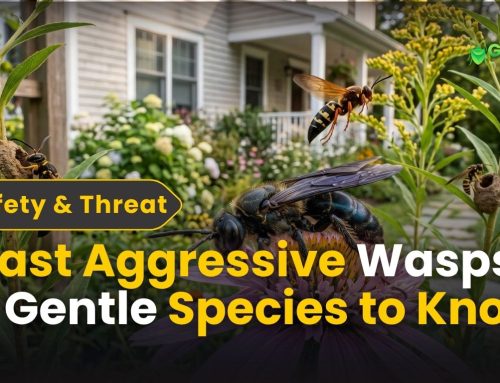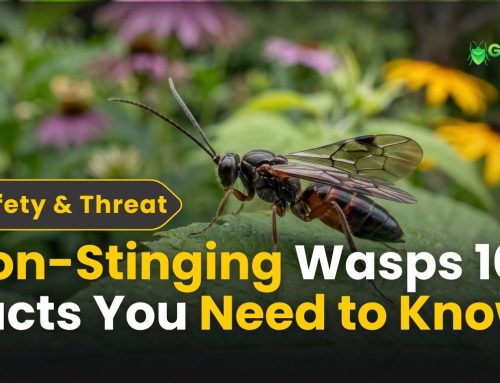
Ground-Nesting Wasps: 7 Essential Facts for Homeowners
A stream of yellow-and-black insects disappearing into a small hole in your lawn can turn an ordinary afternoon outside into a safety concern. Is it a bee colony, a harmless solitary wasp, or a defensive yellow jacket nest? More importantly, should you leave it alone or have it treated?
This Ground-Nesting Wasp Guide gives Connecticut homeowners a practical answer. Several kinds of wasps and bees use soil, abandoned animal burrows, landscape voids, and spaces beneath hardscaping. Some are solitary insects that rarely create problems. Others, particularly yellow jackets, can establish colonies with many workers and defend a nest aggressively when people, pets, lawn equipment, or landscaping activity gets too close.
For homeowners in Greenwich, Stamford, Darien, Westport, Fairfield, Wilton, New Canaan, Norwalk, and surrounding Fairfield County communities, identification matters. Treating every ground-nesting insect as a dangerous “ground hornet” can unnecessarily kill beneficial pollinators. Assuming every hole is harmless can create the opposite problem.
Below are seven essential facts that will help you identify ground wasps, understand why they picked your property, evaluate the danger, know when treatment makes sense, and determine when professional pest control is the safer choice.
What Is a Ground-Nesting Wasp?
A ground-nesting wasp is a wasp that builds, occupies, or accesses its nest through the soil or another opening at ground level. The term describes nesting behavior rather than one specific species.
In Connecticut, a busy underground nest containing numerous yellow-and-black insects may be a yellow jacket colony. Other soil-nesting insects include solitary digger wasps and several types of ground-nesting bees. Cicada killers also excavate burrows and can look intimidating because of their size, but their behavior differs substantially from that of social yellow jackets.
That distinction is important because the appropriate response depends on what is actually nesting there.
Here is the fastest practical distinction:
| What You Observe | Possible Explanation | Typical Concern |
| Many yellow-and-black insects entering one opening | Yellow jackets or another social wasp | Higher, especially near people |
| One large wasp using an individual burrow | Solitary ground-nesting wasp, potentially a cicada killer | Usually lower |
| Numerous individual holes spread across exposed soil | Ground-nesting bees or solitary wasps | Often lower |
| Insects entering a crack beside a foundation or hardscape | Yellow jackets or another cavity-nesting insect | Needs careful identification |
| Fuzzy, bee-like insects around many small soil holes | Ground-nesting bees | Usually less defensive |
| Constant traffic into one concealed entrance | Established social colony | Avoid disturbing the area |
Pictures help narrow an identification, but a photograph of the entrance alone often cannot confirm the species. Observing the insect’s body shape, coloring, hair, size, flight pattern, number of nest entrances, and traffic pattern provides a much better diagnosis.
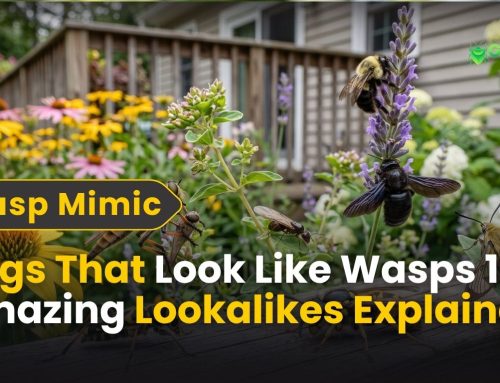
Homeowners who want additional visual comparisons can use Green Pest Management CT’s ground wasp nest pictures and identification guide and Connecticut wasp and hornet identification encyclopedia.
Fact 1: “Ground Wasp” Is Not One Species
One of the biggest sources of confusion is terminology.
People commonly search for “ground wasps,” “ground hornets,” “ground nesting hornets pictures,” “ground nesting bees wasps,” or simply “a wasp that lives in ground.” These phrases can describe insects with very different biology.
Proper identification should come before control.
Yellow Jackets
Yellow jackets are among the most important ground-nesting social wasps for Connecticut homeowners to recognize.
Depending on the species and available nesting sites, yellow jackets may establish colonies underground, in structural voids, or in other protected cavities. An underground colony may use an existing void or abandoned burrow rather than beginning with a conspicuous mound.
Workers repeatedly travel through a relatively small entrance. Consequently, the colony can remain unnoticed until someone mows nearby, trims landscaping, plays in the area, or accidentally steps close to the entrance.
Yellow jackets are social insects. A colony has a queen, workers, developing brood, and a nest structure hidden inside the cavity. Workers defend the colony when they perceive a threat.
This social defense is one reason an active yellow jacket nest generally deserves more caution than a solitary wasp burrow.
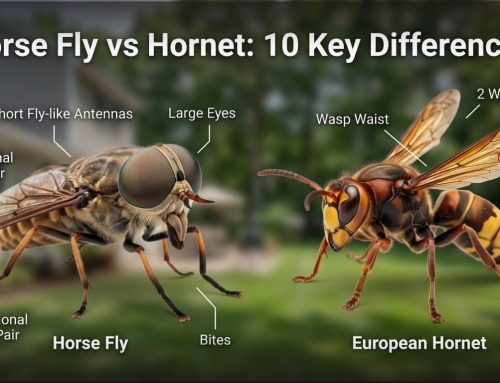
For a detailed species and behavior overview, see Green Pest Management CT’s yellow jacket deep-dive guide and yellow jacket versus European hornet comparison.
Cicada Killers
Cicada killers are large solitary wasps that dig burrows, usually in suitable areas of soil. Their size can alarm homeowners, and they are frequently given informal names such as “ground hornets.”
A female provisions her burrow with cicadas for her offspring. Males may fly conspicuously around nesting territory, but male wasps do not have functional stingers. Females can sting but generally are not comparable to a social yellow jacket colony defending a communal nest.
The presence of several individual burrows can make an aggregation look like a colony even though each female’s nesting behavior is largely solitary.
That’s an important identification clue.
Solitary Digger Wasps
Numerous solitary wasps use soil for reproduction. They may hunt other insects or arthropods, transport prey to their burrows, and lay eggs in underground nest cells.
Their ecological role can be useful. Many wasps are predators of other insects and therefore contribute to natural population control.
Seeing one wasp repeatedly visiting its own hole is quite different from seeing dozens of workers pouring into a shared entrance.
Ground-Nesting Bees
Not everything entering the lawn is a wasp.
Mining bees and other solitary ground-nesting bees can create multiple holes in suitable soil. Homeowners sometimes notice these aggregations in spring when many adults are active at once.
Bees generally appear hairier than the smooth-bodied wasps people associate with yellow jackets. Behavior is also informative. A concentration of individual holes with relatively low defensive activity can point toward solitary bees rather than an underground yellow jacket colony.
Pollinating bees deserve protection whenever practical. Avoid applying insecticides merely because insects are emerging from the lawn without first determining what they are.
The bee versus wasp identification guide explains useful visual differences.
Are Ground Hornets Actually Hornets?
Often, no.
“Ground hornet” is a common name rather than a precise identification for every large wasp found around soil. Homeowners may use it for cicada killers, yellow jackets, or other wasps.
True hornet, yellow jacket, and wasp terminology can get confusing quickly. Green Pest Management CT’s wasp versus hornet Connecticut comparison hub and wasps, hornets, and yellow jackets comparison provide additional context.
The practical lesson is simple: don’t base a treatment decision on the nickname alone.
Fact 2: Nest Traffic Is Often More Useful Than the Hole Itself
Ground nesting wasp identification starts with observation, but observation should happen from a safe distance.
A hole in the ground tells you very little by itself. Chipmunks, mice, ants, beetles, bees, and wasps can all create or use soil openings. Yellow jackets can also occupy cavities where the visible entrance is only a fraction of the actual nest area.
Rather than approaching the entrance, look for repeated flight activity.
Signs of an Active Underground Social Wasp Nest
An established social nest often reveals itself through traffic. Signs can include:
- Multiple wasps repeatedly entering and leaving the same opening
- A consistent flight path between the nest and surrounding property
- Yellow-and-black insects disappearing completely below ground
- Activity around an old animal hole or concealed landscape void
- Wasps entering beneath a stone, retaining feature, root area, or similar protected space
- Increasing numbers of workers as the season advances
- Defensive activity after mowing, trimming, digging, or walking near the site
- Workers hovering or circling near the entrance after a disturbance
- Repeated wasp sightings in the same small section of lawn
An individual wasp visiting one burrow is not automatically evidence of a dangerous colony.
What Does a Ground Wasp Nest Look Like?
The surprising answer is that the actual nest may not be visible at all.
Unlike the exposed paper comb of some paper wasps or the conspicuous enclosed aerial nests associated with bald-faced hornets, a subterranean yellow jacket colony is concealed. You may see only an entrance in the lawn.
Inside a cavity, social wasps construct nest material and brood cells. The entrance functions as a transportation route for workers traveling between the colony and the outside environment.
That is why “ground wasp nest pictures” can be misleading when used without context. Two entrances can look almost identical while housing completely different insects.
For comparisons among nest structures, see the types of wasp nests guide and wasp nest identification chart.
Identification by Body Shape
When you can observe an insect without approaching a nest, look at several characteristics together.
| Feature | Yellow Jacket | Solitary Ground Wasp | Ground-Nesting Bee |
| Body | Compact wasp shape | Varies; often slender or large | Generally more bee-like |
| Hair | Relatively smooth | Usually less fuzzy than bees | Often visibly hairy |
| Nesting | Social colony | Usually individual burrow | Commonly solitary |
| Entrance traffic | Many workers possible | Often one individual | Multiple bees may use separate holes |
| Defensive colony behavior | Can be strong | Generally limited | Usually relatively low |
| Ecological role | Predation/scavenging varies by species | Predator | Pollinator |
Color alone is not enough. Many unrelated insects use black-and-yellow patterns.
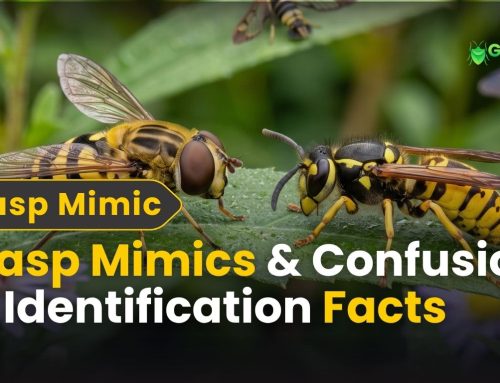
The site’s yellow-and-black striped wasp identification resource can help with that distinction.
Why Pictures Sometimes Fail
A homeowner may send a photo of a hole surrounded by bare dirt and ask, “What kind of ground wasp is this?”
There may simply not be enough information in the image.
The most useful images include the insect itself, provided the photograph can be taken without approaching or disturbing a potentially defensive nest. Video captured from a safe position can sometimes reveal traffic patterns even better.
Do not stand over an active hole to obtain a close-up. Identification is not worth provoking the colony.
Fact 3: The Biggest Risk Is Disturbing a Social Nest
Ground-nesting wasps aren’t equally dangerous.
Solitary species generally have little incentive to mount a coordinated defense. Social wasps protecting a shared colony are different. When a yellow jacket nest is disturbed, multiple workers can respond.
Unlike honey bees, many wasps are capable of stinging more than once.
Everyday Activities Can Trigger Nest Defense
Underground colonies create a particular problem because homeowners may have no idea a nest is present until they disturb it.
Consider an entrance concealed in ordinary grass. A person walks past it every day and nothing happens. Then a lawn mower passes directly above the cavity. Suddenly the colony receives vibration and movement immediately around the nest.
Similar situations can occur during:
- Lawn mowing
- String trimming
- Gardening
- Pulling weeds
- Digging
- Leaf blowing
- Children playing
- Dogs investigating the hole
- Landscaping work
- Moving stones or landscape materials
This explains why someone can live with a colony for weeks and then experience a defensive incident seemingly “out of nowhere.”
Who Should Be Especially Cautious?
Any active social wasp nest deserves respect, but location changes the practical risk substantially.
A colony in a remote portion of a large property may present a different exposure than one beside a front path, patio, children’s play space, swimming pool, driveway, mailbox, garden, school pickup area, or frequently used lawn.
Households with known insect-sting allergies should use particular caution. Serious allergic reactions require medical care rather than pest-control advice.
The U.S. Centers for Disease Control and Prevention provides information on venomous insects and occupational exposure, while medical questions about a sting should be directed to an appropriate healthcare professional.
What to Do After a Sting
For an ordinary localized reaction, follow established medical guidance rather than home-remedy folklore. If a stinger is present, note that this may suggest a bee rather than a typical yellow jacket because yellow jackets normally do not leave a barbed stinger behind in the way honey bees can.
Call 911 for symptoms suggesting a severe allergic reaction, such as difficulty breathing, significant throat or tongue swelling, fainting, or other signs of anaphylaxis.
Pest treatment and medical treatment are separate issues. If someone is having a potentially serious reaction, deal with the medical emergency first.
For general distinctions in stinging insect reactions, Green Pest Management CT also maintains a hornet sting versus wasp sting guide.
Don’t Block an Active Nest Entrance
A common instinct is to find the hole and immediately cover it.
That can be a mistake.
An underground nest occupies a cavity larger than the entrance you can see, and simply plugging the opening does not mean the colony has been eliminated. Depending on nest circumstances, insects may continue searching for a route out.
The same principle is especially important when wasps use structural cavities: closing an access point before resolving the colony can create unintended movement elsewhere.
Identification and an appropriate control plan should come before sealing.
Fact 4: Your Yard Is Usually Providing a Suitable Nesting Opportunity
Ground wasps aren’t necessarily present because a property is dirty or poorly maintained.
Nest-site selection is about biology and opportunity.
Different ground-nesting species prefer different conditions. Some solitary species favor exposed, sandy, loose, or well-drained soil because it is easier to excavate. Social yellow jackets may use abandoned rodent burrows and other existing underground cavities.
Common Conditions Around Connecticut Homes
Fairfield County properties offer a wide variety of environments, from compact urban and suburban lots in Stamford and Norwalk to larger landscaped properties in Greenwich, New Canaan, Wilton, and surrounding communities.
Potential nesting locations include:
- Old rodent burrows
- Soil edges around landscaped areas
- Lawn cavities
- Areas beneath roots
- Gaps associated with stonework
- Protected spaces along hardscaping
- Disturbed soil
- Thin or sparse lawn areas favored by some solitary nesting insects
- Other sheltered ground-level voids
Not all of those conditions can or should be eliminated. The objective is not to sterilize a landscape. It’s to reduce preventable opportunities in high-use areas while preserving a functional outdoor ecosystem.
Food Can Affect Wasp Activity Too
Nesting and foraging are separate behaviors.
The fact that wasps are feeding near a trash container does not mean the nest is underneath it. Workers can travel away from the colony while searching for protein or carbohydrate sources.
Depending on species and season, wasps may be attracted to insects, food residue, sweet liquids, ripe or fallen fruit, outdoor meals, open drink containers, garbage, and other resources.
Managing food sources can reduce nuisance activity, but removing a food source does not eliminate an established underground colony.
Why Are Wasps Suddenly Around the Yard?
Sometimes the nest has been present longer than the homeowner realizes.
A young social colony can be relatively inconspicuous. As the colony develops and worker numbers rise, traffic becomes easier to detect. Seasonal changes in foraging can also make wasps more noticeable around people.
So “they appeared overnight” often means “their activity finally became visible.”
Fact 5: Connecticut Wasp Activity Changes With the Seasons
Timing plays a major role in what homeowners see.
Connecticut’s cold winters limit year-round activity of annual social wasp colonies outdoors. Queens establish new colonies during the warmer part of the year, colony activity develops over the season, and freezing conditions eventually bring the annual colony cycle to an end. Newly produced reproductive individuals are responsible for continuing the next generation.
Weather causes year-to-year variation, so calendar dates should be treated as general patterns rather than guarantees.
Spring: Nest Establishment
Spring is often the beginning of new social-wasp colony development.
A queen that survived winter establishes a nest and raises the first workers. Early colonies are much smaller than mature late-season colonies.
At the same time, homeowners may notice solitary ground-nesting bees active in lawns and bare soil. This is why springtime soil activity should not automatically be identified as yellow jackets.
Early to Mid-Summer: Colony Growth
As social colonies gain workers, activity becomes easier to notice.
Workers forage while the queen concentrates on egg production. The increased number of insects moving around a nest can reveal an entrance that was easy to overlook earlier in the year.
Routine landscaping also increases human encounters. Mowing and yard work bring people directly into locations where nests may be hidden.
Late Summer and Early Fall: High Visibility
Late summer is when many homeowners become acutely aware of yellow jackets.
Established colonies may have substantial worker populations, and foraging wasps can become conspicuous around outdoor food and drinks. Fairfield County residents often spend these months on patios, lawns, porches, pool areas, sports fields, and gardens—the same outdoor environments where accidental encounters happen.
This combination of colony development and human outdoor activity makes late-season nest awareness particularly important.
Late Fall and Winter
Annual social wasp colonies do not simply continue operating underground indefinitely through Connecticut winter conditions.
Cold weather ends normal colony activity, while future queens survive in protected overwintering sites and begin the cycle again.
An old annual yellow jacket nest ordinarily is not simply restarted as the same functioning colony the following spring. However, a property containing attractive nesting opportunities can experience new nests in subsequent years.
This distinction matters when homeowners find an old entrance during winter. Seeing an abandoned hole is different from seeing active traffic during July or August.
For more information about annual development, see the wasp lifespan and lifecycle guide.
Fact 6: DIY Treatment Can Create More Risk Than the Nest Was Creating
Search engines contain no shortage of home remedies for underground wasps. Some are ineffective. Others put the person applying them directly in the colony’s defensive zone.
The most important question isn’t “What can I pour into this hole?”
It is: “What insect is this, and is intervention necessary?”
Ground-Nesting Bees Often Don’t Need Treatment
Beneficial solitary bees should not be treated like defensive yellow jacket colonies simply because they nest in soil.
If the insects are short-lived seasonal pollinators using a low-conflict part of the yard, tolerance may be the best solution. Changes in landscape conditions may also make the location less attractive over time.
Connecticut homeowners should consider pollinator protection as part of responsible pest management.
Solitary Wasps May Also Be Tolerable
A cicada killer or other solitary predatory wasp nesting in a remote area often creates much less risk than its appearance suggests.
Location still matters. An aggregation beside a playground, heavily used patio, or walkway creates a different management question than one at the back of an unused landscape bed.
Integrated Pest Management, or IPM, starts with identifying the pest, understanding its biology, evaluating whether it is causing an unacceptable problem, and selecting a proportionate response.
Avoid Gasoline, Fire, and Improvised Chemicals
Never pour gasoline, kerosene, bleach, or other unapproved substances into a suspected nest.
Do not attempt to burn it.
Besides creating obvious injury and property hazards, improvised chemical use can contaminate soil and does not represent responsible pest management.
Pesticides in the United States are regulated. The U.S. Environmental Protection Agency’s guidance on using pesticides safely explains the importance of following pesticide labels and using products only according to their approved directions.
The label is not a loose suggestion. Using a pesticide in a manner inconsistent with its labeling can be unlawful and unsafe.
Don’t Attack the Hole With a Hose
Flooding a nest can bring the person holding the hose into prolonged proximity to the entrance. It also does not provide reliable control of a concealed colony.
Underground cavities have irregular shapes, drainage, and multiple spaces. Water entering the visible opening does not mean every insect or nest component has been reached.
Don’t Mow Over a Known Nest
Once you’ve identified a high-traffic social-wasp entrance, avoid mowing directly over it while the colony remains active.
Temporarily reroute activity around the location if this can be done without approaching the entrance. Alert other household members and landscaping contractors.
Avoid placing a marker immediately beside the opening while wasps are active. A useful warning marker can be positioned far enough away to identify the general exclusion area without requiring someone to enter the nest’s defensive zone.
Don’t Assume Protective Clothing Makes DIY Work Safe
Ordinary long sleeves, garden gloves, or a sweatshirt are not equivalent to professional stinging-insect protective equipment.
A homeowner attempting treatment still has to approach the colony, understand where the true entrance is, select an appropriate registered product, follow its label, and know what to do if the treatment does not work as expected.
For a high-risk nest, that is often a poor tradeoff.
Fact 7: Nest Location and Species Determine When Professional Treatment Makes Sense
Not every ground-nesting insect requires pest control. But there are situations where professional inspection is the sensible next step.
Consider professional help when an active suspected social-wasp nest is close to:
- Front doors or walkways
- Patios and decks
- Children’s play areas
- Pools
- Regular lawn-care routes
- Pet areas
- Driveways
- Outdoor workspaces
- Foundation openings or structural voids
- Areas that cannot reasonably be avoided
Professional assistance is also appropriate when the species cannot be confidently identified, the nest seems large or defensive, prior treatment attempts have failed, or someone on the property has a serious sting allergy.
Green Pest Management CT provides pest control support for homeowners across Greenwich, Stamford, Darien, Westport, Fairfield, Wilton, New Canaan, Norwalk, and surrounding Fairfield County communities. Homeowners dealing with an active stinging-insect problem can review the company’s professional hornet exterminator services and ground hornet treatment information for Connecticut.
Ground-Nesting Wasp Identification: A Step-by-Step Homeowner Checklist
Identification does not require putting yourself next to the nest. In fact, good observation usually works better when you aren’t disturbing the insects.
Step 1: Stay Away From the Entrance
Do not stand directly over the hole.
Watch from a position where the insects are not reacting to you. Keep children and pets away while you evaluate the situation.
Step 2: Count Entrances, Not Just Insects
Is there one hole with numerous insects entering it?
That pattern supports a different diagnosis from twenty small holes, each apparently associated with an individual insect.
A concentrated stream of insects into one entrance raises suspicion of a social colony. Distributed individual holes may point more toward solitary bees or wasps.
Step 3: Look at the Insects
When possible from a safe distance, observe:
- Yellow-and-black versus other coloration
- Smooth versus fuzzy body
- Approximate size
- Slender or robust shape
- Number of insects
- Whether insects repeatedly use the same entrance
Never try to catch an insect by hand for identification.
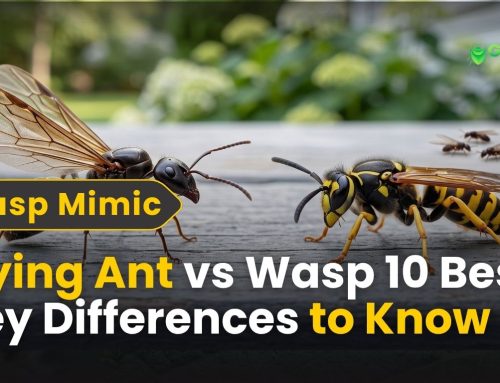
For more detailed visual identification, use the Connecticut wasp and hornet ID guide or guide to flying insects that look like wasps.
Step 4: Observe Behavior
Behavior is often the deciding clue.
Are insects calmly working separate holes? Is one large solitary wasp carrying prey? Or is there a steady stream of workers moving through a shared entrance?
If activity suddenly becomes directed toward you, move away rather than continuing your inspection.
Step 5: Consider the Season
Springtime aggregations of individual soil-nesting bees should not automatically be labeled yellow jackets.
Heavy traffic at a shared underground entrance later in the growing season tells a different story.
Season alone cannot identify a species, but it helps support or challenge your initial conclusion.
Step 6: Evaluate Location and Exposure
Once you’ve narrowed the identification, consider whether people can realistically avoid the area.
A relatively low-risk species in an unused landscape zone may simply be monitored. A suspected yellow jacket colony beside the only path to a front entrance requires a different response.
Step 7: Request a Professional Inspection When Identification Is Uncertain
A pest-management professional evaluates both the insect and the setting.
That distinction is central to IPM: pest control should solve an actual problem rather than automatically kill every insect found on a property.
Ground Wasps vs. Ground-Nesting Bees vs. Yellow Jackets
Homeowners frequently use these names interchangeably. They shouldn’t.
| Question | Yellow Jackets | Solitary Ground Wasps | Ground-Nesting Bees |
| Are they social? | Yes | Usually no | Many are solitary |
| Can they nest underground? | Yes | Yes | Yes |
| Can several insects be visible? | Yes | Yes, in aggregations | Yes, in aggregations |
| Do they share one defensive colony? | Yes | Usually no | Generally no for solitary species |
| Are they pollinators? | Can visit flowers | Some visit flowers; often predators | Important pollinators |
| Is automatic treatment appropriate? | Depends on exposure/risk | Usually not | Usually not |
| Does identification matter? | Absolutely | Absolutely | Absolutely |
For a broader insect comparison, Green Pest Management CT’s hornets versus bees identification guide explains features that homeowners commonly confuse.
Are Ground-Nesting Wasps Beneficial?
Some are very beneficial.
Predatory wasps help regulate populations of other insects and arthropods. Cicada killers provision their nests with cicadas. Other solitary species specialize in different prey.
Ground-nesting bees contribute pollination.
Even social wasps have ecological roles as predators and scavengers. The fact that an insect can sting does not make it ecologically useless.
Pest management is therefore about context.
A stinging insect doesn’t need to be removed solely because it exists somewhere on a two-acre property. The management threshold changes when a defensive colony overlaps with routine human activity.
This is a core IPM concept: identify first, assess risk second, intervene when justified, and use an appropriate method.
The EPA provides additional background on Integrated Pest Management principles for reducing pest risks while making informed management decisions.
Why Ground Wasp Nests Can Be Difficult to Treat
An underground nest is a three-dimensional structure hidden from view.
The small opening visible in grass is only an access point. The occupied cavity may extend away from the entrance, and its precise configuration usually cannot be judged from the surface.
This creates several practical challenges.
You Can’t See the Colony
With an exposed paper wasp nest, the physical structure is visible. With an underground yellow jacket nest, most of the relevant biology occurs out of sight.
A person may underestimate its size, orientation, or activity.
The Entrance May Be Easy to Miss
Grass, leaves, roots, stones, and landscape features can conceal the opening.
A homeowner who only sees wasps “coming out of the lawn” may not immediately locate the flight path. Walking around searching for it can create unnecessary exposure.
Activity Doesn’t Always Stop Immediately
Successful pest management should be evaluated based on the treatment method, label instructions, pest biology, and follow-up observations—not on whether every visible insect disappeared within seconds.
Returning immediately to inspect an opening can expose the homeowner to surviving or returning workers.
Multiple Pest Problems Can Look Similar
A hole surrounded by excavated soil might belong to a solitary wasp. A small opening in established turf could provide access to a yellow jacket colony. Numerous little mounds could be associated with bees or entirely different organisms.
Professional inspection is valuable precisely because “something flying into the ground” isn’t a complete diagnosis.
DIY vs. Professional Ground-Wasp Control
Whether DIY management is appropriate depends more on species and risk than on confidence with home projects.
| Factor | DIY Observation/Prevention | Professional Pest Control |
| Species is uncertain | Limited | Professional identification useful |
| Solitary beneficial insect | Often monitoring is appropriate | Usually unnecessary unless conflict exists |
| Active yellow jacket colony | Higher exposure | Appropriate consideration |
| Nest beside doorway/play area | Poor DIY situation | Professional assessment recommended |
| Known serious sting allergy | Avoid direct exposure | Professional assistance strongly preferred |
| Structural entry point | Easy to mishandle | Inspection can locate access and activity |
| Prevention work after inactivity | Often practical | Can be incorporated into IPM |
| Repeated nests/problems | Root cause may be missed | Broader property inspection useful |
A homeowner’s best DIY contribution is often prevention and monitoring rather than direct confrontation with an established social colony.
For additional context, compare DIY versus professional hornet nest removal and DIY versus professional hornet pest control.
What Happens During Professional Ground-Wasp Treatment?
The specific treatment depends on the pest, site, product label, environmental considerations, and applicable regulations. There is no responsible one-method-fits-all treatment plan.
A professional process generally begins with diagnosis rather than pesticide application.
1. Inspect the Property
The technician evaluates where activity is occurring and how insects interact with the site.
Questions include: Is this one shared nest? Are there multiple solitary burrows? Is activity actually emerging from soil, or are insects accessing a structural void close to ground level?
2. Identify the Pest as Closely as Practical
A yellow jacket colony requires different decision-making from solitary bees.
Visual characteristics, behavior, entrance activity, season, and nest location all contribute to identification.
3. Evaluate Human and Environmental Risk
The technician considers nearby doors, paths, children, pets, outdoor activity, sensitive areas, and other site conditions.
Sometimes this assessment supports treatment. Sometimes it supports leaving a beneficial insect alone.
4. Select an Appropriate Management Method
When pesticide treatment is justified, professionals select registered products and application methods appropriate for the target pest and site, following label requirements.
Treatment should never consist of casually applying “something strong” to an unidentified hole.
5. Evaluate Activity
Follow-up depends on the specific situation and treatment.
Homeowners should avoid assuming a site is immediately safe for mowing or digging simply because traffic appears lower. Follow the pest professional’s instructions regarding re-entry and monitoring.
6. Address Contributing Conditions Where Practical
After a colony is no longer active, prevention may include appropriate exclusion or landscape changes.
This should be done after—not instead of—resolving an active nest when intervention is needed.
Homeowners facing a particularly urgent nest near a high-use area can review Green Pest Management CT’s information on emergency hornet removal and immediate hornet control in Connecticut.
How to Prevent Ground-Nesting Wasps Around Your Property
No prevention program can guarantee that a flying insect will never choose a property. Connecticut landscapes contain soil, insects, plant life, and natural cavities—the resources wildlife uses.
Prevention should therefore focus on practical risk reduction.
Maintain High-Use Lawn Areas
Some solitary ground nesters favor bare or sparsely vegetated soil. Maintaining healthy turf where appropriate can reduce some attractive nesting opportunities.
That does not mean saturating the lawn with pesticides. Healthy landscape management and insecticide application are separate issues.
Address Rodent Problems
Because some social wasps can take advantage of abandoned animal burrows and existing cavities, rodent management may have secondary pest-prevention benefits.
Seal structural rodent entry points where appropriate and manage conducive conditions as part of a broader IPM program.
Manage Outdoor Food and Waste
Keep trash containers properly closed. Clean food residues around outdoor eating areas and promptly address spilled sugary beverages.
Pick up fallen fruit where it creates persistent insect activity.
Remember that sanitation can reduce foraging pressure without eliminating an established nest somewhere else on the property.
Inspect Before Yard Work
Before mowing an area that hasn’t been maintained recently, observe it briefly.
If numerous yellow jackets are repeatedly crossing a small section of lawn and disappearing, investigate visually from a distance instead of driving directly over the location.
Landscapers should be told about known nests before they enter the area.
Inspect High-Traffic Areas During the Warm Season
Homeowners don’t need to patrol their yard every day. Periodically paying attention to insect traffic around play areas, walkways, patios, and lawns can reveal a developing problem before someone accidentally disturbs it.
Seal Appropriate Structural Gaps
Wasps using buildings are a different issue from true soil nesting, but homeowners often confuse the two because an entrance can be close to grade.
Appropriate exclusion can help prevent future access to some structural voids. Do not seal an opening while a suspected active colony is using it without understanding where the insects may go.
Avoid Routine “Just in Case” Spraying
Preventive broad-spectrum insecticide application to every patch of lawn is not an intelligent substitute for identification.
It can affect non-target organisms while failing to address the specific nesting conditions that led to the concern.
IPM favors targeted management.
What Not to Do Around a Ground Wasp Nest
Mistakes usually happen because the nest is treated like a simple hole rather than an occupied colony.
Avoid these common approaches:
- Do not put your face near the entrance to identify the insect.
- Do not insert sticks or tools into an active hole.
- Do not run a lawn mower directly over a known social-wasp nest.
- Do not pour gasoline, bleach, or other household chemicals into the soil.
- Do not attempt to burn an underground nest.
- Do not seal an active entrance before understanding the nest.
- Do not assume every ground-nesting insect is a yellow jacket.
- Do not spray beneficial ground-nesting bees simply because they are visible.
- Do not allow children or pets to investigate the hole.
- Do not repeatedly approach an unsuccessfully treated nest to check whether it worked.
If aggressive insects are already responding, prioritize moving out of the immediate nest area instead of trying to finish yard work or obtain a photograph.
Ground-Nesting Wasps in Fairfield County, Connecticut
Local conditions matter because pest activity follows climate and land use.
Fairfield County experiences cold winters and warm summers, creating a strongly seasonal cycle for social wasps. Homeowners typically become more concerned as outdoor recreation and mature colony activity overlap during the warmer months.
The region’s varied housing also creates varied pest situations.
Greenwich and New Canaan
Larger landscapes, mature vegetation, stonework, expansive lawns, and wooded edges can create numerous natural nesting opportunities. A nest may be located far from the house yet still conflict with a pool, garden, sports area, or routine lawn maintenance.
Stamford and Norwalk
Denser neighborhoods create their own challenges. Outdoor spaces can be relatively close to entrances, driveways, neighboring properties, patios, and public walking areas.
That proximity can turn a small nesting area into a significant exposure concern.
Darien and Westport
Frequently used yards, patios, pools, gardens, landscaping, and outdoor entertaining spaces make nest location particularly important. A colony beside a lightly used property boundary has a very different risk profile from one beside a deck or pool.
Fairfield and Wilton
Properties can range from compact residential lots to larger wooded settings. Homeowners should pay particular attention when mowing near previously undisturbed lawn edges, stone features, and other potential cavities.
Across all these communities, Green Pest Management CT’s role is not simply to “spray wasps.” Proper pest control begins by determining what insect is present and whether intervention is warranted.
Homeowners who need help with broader flying insect concerns can explore professional flying insect control services or Green Pest Management CT’s professional pest-control service resource.
When Should a Ground-Nesting Wasp Nest Be Treated?
Treatment is most justified when a confirmed or strongly suspected defensive social colony creates meaningful exposure to people.
Examples include a nest immediately beside a home’s entrance, a nest repeatedly disturbed during required lawn maintenance, or a colony adjacent to a play area.
A solitary wasp in an unused landscape edge may not meet the same threshold.
Ask four questions:
- What insect is it?
- Is it social or solitary?
- How close is the nest to routine human activity?
- Can the location reasonably be avoided until seasonal activity ends?
Those questions often lead to a better decision than asking whether every wasp is “dangerous.”
When Waiting May Make Sense
Monitoring may be reasonable when identification indicates a low-risk solitary species or ground-nesting bees and the insects occupy a location where they are unlikely to be disturbed.
Season also matters. Management should reflect the actual pest and current activity rather than automatically treating an old, inactive hole.
When Waiting Is a Bad Idea
Don’t rely on seasonal cold as the solution if an active yellow jacket colony creates a current safety issue.
If family members must walk past the nest every morning, a landscaper must work directly over it, or someone with a serious sting allergy cannot safely use the property, the fact that winter will eventually arrive doesn’t solve today’s exposure.
How Much Does Ground Wasp Treatment Cost?
Homeowners naturally ask about treatment cost, but an accurate answer requires an inspection or enough information to understand the specific problem.
As requested for this guide, no pricing estimates are provided here.
Variables that can affect service requirements include pest identification, nest location, accessibility, number of activity areas, structural involvement, treatment method, and whether follow-up is necessary.
For an accurate assessment in Fairfield County, contact Green Pest Management CT and describe what you’re seeing rather than assuming the nest species in advance.
What Does Integrated Pest Management Mean for Wasps?
Integrated Pest Management is frequently misunderstood as simply substituting one pesticide for another. It is broader than that.
IPM is a decision-making framework.
For ground-nesting insects, that means identifying the organism, understanding why it is there, assessing whether it creates a meaningful pest problem, choosing an appropriate response, applying pesticides responsibly when needed, and using prevention or exclusion where practical.
For example, consider two Fairfield County properties.
At the first, numerous gentle pollinating bees use scattered holes in a distant sunny patch for a short seasonal period. There is little human interaction.
At the second, a high-traffic yellow jacket colony occupies a cavity beside a home’s front steps.
Both involve flying insects associated with the ground. Treating them as identical pest problems would be poor pest management.
Professional judgment lies in recognizing the difference.
Ground Nest vs. Paper Wasp Nest vs. Hornet Nest
Nest architecture can eliminate some identification possibilities.
Paper wasps commonly construct exposed open-comb nests in protected locations. Bald-faced hornets construct enclosed paper nests that may become conspicuous on trees, shrubs, buildings, or similar elevated locations. Yellow jackets can use underground or concealed cavities, depending on species and circumstances.
| Nest Feature | Likely Group |
| Busy entrance disappearing underground | Possible yellow jackets |
| Open umbrella-like paper comb | Paper wasps |
| Large enclosed aerial paper nest | Bald-faced hornets or related aerial nesters |
| Individual soil burrow with one large wasp | Possible solitary digger wasp |
| Numerous separate small soil holes | Possible ground-nesting bees/solitary wasps |
A nest’s shape is only one part of identification. Green Pest Management CT’s paper wasp nest guide, hornet nest versus wasp nest comparison, and bald-faced hornet identification guide show how nest architecture differs.
What If Wasps Are Going Into the Foundation?
Treat that as a different situation from an obvious soil burrow.
Wasps entering siding, a foundation gap, utility penetration, wall void, soffit, or another part of a building may have a concealed structural nest.
Do not immediately seal the exterior entrance.
If an active colony is behind building material, simply closing the obvious route may fail to eliminate it and can complicate the situation.
Professional inspection can help determine whether activity is genuinely below ground or associated with the structure.
What If There Are Several Holes?
Multiple holes don’t automatically mean multiple yellow jacket colonies.
This pattern is particularly important when identifying ground-nesting bees and solitary wasps. Many individuals can select the same favorable patch of soil while maintaining separate nests. This creates what looks like a busy “community” even though it isn’t a social colony behaving like yellow jackets.
Look at how insects use the site.
Many insects entering one common opening suggest one scenario. Individual insects entering separate holes suggest another.
That behavioral distinction is one of the most useful pieces of ground nesting wasp identification.
Do Ground Wasps Come Back Every Year?
Not necessarily, and the answer depends on the species.
Annual social wasp colonies follow a seasonal lifecycle rather than keeping the same underground colony continuously active year after year through Connecticut winters. However, suitable properties can experience new nesting activity in later seasons.
Solitary ground-nesting insects may also favor the same general soil conditions from year to year.
This is why homeowners sometimes say, “The wasps come back to the same spot every summer.” The observation may be correct at the property level without meaning the exact same colony survived.
Addressing conducive conditions can sometimes make a high-conflict site less attractive, although no realistic landscape modification can eliminate every possible nesting opportunity.
Can You Prevent Every Wasp Nest?
No practical pest-management program can promise that.
Wasps are mobile insects that naturally inhabit Connecticut. Queens and solitary females can fly onto a property from surrounding areas and evaluate potential nest sites.
Effective prevention is therefore about reducing risk rather than promising a wasp-free ecosystem.
Manage waste, maintain frequently used areas, address structural openings when appropriate, monitor known trouble spots, and respond early when a defensive nest develops near people.
That strategy is more realistic—and more environmentally responsible—than widespread unnecessary pesticide use.
Why Accurate Identification Matters for Pollinators
The phrase “ground nesting bees wasps” reflects a very common homeowner problem: many people simply cannot tell which insect they have.
That’s understandable. Identification can be difficult even with photographs.
But the consequences of a wrong identification matter.
Ground-nesting bees may provide pollination services. Solitary wasps can prey upon other insects. Parasitic wasps—many of which are tiny and barely noticed—also play major roles in regulating other insect populations.
For an introduction to their ecological role, see Green Pest Management CT’s guide to parasitic wasps and parasitic and parasitoid wasp resource hub.
A beneficial insect should not become a pesticide target because it happens to resemble another species.
Professional Experience: What Homeowners Commonly Miss
One of the recurring lessons in stinging-insect work is that homeowners naturally focus on appearance, while behavior often gives the better clue.
A large insect can look terrifying and still represent a relatively limited threat. A much smaller yellow jacket disappearing through an inconspicuous lawn opening can belong to a defensive social colony.
The nest itself may also be far less obvious than expected. People often imagine a ground wasp nest as a visible paper structure protruding from the lawn. In reality, an underground cavity can leave very little evidence at the surface besides worker traffic.
Three observations are particularly useful in the field: how many insects are involved, whether they share one entrance, and how they respond to activity around the nest.
Those clues should guide the next decision rather than size alone.
Homeowner Action Plan
If you discover suspected ground wasps on your Connecticut property, use this sequence:
- Stop mowing, digging, or trimming immediately around the suspected entrance.
- Keep children, guests, and pets away from the area.
- Observe insect activity from a safe distance rather than standing over the hole.
- Determine whether insects share one entrance or occupy individual holes.
- Note body shape, coloring, hair, size, and seasonal timing.
- Compare the insects with reliable identification resources.
- Avoid gasoline, fire, flooding, and unapproved pesticides.
- Decide whether the nest actually conflicts with normal use of the property.
- For suspected yellow jackets, difficult locations, or uncertain identification, arrange a professional inspection.
- After the issue is resolved, address appropriate prevention and exclusion conditions.
This approach reduces unnecessary pesticide use while also taking genuine stinging-insect risks seriously.
When to Contact Green Pest Management CT
Professional assistance is especially useful when you cannot tell whether the insects are bees or wasps, when numerous wasps use one underground entrance, when the nest is close to people, when mowing continually disturbs it, or when insect activity is associated with the building itself.
Green Pest Management CT serves Greenwich, Stamford, Darien, Westport, Fairfield, Wilton, New Canaan, Norwalk, and surrounding Fairfield County areas.
A professional inspection can identify the likely pest, evaluate the nesting location and exposure risk, and determine an appropriate pest-management strategy.
For additional education before scheduling service, visit the company’s wasp and hornet behavior and identification hub or Connecticut hornet control guide.
If an active nest is interfering with normal use of your property, contact Green Pest Management CT to schedule an inspection.
Frequently Asked Questions
What is a ground-nesting wasp?
A ground-nesting wasp is a wasp that nests in soil or uses an underground cavity accessed through a ground-level entrance. It is a descriptive term, not one species. Yellow jackets and various solitary wasps can nest below ground.
How do I know if I have ground wasps or bees?
Look at both appearance and nesting behavior. Bees are generally hairier, while many wasps appear smoother. Numerous insects sharing one active underground entrance can indicate a social wasp colony, while many separate holes may indicate solitary bees or wasps. A bee versus wasp identification comparison can help narrow the possibilities.
What does a yellow jacket nest in the ground look like?
From the surface, it may look like little more than a hole with repeated yellow jacket traffic. The colony and nest structure are concealed within the underground cavity, which is why observing worker traffic is often more useful than looking at the hole.
Are ground-nesting wasps dangerous?
Some can be. The risk depends heavily on species and nest location. Social yellow jackets can defend their colony and sting repeatedly, while many solitary ground wasps are considerably less defensive. A nest beside a doorway or play area also creates more exposure than one in a remote location.
Should I plug a ground wasp hole?
Do not simply plug an entrance to an active suspected social-wasp nest. Blocking the visible opening does not necessarily eliminate the concealed colony and can create unintended problems. Identify and resolve the colony appropriately before considering exclusion.
When should ground wasps be treated?
Consider treatment when a confirmed or suspected defensive social colony creates meaningful exposure—for example, beside a walkway, lawn-care route, patio, pool, play area, or entrance. Beneficial solitary insects in low-conflict locations may not require treatment.
What is the safest way to get rid of ground wasps?
First identify the insect and determine whether treatment is necessary. Avoid fire, gasoline, flooding, and unapproved chemicals. For an active social-wasp colony or uncertain identification, professional pest control can reduce the need for a homeowner to approach the nest. Green Pest Management CT provides additional information on ground hornet identification and treatment.
Do ground wasps leave in winter in Connecticut?
Annual social wasp colonies decline as cold conditions arrive and do not continue as the same functioning colony indefinitely through Connecticut winter. Future queens overwinter separately and can establish new colonies in later seasons.
Why do I keep getting ground wasps in my yard?
Your property may repeatedly provide suitable soil, existing burrows, cavities, protected areas, or other favorable nesting conditions. Seeing activity in the same general area in multiple years does not necessarily mean the same social colony survived from one year to the next.
When should I call a Connecticut pest-control professional?
Call when many wasps are entering one hole, the nest is close to people or pets, activity occurs inside or beside the structure, you cannot confidently identify the insect, or direct interaction with the colony would create unnecessary sting exposure. Households with known severe sting allergies should be particularly cautious.
Final Thoughts: Use Identification, Not Guesswork
The most important lesson in this Ground-Nesting Wasp Guide is that “ground wasp” does not tell you enough to make a safe treatment decision.
A large solitary wasp digging one burrow, a seasonal aggregation of pollinating ground bees, and a mature underground yellow jacket colony are three different situations. They should not receive the same response.
Start with identification. Observe entrance traffic from a safe location. Consider the season, number of insects, nesting pattern, and proximity to people. Protect beneficial insects when they aren’t creating an unacceptable risk, and avoid dangerous DIY techniques when a defensive social colony needs control.
For Connecticut homeowners, seasonal awareness matters as well. Activity changes from spring through fall, and hidden nests often become noticeable only after colony traffic increases or routine yard work disturbs them.
Green Pest Management CT helps homeowners in Greenwich, Stamford, Darien, Westport, Fairfield, Wilton, New Canaan, Norwalk, and surrounding Fairfield County communities evaluate stinging-insect problems using professional inspection and pest-management principles.
If numerous wasps are disappearing into one ground-level opening or an active nest is interfering with normal use of your property, schedule an inspection with Green Pest Management CT rather than testing an improvised treatment at close range. Proper identification is the first—and often most important—part of solving the problem safely.