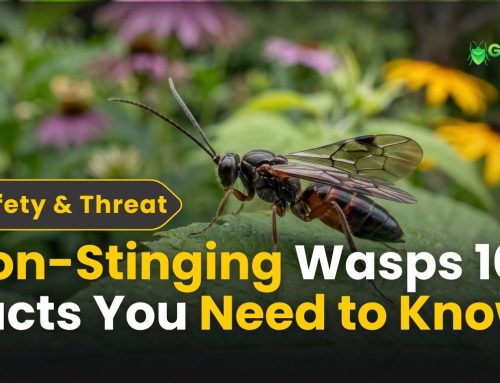
Flying Ant vs Wasp: 10 Key Differences You Need to Know
The fastest way to identify a flying ant vs wasp is to examine the antennae, waist, wings, and behavior. Flying ants have distinctly elbowed antennae and a constricted waist with one or two noticeable nodes. Their front wings are generally larger than their hind wings. Wasps have differently shaped antennae, a wasp-type narrow waist without ant nodes, and body proportions that vary considerably among species.
The distinction matters because these insects point to different problems. A sudden indoor emergence of winged ants can indicate an ant colony in or near the structure. Repeated yellow jackets entering a wall or lawn opening can indicate a social-wasp colony with a significant sting risk.
There is also a third insect Connecticut homeowners should know: termite swarmers. They are frequently mistaken for both flying ants and wasps.
This guide explains 10 practical differences, how to recognize swarm behavior, ant vs. termite confusion, stinging risk, seasonal patterns, prevention, and when homeowners in Greenwich, Stamford, Darien, Westport, Fairfield, Wilton, New Canaan, Norwalk, and surrounding Fairfield County should arrange a professional inspection.
What Is a Flying Ant?
A flying ant is not a separate ant species simply because it has wings. It is a reproductive member of an ant colony.
Established ant colonies can produce winged males and females, commonly called alates. Under suitable environmental conditions, they leave the colony for mating and dispersal flights.
After mating, a fertilized queen of many ant species sheds her wings and attempts to establish a new colony. Males have a different reproductive role and generally do not establish nests.
This is why finding a swarm of winged ants is different from finding ordinary worker ants.
It is evidence of reproductive activity associated with an established colony somewhere in the surrounding environment.
Whether that colony is outdoors or associated with the structure requires further inspection.
What Is a Wasp?
Wasps are insects in the order Hymenoptera, the same order that contains ants and bees.
The term covers an enormous range of insects.
Some wasps are solitary and present very little threat to people. Others, including yellow jackets, paper wasps, and hornets, form social colonies that workers may defend.
This matters because “wasp” does not automatically mean aggressive.
A tiny parasitoid wasp and a yellow jacket colony beside a front door require completely different risk assessments.
Green Pest Management CT’s Connecticut wasp and hornet encyclopedia can help identify genuine wasps after you have ruled out an ant.
Flying Ant vs Wasp: Quick Comparison
| Feature | Flying ant | Wasp |
| Antennae | Distinctly elbowed | Usually straighter or differently curved |
| Waist | Narrow with 1 or 2 nodes | Narrow, but no ant-like nodes |
| Wings | Two pairs | Two pairs |
| Wing proportions | Forewings generally larger | Varies by wasp group |
| Social organization | Comes from ant colony | Can be social or solitary |
| Body form | Typical ant shape | Highly variable |
| Sting risk | Species-dependent; many common alates are not a typical sting concern | Females of many species can sting |
| Swarming | Reproductive flights common | Different dispersal/nesting patterns |
| Nest | Soil, wood, voids, other sites depending on ant | Ground, cavities, paper nests, solitary nests, etc. |
| Best clue | Elbowed antennae + nodes | Wasp waist + non-ant antennae |
One characteristic is rarely enough. Antennae, waist structure, wing proportions, and behavior should be considered together.
10 Key Differences Between Flying Ants and Wasps
1. Flying Ants Have Distinctly Elbowed Antennae
If you have a clear photograph, examine the antennae first.
Ant antennae have a characteristic elbowed appearance. A long basal segment emerges from the head and bends noticeably before the remaining segments.
This creates an angular shape.
Wasps also have segmented antennae, but they generally do not display the strongly elbowed configuration typical of ants.
This characteristic is particularly useful when body color causes confusion.
Both ants and wasps can be dark brown, black, reddish, yellowish, or combinations of colors. Antenna shape is much more reliable than asking whether an insect “looks black enough to be an ant.”
A top or side photograph often shows the antennae clearly enough for identification without handling the insect.
2. The Waist Has a Different Structure
Both ants and many wasps have narrow waists, which is one reason people confuse them.
The details are different.
Ants have one or two distinct waist segments, called the petiole and, in some groups, postpetiole. These often appear as small bumps or nodes connecting the main thorax region to the abdomen.
A wasp has a constriction but lacks the characteristic ant node arrangement.
If you can see a definite little knob or series of nodes at the waist combined with elbowed antennae, ant identification becomes much stronger.
This is one reason body outline is more informative than color.
Green Pest Management CT’s larger guide to insects that look like wasps explains additional body-shape clues for other confusing insects.
3. Flying Ant Wings Have Characteristic Proportions
Both flying ants and wasps have two pairs of wings, so simply counting wings will not solve the identification.
Wing proportions can help.
On flying ants, the front wings are typically longer than the rear pair.
The rear wings are noticeably smaller.
Wasps also have front and hind wings, but their shape, venation, and proportions differ by group. During wasp flight, small hooks called hamuli couple the front and hind wings, helping the two wings on each side function together.
That can make a moving wasp appear to have only one pair.
Do not attempt to hold a live insect to spread its wings. A photograph or safely collected dead specimen is sufficient.
4. Flying Ants Often Appear in Sudden Swarms
Behavior can provide as much information as anatomy.
Winged ants frequently emerge in numbers during reproductive dispersal events. Environmental conditions such as temperature, humidity, rainfall history, season, and species biology can influence timing.
Homeowners may suddenly find numerous winged insects around windows, doors, siding, patios, foundations, or exterior lights.
Indoors, alates often move toward windows because they are attracted to light.
Social wasps do not normally produce a swarm of winged reproductives that behaves exactly like an ant mating flight around an interior window.
Instead, worker wasps are often observed repeatedly traveling between a nest and the outside environment.
That difference in pattern can be highly informative.
5. Repeated Wasp Traffic Usually Points Toward a Nest
Suppose you see 30 winged insects at one window in a short period. Ant reproductive activity should be considered.
Now suppose you see yellow-and-black insects entering and leaving the exact same hole in your siding throughout the day.
That pattern points much more strongly toward an active wasp colony.
Pest-control professionals often follow flight behavior because the nest itself may be completely concealed.
Social wasps may use:
- Ground cavities
- Wall voids
- Soffits
- Roof openings
- Hollow trees
- Stone walls
- Shrubs
- Eaves
- Sheds
Yellow jackets can be particularly troublesome when a colony is concealed underground or inside a structure.
The yellow jacket behavior guide explains the warning signs of an established colony.
6. Flying Ant Sting Risk Is Different From Wasp Sting Risk
For Connecticut homeowners, an unknown winged insect’s ability to sting is an understandable concern.
Many ant reproductive swarms do not create the type of immediate stinging hazard associated with a disturbed yellow jacket or hornet colony.
That does not mean every ant species worldwide is harmless. Ant defensive capabilities differ considerably across species.
The practical residential distinction is that social wasps such as yellow jackets, paper wasps, and hornets possess female workers capable of stinging, often repeatedly.
A worker honey bee typically leaves a barbed stinger in human skin. Wasps generally retain their stinger and can potentially sting again.
If you cannot determine whether insects around an active nest entrance are ants or wasps, keep your distance rather than testing their defensive behavior.
The wasp and hornet safety assessment provides additional guidance for uncertain situations.
7. Ant and Wasp Nests Are Built Differently
Finding a nest structure can make identification much easier.
Paper wasps construct recognizable open combs with exposed hexagonal cells.
Bald-faced hornets construct enclosed paper nests. Despite their name, bald-faced hornets are a type of yellow jacket.
Other yellow jackets may occupy underground cavities or structural voids, where their paper nest is hidden.
Ants typically create colonies in soil, wood, under landscaping materials, within natural cavities, or in structural voids depending on species. You will not see them maintaining an exposed paper comb beneath the eaves.
The wasp nest identification guide explains common wasp nest architecture.
Nest material is often more useful than trying to identify a fast-moving insect from across the yard.
8. Ant Workers and Wasp Workers Behave Differently
When a reproductive swarm ends, ordinary ant workers provide another identification clue.
Wingless worker ants often travel along defined trails between nests and food or water resources.
Wasps do not form ant-like walking trails across counters, foundation edges, patios, or baseboards.
Social-wasp workers typically fly between their colony and foraging destinations.
Of course, individual wasps can walk across surfaces, and ants can scatter rather than maintain a perfect trail. Behavior should still be combined with anatomy.
An indoor pattern of wingless ants followed later by winged ants makes an ant colony much more plausible.
9. Indoor Flying Ants Can Signal a Different Problem From Indoor Wasps
A few outdoor alates entering through an open window are different from repeated indoor emergence.
When many winged ants appear to be coming from the structure itself, a professional should consider whether an ant colony is established in a wall, wood, or another protected site.
Moisture conditions can also matter for some ant species.
Indoor wasps require a different investigation.
Wasps appearing inside may have entered accidentally, or a structural colony may be present in a wall, ceiling, attic-adjacent void, or another cavity.
If social wasps are using an exterior opening, do not simply seal the hole.
Blocking an active wasp colony’s normal exit can cause workers to search for alternate routes, potentially toward occupied portions of the home.
This is a good example of why accurate identification changes the management strategy.
10. Flying Ants Are Easily Confused With Termite Swarmers Too
One of the biggest mistakes in flying ant vs wasp identification is forgetting a third possibility: termites.
Termite swarmers are reproductive insects that leave mature colonies.
They can appear suddenly in large numbers and are frequently mistaken for winged ants.
Flying ant vs. termite
Winged ants have elbowed antennae.
Termite swarmers generally have straight or bead-like antennae.
Winged ants have an obvious constricted waist. Termites have a broader waist without the same ant-like constriction.
Ant forewings are generally larger than their hind wings. Termite wing pairs are much more similar in size.
Discarded termite wings may also accumulate after a swarm.
If a substantial indoor emergence cannot confidently be identified as ants or termites, professional inspection is preferable to guessing. The implications for the property differ significantly.
Is It a Flying Ant, Wasp, or Termite?
This three-way comparison is useful for quick identification:
| Feature | Flying ant | Wasp | Termite swarmer |
| Antennae | Elbowed | Variable, not ant-like | Relatively straight/bead-like |
| Waist | Pinched with node(s) | Narrow wasp waist | Broad |
| Wing pairs | 2 | 2 | 2 |
| Wing size | Front larger than rear | Variable | Pairs similar in size |
| Swarming | Common reproductive behavior | Not ant-style mating swarm | Common reproductive behavior |
| Main household concern | Ant colony | Sting/nest risk varies | Potential termite colony |
A clear specimen photograph can often resolve the question quickly.
What About Other Bugs That Look Like Wasps?
Ants are only one source of wasp confusion.
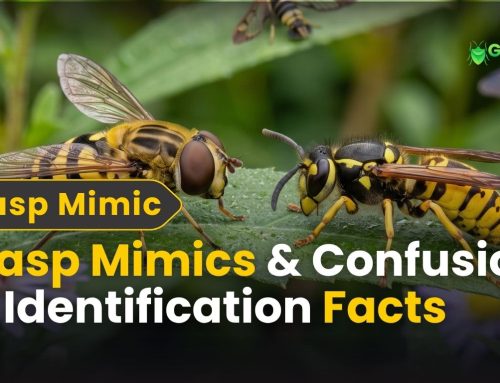
Hoverflies may be even more convincing. Many have yellow-and-black patterns resembling yellow jackets but possess no stinger.
Because hoverflies are true flies, they have one functional pair of wings. They also commonly have large eyes and shorter antennae.
Some longhorn beetles use wasp-like coloration as well. The easiest clue for a beetle that looks like a wasp is its hardened front wing covers, or elytra.
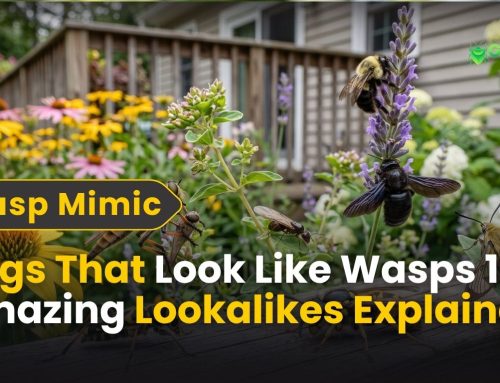
Clearwing moths, carpenter bees, bumblebees, robber flies, and other insects can add to the confusion.
Green Pest Management CT’s wasp mimic identification hub covers these groups in more depth.
Horse Fly vs. Hornet: Another Common Identification Problem
Large, loud flying insects often get called hornets regardless of their actual identity.
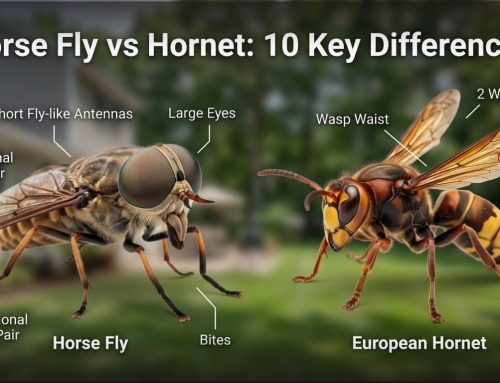
Horse flies are true flies. They have one functional pair of wings and prominent compound eyes. Females of blood-feeding horse fly species can inflict painful bites.
Hornets are social wasps. Female workers sting using a venom-delivering stinger.
The mechanism is different: horse fly bite versus hornet sting.
The yellow fly versus deer fly guide can help identify biting flies, while the hornet identification guide covers genuine hornets.
Why Do Flying Ants Appear Around Connecticut Homes?
Ant colonies can produce winged reproductives once the colony reaches the appropriate developmental stage and environmental conditions favor dispersal.
Weather plays a role.
Warm temperatures, humidity, soil moisture, recent precipitation, and species-specific timing can all contribute to flight activity.
This helps explain why homeowners sometimes see nothing unusual one day and a significant emergence the next.
Outdoor swarm events are a normal part of ant biology.
Indoor emergence deserves more investigation because it raises the question of where those insects developed before becoming visible.
Fairfield County’s spring and summer conditions support numerous ant species, making seasonal alate activity unsurprising.
Causes of Wasp Activity Around Homes
Wasps appear for different reasons.
Flowering vegetation attracts foragers. Caterpillars and other prey can attract hunting wasps. Outdoor food, garbage, sweet beverages, and fallen fruit may attract yellow jackets.
Protected nesting opportunities also matter.
Eaves, soffits, wall voids, old rodent burrows, hollow trees, shrubs, sheds, decks, and other sheltered spaces can provide nest sites depending on the species.
Seeing one foraging wasp does not prove a colony is attached to your home.
Repeated traffic to the same location is much stronger evidence.
Seasonal Flying Ant vs Wasp Activity in Connecticut
Spring
Warming temperatures increase activity among ants, social-wasp queens, bees, and other insects.
Depending on ant species and conditions, homeowners may begin seeing winged reproductives.
Wasp queens are also beginning or developing colonies during the warmer part of spring.
Summer
This is a high-activity period for both groups.
Ant colonies forage actively, and some species may have reproductive flights. Social-wasp colonies increase in size as worker numbers grow.
This is also when hoverflies, beetles, bees, and other wasp lookalikes add to homeowner confusion.
Late summer and early fall
Social-wasp colonies may become much more noticeable.
Yellow jackets in particular can create conflicts around garbage, outdoor dining, patios, lawns, and landscaping.
Ant activity can continue as weather remains suitable.
Cold weather
Outdoor activity decreases significantly as temperatures fall.
Large numbers of winged insects appearing inside during colder conditions can provide useful clues about an indoor or structural source and should be identified.
Flying Ants and Wasps in Fairfield County
Property conditions influence where insects are found across Fairfield County.
Greenwich, Wilton, and New Canaan contain many wooded and landscaped properties with mature trees, soil, stone features, and structural nesting opportunities.
Darien, Westport, and Fairfield properties frequently include decks, patios, landscaped beds, pools, and outdoor entertainment areas where homeowners may notice both ant reproductive activity and foraging wasps.
Stamford and Norwalk combine dense residential areas with suburban landscapes. Here, a colony associated with a shared wall, roofline, walkway, or exterior construction gap can become noticeable quickly.
The same identification rule applies everywhere: determine whether you are seeing reproductive ants, ant workers, solitary insects, or workers servicing a social-wasp colony before choosing treatment.
Risks: Which Is More Dangerous, a Flying Ant or Wasp?
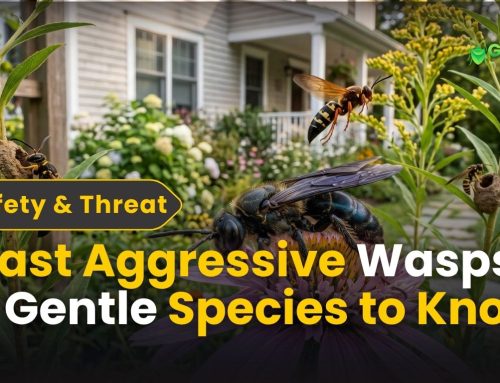
In the residential scenarios most Connecticut homeowners encounter, an active social-wasp colony usually presents the greater immediate sting concern.
Yellow jackets, hornets, and paper wasps can defend their nests, and workers are capable of repeated stinging.
A winged-ant emergence presents a different concern: determining the ant species and colony source.
Risk also depends on the person. A genuine wasp sting can trigger a serious allergic reaction in someone sensitive to venom.
If a sting causes difficulty breathing, significant swelling of the tongue or throat, fainting, or rapidly progressing symptoms consistent with anaphylaxis, call 911.
Green Pest Management CT’s wasp sting treatment guide covers basic first aid and medical warning signs.
Prevention Tips for Flying Ants and Wasps
Because ants and wasps have different biology, prevention should target the identified pest rather than use one generic spray.
Useful steps include:
- Repair damaged window and door screens.
- Address moisture problems that may support certain ant infestations.
- Keep outdoor food and garbage securely contained.
- Clean sweet beverage and food spills around patios.
- Inspect eaves, decks, sheds, and play structures for developing wasp nests.
- Watch for repeated traffic through structural gaps.
- Maintain appropriate vegetation clearance where practical.
- Identify insects before applying pesticides.
- Avoid sealing active social-wasp entrances.
- Keep children and pets away from known wasp colonies.
The U.S. Environmental Protection Agency’s Integrated Pest Management guidance supports this identification-first, prevention-focused approach.
DIY Identification vs Professional Inspection
Homeowners can often perform basic identification safely.
Photograph the insect, preferably from the side and above. Look for elbowed antennae, waist nodes, and wing proportions.
If specimens are already dead, retaining one in a sealed container may help with professional identification.
Avoid handling live insects.
Professional inspection becomes useful when winged insects repeatedly emerge indoors, the source appears to be inside a wall or structural void, termite identification cannot be ruled out, or the insects may actually be social wasps.
An active yellow jacket or hornet colony near a door, deck, pool, walkway, or play area is not a suitable location for experimental identification.
What Happens During Professional Pest Identification?
A professional inspection should start by identifying the insect and finding the source.
With flying ants, a technician may assess emergence areas, trails, moisture conditions, entry points, structural voids, and other signs that help locate colony activity.
If termite swarmers are suspected, the investigation changes accordingly.
For wasps, the technician observes worker flight paths, entry points, nest location, species characteristics, and exposure risk.
Management is then selected according to the actual pest.
This is a basic principle of Integrated Pest Management: do not apply a treatment until the target organism and problem are reasonably understood.
When pesticide use is appropriate, the product must be used according to its label. The EPA provides homeowner information about safe pesticide use and pest control.
DIY Wasp Treatment vs Professional Control
Seeing one wasp outdoors rarely requires professional removal.
An active social-wasp nest in a high-use location is different.
Professional assistance is especially appropriate when insects enter a wall or roof void, the nest is underground beside a mowing route, ladder access is required, or someone at the property has a serious sting allergy.
If the problem turns out to be ants, spraying the visible winged reproductives is unlikely to be the same as managing the colony itself.
If it is a social-wasp colony, treating visible workers away from the nest likewise may not address the source.
Green Pest Management CT’s professional flying-insect service guide explains how source identification shapes treatment.
Common Mistakes to Avoid
Do not identify an insect solely by color.
Avoid assuming wings automatically mean wasp. Ants and termites produce winged reproductives, while many flies, bees, beetles, and moths can resemble wasps.
Do not spray a swarm before collecting identification information if it can be obtained safely.
Never block an active structural wasp entrance.
Do not approach a ground opening to determine whether yellow jackets occupy it.
And if termite swarmers are a possibility, do not dismiss an indoor emergence as “just flying ants” without confirming the identification.
Frequently Asked Questions
What is the easiest way to tell a flying ant vs wasp?
Check the antennae and waist. Flying ants have clearly elbowed antennae and one or two waist nodes. Wasps have a different waist structure and generally lack the distinctly elbowed ant antennae.
Do flying ants sting?
Sting and bite capabilities vary among ant species, but common winged-ant swarms do not present the same typical sting hazard as a disturbed social-wasp colony. Avoid handling unidentified insects regardless.
Why are flying ants suddenly in my house?
Winged ants are reproductive colony members. A sudden indoor appearance may mean outdoor alates entered the home or that a colony is associated with the structure. Repeated emergence from one interior location deserves inspection.
How can I tell a flying ant from a termite?
Flying ants have elbowed antennae, narrow waists, and forewings larger than the hind wings. Termite swarmers generally have straighter antennae, broader waists, and pairs of wings of approximately equal length.
Do wasps have elbowed antennae?
Not in the characteristic way ants do. Strongly elbowed antennae combined with waist nodes are good clues that the insect is an ant rather than a typical wasp.
Are flying ants insects that look like wasps?
Yes. Their narrow waists and two pairs of wings can make reproductive ants look wasp-like. Antennae and waist-node structure provide the clearest differences.
Which is more dangerous, a flying ant or yellow jacket?
An active yellow jacket colony generally presents the greater immediate residential sting risk because workers can defend the colony and sting repeatedly. Flying ants require identification mainly to determine the ant species and colony source.
Can I seal the hole where wasps are entering?
Not while an active social-wasp colony remains inside unless the sealing is part of a professionally planned control strategy. Trapped wasps may seek alternative exits, including toward occupied rooms.
When should I call pest control for flying ants?
Consider professional inspection when numerous alates repeatedly appear indoors, they emerge from walls or trim, the colony source is unclear, or termites cannot confidently be excluded.
When should I call pest control for wasps?
Professional assistance is appropriate for social-wasp nests near people, colonies inside structural voids, underground nests beside high-use areas, elevated nests requiring ladders, and situations involving a serious sting allergy.
Conclusion: Flying Ant vs Wasp Identification Starts With Antennae and Waist
The flying ant vs wasp question is usually easiest to solve by looking beyond color. Winged ants have elbowed antennae, one or two characteristic waist nodes, and front wings generally larger than their hind wings. Wasps have different antennae and waist anatomy, and social species can show repeated worker traffic around a colony.
Do not overlook termite swarmers, particularly when winged insects appear indoors. Their broad waist, relatively straight antennae, and similarly sized wing pairs distinguish them from ants.
For Connecticut homeowners, correct identification determines the next step. Flying ants may require locating an ant colony. Termite-like insects require a different assessment. A social-wasp nest can create an immediate sting concern and should not be approached or sealed blindly.
Green Pest Management CT serves Greenwich, Stamford, Darien, Westport, Fairfield, Wilton, New Canaan, Norwalk, and surrounding Fairfield County. If a swarm is emerging indoors or unknown insects repeatedly enter a structural opening, homeowners can arrange a professional pest identification and inspection to determine what is present and choose an appropriate Integrated Pest Management approach.