Ants in Garden Control Protect Plants & Lawn in CT 2027
Ants in a Connecticut garden are not automatically a problem. In fact, ants are normal parts of outdoor ecosystems. They move soil, remove organic material, prey on some insects and provide food for wildlife. The goal of ants in garden control should therefore be targeted management—not eliminating every ant on the property.
Control becomes worth considering when ants repeatedly enter the house, interfere with use of patios or garden beds, undermine sensitive areas, or protect populations of aphids and other honeydew-producing plant pests. The best first step is to determine why the ants are concentrated where you see them.
That distinction matters for homeowners in Greenwich, Stamford, Darien, Westport, Fairfield, Wilton, New Canaan and Norwalk. Fairfield County gardens combine lawns, mature trees, ornamental plantings, vegetable beds, stonework and wooded edges, all of which naturally support insects.
Before reaching for an insecticide, inspect the plants, follow ant trails and locate the source. A line of ants climbing a rose or vegetable plant can point to a very different problem from a colony repeatedly traveling from a landscape bed into the kitchen.
This guide explains when garden ants should be controlled, when they can be left alone, how to protect plants and lawns, and when Green Pest Management CT recommends professional inspection.
How Do You Control Ants in a Garden?
For effective ants in garden control, first determine whether the ants are actually causing a problem. If they are concentrated on plants, inspect stems and leaf undersides for aphids, scale insects, mealybugs or other honeydew-producing pests. If ants are nesting in soil, identify whether the colony is damaging a particular area or simply existing naturally.
Then use an Integrated Pest Management approach:
- Identify the insect before treating.
- Follow trails to determine where ants are nesting and feeding.
- Inspect plants for honeydew-producing pests.
- Correct unnecessary food and water sources.
- Avoid automatically treating every outdoor colony.
- Use physical, cultural or biological controls where appropriate.
- Select pesticide products only when needed and only when labeled for the site and target pest.
- Use extra care around vegetables, fruit, herbs, children and pets.
- Prevent outdoor trails from developing into indoor infestations.
- Request professional inspection when ant activity is extensive, repeatedly enters the structure or cannot be identified confidently.
The U.S. Environmental Protection Agency’s Integrated Pest Management guidance supports this general principle: understand the pest and combine suitable management methods while reducing unnecessary risks.
What Are Garden Ants?
“Garden ants” is a general description rather than a specific species.
Multiple ant species can occur in Connecticut landscapes. Their biology, colony size, nesting locations, food preferences and interactions with plants can differ considerably.
Ants are social insects. Colonies contain reproductive individuals and workers that perform tasks such as foraging, nest maintenance and brood care.
Workers establish routes to reliable resources.
That explains why a plant can suddenly appear covered in ant activity even when the ants are not eating the plant itself. They may be traveling toward another insect that provides food.
For ant activity elsewhere around the property, Green Pest Management CT’s location-specific ant control hub explains how control changes between gardens, lawns, kitchens, bathrooms, bedrooms and vehicles.
Are Ants Good or Bad for a Garden?
They can be either, depending on context.
This is why blanket treatment of an entire garden is rarely an intelligent first response.
Potential Benefits
Ants can contribute to soil processes through their tunneling activity and movement of organic material. Some species prey on other small organisms, and ants themselves are part of the food web.
Outdoor colonies are natural.
Their mere presence beside a vegetable plant is not evidence that treatment is necessary.
Potential Problems
The situation changes when ants interfere with plants or people.
One of the best-known garden relationships involves aphids.
Many aphids feed on plant sap and excrete a sugary liquid called honeydew. Ants can consume this honeydew and, in some relationships, defend aphids from natural enemies.
This can indirectly make a plant-pest problem harder to control.
Ants can also become a nuisance when large numbers nest beneath pavers, establish activity in frequently used areas, or build routes toward the house.
The right question is therefore not “How do I kill all the ants?”
Ask, “What are these ants doing, and does that activity require intervention?”
Signs Your Garden Ant Activity Needs Attention
A few workers crossing soil normally do not justify treatment.
Look instead for persistent patterns.
Potentially important signs include heavy ant traffic up plant stems, visible aphid or scale populations, recurring trails from garden beds toward the foundation, soil activity interfering with a sensitive planting area, ants repeatedly entering irrigation or nearby structures, and colonies creating problems around patios or high-use areas.
The pattern matters more than the raw number of ants.
Follow the Trail
Professional pest inspections often begin with observation because the insects themselves can show you where to look.
Watch workers move in both directions.
A trail may lead to a soil opening at one end and an aphid-covered shrub at the other.
Another may disappear beneath landscape edging and continue toward the house.
Don’t destroy the trail before learning what it connects.
Why Are Ants Crawling All Over My Plants?
When ants repeatedly climb the same plant, inspect that plant closely before treating the ants.
Aphids
Aphids are small, soft-bodied insects that feed by inserting their mouthparts into plant tissue and consuming fluids.
They can occur in groups on new growth, stems and the undersides of leaves.
Their honeydew can attract ants.
Scale Insects and Mealybugs
Other sap-feeding insects can also produce honeydew.
Scale insects may look like small bumps attached to plant tissue, while mealybugs often have waxy appearances.
Identification is important because the treatment should target the actual plant problem instead of only the ants taking advantage of it.
Look for Honeydew and Sooty Mold
Sticky material on leaves or objects beneath an infested plant can indicate honeydew.
A dark fungal growth called sooty mold may develop on honeydew-coated surfaces. The mold is not the reason the ants are there; both can be connected to honeydew-producing insects.
Connecticut gardeners can use the UConn Home & Garden Education Center as an authoritative local resource for plant, insect and garden questions.
Are Ants Eating My Garden Plants?
Usually, seeing ants on a plant does not by itself prove the ants are eating it.
They could be collecting honeydew, feeding on another resource, or simply using the plant as a route.
Plant damage should be diagnosed separately.
Look at the exact symptoms.
Chewed leaves, distorted growth, stippling, discoloration and sticky foliage can result from very different pests.
Correct identification matters because treating ants will not solve damage caused by beetles, caterpillars, mites or other organisms.
If ants disappear but the plant damage continues, the wrong problem was targeted.
This is a central principle of Integrated Pest Management: treat the cause, not just the most noticeable insect.
Ants in Garden Control: Step-by-Step Process
Good garden ant management begins with diagnosis and escalates only as far as necessary.
Step 1: Decide Whether Control Is Necessary
Start by asking whether the ants are causing measurable harm or creating a route into the home.
If the colony is outdoors, away from high-use spaces and not contributing to a plant-pest issue, leaving it alone may be appropriate.
This avoids unnecessary pesticide use and disturbance of the garden ecosystem.
Step 2: Identify the Insect
Confirm you’re dealing with ants.
Workers generally have elbowed antennae and a narrow waist. Winged reproductive ants can appear seasonally and may be confused with other insects.
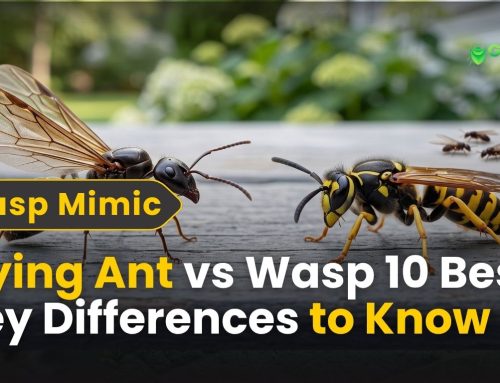
If you’re seeing winged insects around plants or the house, the flying ant versus wasp guide explains useful identification features.
Step 3: Map the Trails
Follow active trails without disturbing them.
Look for soil nest openings, pavement cracks, landscape edging and plants receiving intense traffic.
Determine whether trails remain within the garden or connect to the foundation.
A trail toward the house deserves more attention than ordinary foraging in a distant bed.
Step 4: Inspect Plants for Sap-Feeding Pests
Check leaves, stems, buds and new growth.
A hand lens can make tiny aphids and scale insects easier to identify.
If honeydew-producing pests are present, dealing with them may reduce one of the ants’ important food sources.
Avoid automatically applying broad-spectrum insecticides. Such products can also affect predators and parasitoids that naturally suppress plant pests.
Step 5: Correct Conditions That Encourage Problems
Remove unnecessary food debris around outdoor eating areas.
Manage damaged or rotting landscape materials where appropriate. Correct irrigation leaks and avoid creating persistently wet conditions where they are unnecessary.
Keep mulch appropriately managed rather than piling it against siding or structural wood.
The objective is not to make a garden sterile. It is to reduce conditions supporting troublesome pest activity near the home.
Step 6: Use Physical and Cultural Controls Where Practical
Aphids on suitable plants can sometimes be reduced with a strong stream of water, depending on the plant and infestation.
Pruning severely infested plant material may be appropriate for certain plants when horticulturally sound.
These methods should be matched to the plant rather than applied blindly.
University extension guidance is valuable because ornamental and edible species tolerate different interventions.
Step 7: Consider Targeted Ant Control
If the colony is genuinely causing a problem, targeted treatment is preferable to broadcasting pesticide across an entire garden.
Ant bait may be useful in some situations because it works with worker-foraging behavior. Product choice and placement must be appropriate to the ant and site.
Do not assume a bait labeled for indoor use belongs in a vegetable garden.
The EPA’s pesticide-label guidance explains why the label determines where, how and against which pests a pesticide can legally be applied.
Step 8: Monitor the Result
Return to the garden over the following days and weeks.
Did ant traffic decline?
Are aphids still present?
Did the route toward the building stop?
Monitoring tells you whether the intervention addressed the cause instead of merely producing a temporary reduction.
Garden Ant Control Methods Compared
| Method | Best use | Main limitation |
| Observation | Determining whether treatment is needed | Does not directly control a problem |
| Aphid management | Reducing honeydew resources | Relevant only when plant pests are involved |
| Sanitation | Removes human food sources | Won’t eliminate an established colony |
| Irrigation/moisture correction | Removes unnecessary favorable conditions | Not a direct colony treatment |
| Physical plant controls | Can reduce some plant pests | Must suit the plant and pest |
| Labeled ant bait | May target colony behavior | Requires correct placement and acceptance |
| Targeted pesticide | Selected infestations | Can affect non-target organisms if misused |
| Professional IPM | Complex or recurring problems | Requires property-specific inspection |
No method is automatically best. A good ants in garden control plan uses the least disruptive method likely to solve the actual problem.
Vegetable Garden Ant Control Requires Extra Care
Food crops change the rules.
Never apply a pesticide to vegetables, herbs, berries or fruit trees unless the product’s label specifically permits that crop or use site and all directions are followed.
A product being “safe for outdoor use” does not automatically mean it can be applied to edible plants.
Pay attention to application instructions and any label restrictions relevant to harvest.
Do not pour unapproved household chemicals around edible plants.
This applies to homemade mixtures too.
Vinegar, salts, soaps, oils and other household substances can injure plants, change soil conditions or affect non-target organisms when used improperly.
“Natural” and “plant safe” are not synonyms.
Homeowners considering lower-impact options can review Green Pest Management CT’s DIY and natural pest remedies guide while verifying any garden treatment against reliable horticultural guidance.
What About Ant Hills in the Lawn?
Ants in yard elimination should be approached differently from an indoor infestation.
An outdoor nest in a low-use area may need no intervention.
Where colonies create recurring mounds in a high-use lawn, disturb sensitive turf or repeatedly send workers toward a building, targeted control may become reasonable.
Avoid treating an entire lawn because one mound exists.
Map the activity and find out whether multiple visible openings belong to the same active area.
Also make sure insects entering a ground hole are actually ants.
Ants or Ground-Nesting Wasps?
If insects are flying rapidly into and out of one hole, especially with obvious wasp-like bodies, do not approach the opening expecting harmless ants.
Connecticut properties can contain ground-nesting wasps.
Use Green Pest Management CT’s ground-nesting wasp identification guide to understand the difference.
The detailed guide to ground-nesting bees and wasps can also help identify situations where pollinators or defensive stinging insects require a different response.
This distinction is important for personal safety.
Can Garden Ants Enter the House?
Yes.
An outdoor colony does not need to live inside a house to cause an indoor infestation.
Workers can forage through cracks and construction joints around foundations, windows, doors and utility penetrations.
Landscape beds immediately beside a foundation deserve particular attention when visible trails head toward the structure.
Once ants reach the house, the room where they appear offers additional clues.
If workers reach food-preparation areas, follow our process to get rid of ants in the kitchen.
For ants associated with water or plumbing, use the bathroom ant removal guide.
If you notice ants in the bedroom at night, inspect exterior walls, windows, adjoining rooms and structural routes rather than assuming food is the only attraction.
Outdoor and indoor ant problems are often two parts of the same investigation.
Can Garden Ants Get Into Your Car?
They can.
A vehicle parked beside a landscape bed or active ant trail can become a new foraging opportunity if food residue is available inside.
This is why car infestations often disappear after the vehicle is cleaned and parked in a different location.
If ants move from a driveway or garden into a vehicle, the ants in car removal guide provides a vehicle-specific process without recommending indiscriminate pesticide application inside the passenger compartment.
Again, location matters.
The colony may be in the garden even though the ants become noticeable in the car.
Common Garden Ant Control Mistakes
The first mistake is treating ants simply because they exist.
An outdoor ecosystem is supposed to contain insects. Pest management should solve defined problems.
Another common mistake is spraying ants on a plant without checking for aphids.
If honeydew remains abundant, you may leave the underlying plant-pest issue unchanged.
Broadcast spraying is another poor default. Treating large areas without identifying the species and source can expose non-target organisms unnecessarily.
Gardeners also commonly pour household chemicals directly into nests.
Boiling water, highly acidic products, salts or improvised chemical mixtures can injure plants, damage turf or create safety problems without providing reliable colony management.
A final mistake is ignoring the house.
If an ant trail clearly connects a garden bed with the foundation, investigate both ends rather than repeatedly treating just the soil.
Protecting Pollinators and Beneficial Insects
Garden pest management affects more than the target insect.
Bees, parasitoid wasps and other organisms contribute to pollination or biological control.
Aphids, for example, have natural enemies. Broad-spectrum pesticide use can sometimes kill those beneficial organisms along with pests.
This is another reason targeted IPM is useful.
Don’t assume every wasp in a garden is dangerous either. Many wasps are predators or parasitoids and can play important ecological roles.
Green Pest Management CT’s parasitic and parasitoid wasp guide explains why some wasps seen around gardens are very different from yellow jackets or defensive social wasps.
For species that resemble stinging pests, our guide to non-stinging and harmless wasp look-alikes can also prevent unnecessary treatment.
Prevention Tips for Gardens and Lawns
Prevention does not mean removing all ants from the property.
Instead, make it less likely that normal outdoor populations will turn into a household problem.
Use this garden and lawn checklist:
- Inspect plants regularly for aphids, scale insects and honeydew.
- Avoid unnecessary overwatering.
- Repair leaking outdoor faucets and irrigation components.
- Keep food waste out of garden areas.
- Clean outdoor dining areas after use.
- Maintain mulch rather than piling it against siding or structural wood.
- Keep vegetation from creating unnecessary direct contact with the building.
- Inspect ant trails that lead toward the foundation.
- Maintain appropriate door, window and utility seals.
- Address moisture-compromised exterior wood.
- Identify ground-nesting insects before disturbing nests.
- Use pesticides only when justified and labeled for the intended site.
- Monitor treated areas to confirm the problem actually improved.
In established gardens, observation can prevent a small issue from turning into a larger one.
Connecticut Seasons and Garden Ant Activity
Connecticut weather changes both ant activity and the garden around them.
Spring
As soil temperatures rise, outdoor insects become increasingly active.
Spring growth also creates new plant tissue where aphids and other plant-feeding insects may appear.
Rain changes soil moisture and can affect where ants establish visible foraging routes.
Early spring inspection is useful because vegetation has not yet reached maximum density.
Summer
Warm weather supports high levels of ant activity.
Gardens provide abundant resources, while patios and outdoor dining areas can introduce human food.
Hot, dry periods can also change where colonies seek water.
Summer is when gardeners should pay close attention to the difference between normal ant activity and a real plant or structural pest problem.
Fall
Ant activity continues while temperatures remain favorable.
Late-season maintenance is useful for reducing trails toward houses before cold weather.
Remove unnecessary food debris and correct building or landscape conditions that support entry.
Winter
Outdoor activity falls sharply during Connecticut’s coldest periods.
You generally will not approach garden ant control in the same way during frozen conditions.
If ants continue appearing indoors in winter, investigate the building separately rather than assuming workers are actively commuting from frozen garden soil.
Ants in Gardens Across Fairfield County, Connecticut
Fairfield County contains diverse residential landscapes, so local property conditions matter.
Greenwich
Greenwich homes often include mature landscaping, stone features, wooded margins and large garden areas. These environments naturally support insects.
Focus control where ant trails affect the home or valuable plantings rather than attempting property-wide eradication.
Stamford
Stamford includes dense residential areas as well as suburban gardens.
In smaller yards, landscape beds can sit close to foundations, making it especially important to monitor trails moving between soil and the structure.
Darien and Westport
Landscaped coastal and near-coastal properties can experience periods of significant humidity and moisture.
Check irrigation, drainage and plant health alongside pest activity.
Fairfield and Norwalk
These communities contain varied properties ranging from compact residential gardens to larger landscaped lots.
Patios, raised beds and foundation plantings can create transition zones between outdoor ant activity and houses.
Wilton and New Canaan
Wooded properties in Wilton and New Canaan naturally support substantial insect diversity.
The objective is not to remove that ecosystem. Property-specific management should concentrate on colonies that interfere with buildings, plants or high-use spaces.
Green Pest Management CT serves all of these areas and surrounding Fairfield County communities.
DIY vs Professional Garden Ant Control
DIY control is often appropriate when the pest and source are clear.
A gardener who discovers ants tending a small aphid population can focus on plant health and aphid management before considering broader ant treatment.
Professional pest control becomes more useful when the infestation repeatedly enters the house, extensive trails occur around the foundation, colonies persist in difficult structural locations, or homeowners cannot confidently identify what they are dealing with.
A professional inspection can also help avoid unnecessary broad pesticide use.
Green Pest Management CT’s professional pest-management service guide explains how an inspection-led approach combines pest identification, environmental conditions and targeted treatment.
What Professional Garden Ant Management Involves
Professional garden pest management should not begin by spraying every visible insect.
Inspection
A technician should map active trails, inspect the foundation and determine whether activity stays outside or extends into the structure.
The inspection may also consider landscaping, mulch, moisture and visible plant-pest activity.
Identification
Species or group identification helps determine likely nesting and feeding behavior.
The technician should also distinguish ants from ground-nesting stinging insects.
Treatment Planning
An IPM strategy might combine targeted ant treatment with sanitation, moisture management, landscape adjustments and recommendations for structural exclusion.
Plant-specific pest problems may require horticultural management rather than a general structural pesticide application.
Monitoring
Follow-up observation determines whether trails and indoor pressure have declined.
Successful pest management should be measurable.
The objective is not the unrealistic promise of an insect-free yard. It is resolving the specific infestation creating the problem.
Pesticide Safety in Gardens
Outdoor use does not mean unrestricted use.
Pesticide labels specify permitted sites, pests, application methods and precautions.
Use special care around edible crops, children’s play areas, pets, pollinator habitat and water.
Do not exceed labeled application rates.
Do not apply a product to a vegetable garden merely because the same product is approved for a building perimeter.
Keep unused pesticides in their original labeled containers and store them according to the manufacturer’s instructions.
The EPA provides additional information for safe pesticide use around homes and gardens.
For plant-specific questions, Connecticut homeowners should also consult UConn Extension or another appropriate agricultural authority.
What About Carpenter Ants in the Garden?
Finding carpenter ants outdoors does not automatically mean your house is infested.
Carpenter ants occur naturally outdoors and can use decaying or moisture-compromised wood.
The concern increases when workers establish persistent trails toward the structure or repeatedly appear indoors.
Inspect tree-to-house contact, exterior wood conditions and moisture issues rather than assuming every outdoor carpenter ant colony needs treatment.
If large ants are moving into the home through a consistent route, professional identification is worthwhile.
The same evidence-based rule applies: outdoor presence and structural infestation are not identical.
When Should You Call Green Pest Management CT?
Consider scheduling a professional inspection when garden ant activity is no longer confined to normal outdoor behavior.
Examples include recurring indoor invasion, trails entering foundation gaps, difficult-to-identify colonies, suspected carpenter-ant activity near the structure, and repeated DIY efforts that fail to address the source.
Professional help is also appropriate when the suspected “ant nest” may actually contain stinging insects.
Green Pest Management CT serves Greenwich, Stamford, Darien, Westport, Fairfield, Wilton, New Canaan, Norwalk and surrounding Fairfield County communities.
The purpose of an inspection is to determine what needs treatment—and equally important, what does not.
Frequently Asked Questions
Are ants bad for my garden?
Not necessarily. Ants are normal components of garden ecosystems and can contribute to soil processes and food webs. Control is most useful when they are contributing to a plant-pest problem or repeatedly invading the home.
What is the best method for ants in garden control?
First identify why the ants are present. Inspect for aphids and other honeydew-producing pests, locate trails and determine whether treatment is actually needed. Use targeted IPM rather than automatically spraying the entire garden.
Why are ants crawling up my plants?
They may be attracted to honeydew produced by aphids, scale insects, mealybugs or other sap-feeding pests. Inspect leaves, stems and new growth carefully.
Are ants eating my plants?
Often they are not. Ants may simply be foraging or collecting honeydew. Identify the actual cause of plant damage before choosing treatment.
Should I destroy every ant nest in my yard?
No. Most outdoor colonies do not require control. Focus ants in yard elimination efforts on colonies causing a defined problem.
Can I use ant killer in my vegetable garden?
Only use a pesticide if its label specifically permits use in the intended edible-crop or garden setting, and follow all instructions and restrictions.
Does vinegar get rid of garden ants?
Vinegar is not a dependable whole-colony solution and can injure plants at some concentrations. Do not pour household chemicals around plants without understanding their effects.
Why do garden ants keep entering my house?
A colony may have established a foraging route to food or moisture indoors. Inspect foundation edges, doors, windows and utility penetrations while addressing indoor resources.
Can garden ants get into my car?
Yes. Cars parked beside active colonies can attract foragers, especially when food debris or sugary residues are present inside.
When should I call pest control for garden ants?
Call when ants repeatedly invade the home, activity around the structure persists despite preventive measures, carpenter ants are suspected or you cannot confidently identify the nest. Green Pest Management CT provides inspections throughout Fairfield County.
Conclusion
Good ant control in the garden begins by recognizing that a healthy Connecticut landscape does not need to be insect-free.
Ants are natural parts of lawns, garden beds and wooded environments throughout Fairfield County. Most outdoor colonies can be left alone.
Treatment becomes valuable when there is a specific problem.
If ants are covering a plant, investigate aphids, scale insects and honeydew before blaming the ants for plant damage. If workers form a trail toward the house, follow it and inspect the foundation. If a nest is in the lawn but causes no meaningful problem, treatment may not be necessary.
When intervention is justified, use Integrated Pest Management: identify, monitor, remove favorable conditions and choose the most targeted effective control available.
That approach protects plants without unnecessarily treating the entire ecosystem.
For homeowners in Greenwich, Stamford, Darien, Westport, Fairfield, Wilton, New Canaan and Norwalk, Green Pest Management CT can evaluate persistent garden and yard ant activity, especially when colonies begin moving toward the structure.
If ants repeatedly invade your home or a garden infestation cannot be identified confidently, schedule a professional inspection. The best pest-control decision is not always deciding what to spray—often, it is determining exactly what needs to be controlled in the first place.