Location-Specific Ant Hub: 10 Essential Guides for Homeowners
Finding ants in a Connecticut home is rarely as simple as seeing a few insects and spraying them. Where the ants appear tells you something important about why they are there, what resource they may be following, and where the colony could be located.
Ants crossing a Greenwich kitchen counter may be exploiting food or moisture. Ants repeatedly appearing around a Stamford bathroom can indicate persistent moisture or an entry point around plumbing. Ants showing up in an upstairs bedroom in Darien deserve a different investigation, while ants emerging beside a Westport patio or Fairfield garden may simply be part of an outdoor colony—or may be establishing trails toward the house.
That is the purpose of this Location-Specific Ant Hub. Instead of treating every ant problem the same way, it shows homeowners how to investigate ants according to the place they are appearing: kitchens, bathrooms, bedrooms, basements, walls, yards, gardens, patios, garages and vehicles.
The quick answer is this: remove food and water sources, identify active trails, determine where ants are entering, avoid randomly spraying visible workers, correct moisture and exclusion problems, and use an appropriately labeled treatment strategy when necessary. Persistent activity, suspected carpenter ants, difficult-to-reach nests or repeated indoor infestations warrant a professional inspection.
Green Pest Management CT serves homeowners in Greenwich, Stamford, Darien, Westport, Fairfield, Wilton, New Canaan, Norwalk and surrounding Fairfield County communities. The goal of effective ant management is not simply to kill the ants visible today, but to understand why they are appearing and prevent the conditions that keep bringing them back.
How Do You Get Rid of Ants Based on Where They Appear?
Start by identifying where ants are most active and what they are seeking. In kitchens, concentrate on food residues, pantry products, pet food, garbage and moisture around sinks and appliances. In bathrooms, investigate plumbing, condensation and damp wood. Bedroom activity requires inspection of windows, walls, adjoining trees, food and possible structural nesting. Outdoors, determine whether the colony actually threatens the house, garden or people before treating it.
Ant trails can lead toward useful evidence. Watch where workers disappear rather than immediately wiping out every ant you see. The trail may reveal a foundation crack, window gap, utility penetration, wall void or exterior nesting area.
If you use pesticides, follow the product label exactly. The U.S. Environmental Protection Agency guidance on pesticide safety is an appropriate resource for homeowners. Keep pesticide products away from children and pets, and never use a pesticide in a way or location that its label does not permit.
Key Takeaways for Connecticut Homeowners
- Where ants appear is often an important clue. Kitchens generally provide food and water; bathrooms provide moisture; bedrooms may reveal structural entry routes; outdoor activity frequently originates in soil, landscaping or decaying wood.
- Do not assume every large dark ant is a carpenter ant. Identification should come before treatment.
- Visible worker ants may represent only a small part of a colony. Killing individual foragers does not necessarily eliminate the nest.
- Random repellent spraying can make diagnosis harder and may interfere with bait-based strategies.
- Food sanitation helps, but cleanliness alone cannot solve every infestation. Ants can enter clean houses for water, shelter or nesting opportunities.
- Moisture control is especially important when ants are associated with damp or damaged wood.
- Connecticut’s seasonal changes affect ant activity. Indoor sightings commonly become more noticeable during warm weather, while changing temperature and moisture conditions can shift foraging patterns.
- Outdoor ants are not automatically pests requiring elimination. Treatment should be targeted to a real problem.
- Carpenter ants can be associated with moisture-damaged wood, although their presence does not automatically prove serious structural damage.
- Professional inspection becomes particularly valuable when activity persists, appears in several rooms, involves suspected structural nesting or repeatedly returns after DIY efforts.
Table of Contents
This Location-Specific Ant Hub covers ant identification and behavior first, then ten practical location guides: kitchens, bathrooms, bedrooms, basements and utility spaces, wall voids and structural areas, yards and lawns, gardens, patios and foundations, garages, and cars. It also explains Connecticut seasonality, prevention, DIY versus professional pest control, Integrated Pest Management, treatment expectations, safety and frequently asked questions.
Location-Specific Ant Problems at a Glance
| Location | What may attract ants | What to inspect first | Practical priority |
| Kitchen | Food, grease, sugar, water | Sink, counters, appliances, pantry | Sanitation plus trail investigation |
| Bathroom | Water and humidity | Plumbing, vanity, tub, damaged caulk | Correct moisture and locate entry |
| Bedroom | Entry routes, occasional food, structural nesting | Windows, baseboards, exterior walls | Trace the trail before treatment |
| Basement | Moisture, cracks, wood | Sills, utilities, foundation | Moisture control and exclusion |
| Wall/structure | Voids, damp wood, access routes | Activity points and exterior conditions | Professional inspection when persistent |
| Yard/lawn | Soil and natural nesting sites | Mounds, trails, foundation edge | Treat only where activity creates a problem |
| Garden | Aphids/honeydew, soil nests | Plants, mulch, raised beds | Address the ecosystem, not only workers |
| Patio/foundation | Cracks, warmth, nearby food | Pavers, expansion joints, siding | Exclusion and targeted management |
| Garage | Food, recycling, gaps | Door edges, stored items, walls | Sanitation and sealing |
| Car | Food debris and nearby colonies | Seats, mats, console, parking area | Clean vehicle and identify external source |
What Is a Location-Specific Ant Hub?
A Location-Specific Ant Hub is a practical method of diagnosing and managing ant activity according to where the insects are found instead of assuming one treatment works everywhere.
This approach closely follows the logic of Integrated Pest Management, commonly shortened to IPM. IPM emphasizes identification, monitoring, prevention and targeted intervention rather than depending solely on routine pesticide applications.
The EPA’s explanation of Integrated Pest Management describes an approach that combines information about pest life cycles with available management methods while considering risks to people, property and the environment.
For homeowners, that translates into a straightforward principle: investigate first.
An ant crawling across a sink tells you where you saw it, not necessarily where it lives. The colony might be beneath exterior soil, within a structural void or some distance from the room. Effective pest control requires connecting those observations.
How to Identify an Ant Problem Before Treating It
Correct identification is one of the most valuable steps in pest management. Ant species differ in nesting behavior, food preferences and treatment response.
Ants are social insects. Colonies generally include reproductive individuals and workers performing tasks such as nest maintenance and food collection. The workers walking through your home can establish trails between a colony and useful resources.
Ant or Something Else?
A common point of confusion is the difference between winged ants and wasps or other insects. Ant reproductive forms can develop wings during seasonal mating activity.
If you encounter a winged insect and are uncertain about the identification, our guide to flying ants versus wasps explains the visible differences.
Broadly, ants have distinctly elbowed antennae and a narrow connection between the thorax and abdomen. Winged ants also have two pairs of wings, with their forewings generally larger than their hindwings.
Do not rely on color alone. Several unrelated insects can look superficially similar.
Why Species Identification Matters
A treatment strategy should account for how a colony behaves.
Some ants nest primarily outdoors and enter buildings to forage. Others may establish colonies or satellite nests associated with structures. Carpenter ants deserve particular attention because they excavate galleries in wood for nesting rather than eating wood as termites do.
Seeing large ants does not automatically confirm carpenter ants, however. A professional inspection is valuable when identification is uncertain or activity appears to originate from structural wood.
Why Ants Enter Connecticut Homes
Ant infestations generally reflect resources and access rather than a mysterious attraction to one particular house.
Food is an obvious resource. Tiny residues of sugar, grease, crumbs and pet food can support foraging. Water is equally important. Leaking plumbing, condensation, damp cabinets and wet structural materials can make a location more attractive.
Access is the third piece. Ants can exploit small openings around foundations, siding, windows, doors, pipes and utility penetrations.
Landscaping influences activity as well. Mulch, tree branches, dense vegetation and other features close to a house can create favorable habitat or convenient routes.
Older Fairfield County properties can have numerous gaps and additions accumulated through decades of repairs and renovation. Newer homes are not immune: utility penetrations, landscaping and moisture conditions can still provide access.
Effective prevention therefore combines sanitation, moisture correction, exclusion and habitat management.
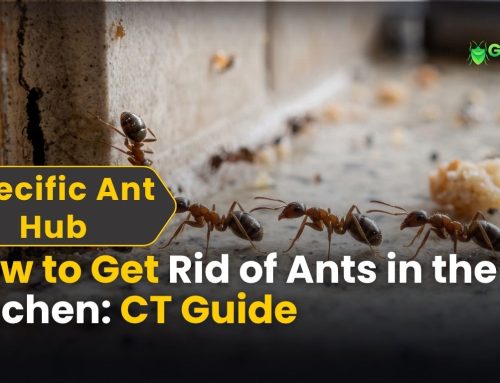
Guide 1: How to Get Rid of Ants in the Kitchen
The kitchen is one of the most common places homeowners notice ants because it concentrates nearly everything foraging workers need.
Sugar, grease, crumbs, fruit residue, cooking spills, pet food and water may all be available within a relatively small space.
Find the Trail Before You Erase It
When you first notice ants, spend a few minutes observing their direction.
Are they moving toward a window? Disappearing behind a backsplash? Traveling beneath the dishwasher? Emerging from the cabinet containing sink plumbing?
That information can be more useful than immediately wiping the counter.
Once you understand the trail, clean food residues thoroughly and remove accessible food sources. Store vulnerable foods in sealed containers. Clean beneath small appliances, where crumbs and grease can remain unnoticed.
Pet feeding areas deserve special attention. Leaving food accessible continuously can provide a dependable resource.
Check Moisture, Not Just Food
An apparently spotless kitchen can still have ants.
Look around the sink, dishwasher, refrigerator water connection and plumbing beneath cabinets. A slow leak can create persistent moisture without producing an obvious puddle.
Fruit flies can sometimes occur in the same kitchen, but they require a different response. If small flying insects are mixed into the problem, use the fruit fly identification and control hub rather than treating every tiny insect as an ant.
Similarly, insects emerging around drains may require the gnat and drain fly control guide to establish the correct pest.
Why Random Kitchen Spraying Can Backfire
Surface spraying every worker you encounter may provide immediate satisfaction without addressing the colony. It can also contaminate surfaces if a product is used improperly.
Where bait is appropriate and labeled for the setting, workers must be allowed to encounter and carry the bait. Applying repellent products around it can interfere with that process.
Follow label directions exactly, particularly in food-preparation areas.
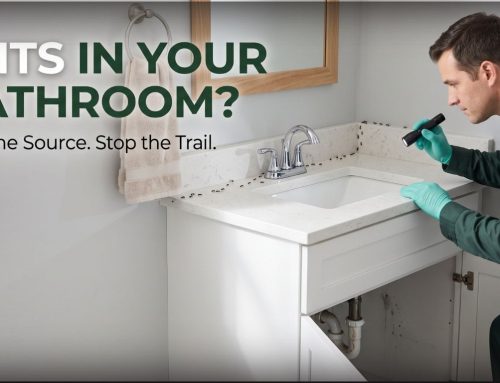
Guide 2: Ants in Bathroom Removal
Bathrooms create a different pest environment. Food is usually not the main attraction; water and humidity are.
Repeated ant activity around sinks, tubs, toilets, vanities and plumbing penetrations should prompt a moisture inspection.
Look Beyond the Ants
Check for deteriorated caulk, dripping fixtures, condensation and moisture beneath the vanity. If wood remains wet because of a plumbing or exterior-water problem, correcting that condition is more important than repeatedly killing visible ants.
Damp structural material can also make some nesting sites more favorable.
In Connecticut, seasonal humidity, rain and snowmelt can change moisture conditions around homes. Roof, flashing, siding and foundation issues can therefore influence indoor pest pressure even when the ants appear in a bathroom far from the obvious source.
Bathroom Ants Are Not Necessarily Coming From the Drain
Seeing ants near a sink does not prove that they live inside the drain.
The sink may simply provide water, while the ants enter through a plumbing penetration or wall gap.
This is a useful diagnostic rule: location identifies the activity zone, not automatically the colony.
Follow movement carefully before sealing openings. Sealing one visible gap while leaving an active infestation unexplained can simply move the visible trail somewhere else.
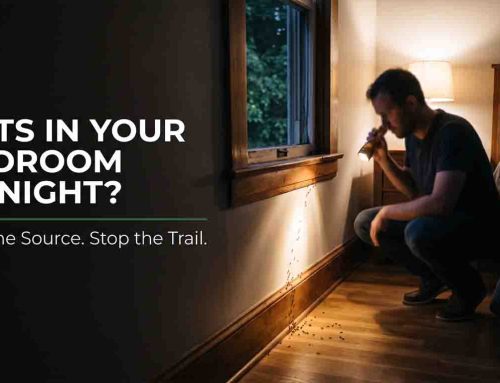
Guide 3: Ants in the Bedroom at Night
Ants in a bedroom can feel especially intrusive because there may be no obvious food source.
Nighttime activity deserves careful investigation.
A bedroom next to an exterior wall may provide access around windows, siding, rooflines or utility penetrations. Bedrooms above porches, garages or additions can also sit near concealed building cavities.
Large ants that repeatedly appear indoors at night may warrant closer identification, particularly when activity occurs near wood or moisture problems.
Search the Room Methodically
Begin with windows, baseboards and exterior-wall intersections. Check whether tree branches or vegetation contact the building outside.
Look for food sources too. Snack wrappers, drink containers and pet bowls can produce straightforward foraging activity.
Do not overlook adjoining spaces. An ant entering a bedroom may have traveled from an attic, wall void or neighboring bathroom.
The most important distinction is between occasional outdoor foragers and consistent activity suggesting a nest or established route.
If the activity persists despite removing food and eliminating obvious entry conditions, schedule a professional inspection.
Guide 4: Ants in Basements, Crawl Spaces and Utility Areas
Basements combine several factors ants can exploit: foundations, plumbing, utility penetrations, stored materials and moisture.
Start your inspection at the sill, foundation walls and locations where pipes, wires or other utilities enter.
Why Moisture Management Matters
A basement does not have to flood to create pest-friendly conditions.
Condensation, high humidity, seepage and slow plumbing leaks can maintain localized moisture. Cardboard stored directly against damp surfaces can make inspections difficult and provide harborage for several kinds of pests.
Address the source rather than simply attempting to cover moisture with pest-control products.
Gutters, grading and drainage outside the house can affect basement moisture too.
Cracks Are Clues, Not Always the Nest
When ants emerge from a foundation crack, homeowners often conclude that the colony is directly behind that exact location.
Sometimes it may be. In other cases, the crack is merely an access route.
Tracing exterior activity and understanding the building’s layout provides better evidence.
Guide 5: Ants in Walls, Windows and Structural Wood
Wall activity can be harder to diagnose because most of the relevant area is invisible.
Workers may emerge around trim, electrical penetrations, window frames or baseboards without revealing the colony’s exact location.
Persistent large-ant activity associated with damp wood deserves professional attention.
Carpenter Ants and Wood
Carpenter ants excavate wood to create nesting galleries. Unlike termites, they do not consume wood for nutrition.
They often have an association with moisture-compromised wood, although nesting conditions vary. Correcting a roof leak, window leak or plumbing problem can consequently be an important part of long-term management.
Homeowners should avoid unnecessarily opening walls simply because ants appeared near a baseboard. Inspection comes first.
The Connecticut climate can create moisture stresses through rain, snow, freeze-thaw cycles and humid summers. Exterior wood, window assemblies, roof edges and other vulnerable areas should be kept in sound condition independent of pest pressure.
Guide 6: Ants in Yard Elimination Without Treating Everything
Seeing ants outdoors does not automatically indicate a pest-control problem.
Ants are normal parts of outdoor ecosystems. They can contribute to soil processes, move organic material and interact with other insects.
Treatment should therefore have a purpose.
A colony may justify management when it is invading the house, creating problematic nesting around structures or interfering significantly with how a space is used.
Map Yard Activity
Look at where trails travel rather than focusing on individual workers.
Inspect foundation edges, pavers, landscape borders, wood piles and areas around patios. Determine whether the movement terminates outside or continues toward the structure.
If stinging insects are emerging from the ground instead, do not automatically assume you found ants. Connecticut yards can also contain ground-nesting wasps and bees. Our ground-nesting wasp guide explains those distinctions.
For a closer identification reference, see ground-nesting bees and wasps.
This distinction matters for safety because the correct response to a defensive stinging-insect nest differs greatly from ordinary ant control.
Guide 7: Ants in Garden Control
Gardens contain abundant ant habitat, and complete ant elimination is neither realistic nor usually necessary.
The more useful question is why ants appear concentrated on a particular plant.
Look for Aphids and Other Honeydew-Producing Insects
Ants may be attracted to honeydew, a sugary substance produced by aphids and some other plant-feeding insects.
If ants repeatedly climb stems and leaves, inspect the plant carefully.
Managing the plant pest may reduce the resource supporting intense ant activity. Treating only ants while ignoring honeydew-producing insects can leave the underlying attraction in place.
Use Extra Care Around Edible Plants
Never apply a pesticide to an edible garden unless its label specifically permits that use and you follow all directions.
The EPA explains why pesticide labels are legally important instructions covering where and how products may be used.
This is a situation where “natural” should not be confused with “harmless.” Homemade mixtures can damage plants, contaminate surfaces or affect non-target organisms.
If you’re considering lower-impact approaches elsewhere around the property, our DIY and natural pest-remedy hub can help separate practical measures from unsupported remedies.
Guide 8: Ants Around Patios, Pavers and Foundations
Patio areas frequently provide protected spaces for ant activity.
Cracks between materials, spaces below pavers and foundation interfaces can provide suitable nesting opportunities for some species. Outdoor dining introduces crumbs and sugary drink residues as well.
The first priority is identifying whether the activity is merely outdoor nesting or part of a trail entering the house.
Inspect the Building Perimeter
Walk slowly around the exterior on a day when activity is visible.
Look at door thresholds, siding transitions, foundation cracks, pipe penetrations, window frames and other construction joints.
Trim vegetation when it creates direct contact with the building, and address deteriorated seals where appropriate.
Do not seal weep openings or other building components that are intentionally designed for drainage or ventilation. When you are uncertain about a construction feature, consult an appropriate building professional.
An IPM approach focuses on meaningful access points without trying to make an entire structure hermetically sealed.
Guide 9: Ants in Garages
Garages sit between indoor and outdoor environments, which makes them natural transition zones for pest activity.
Garage doors have large perimeter openings. Groceries, recycling, pet supplies, grass seed and household products may be stored nearby.
Attached garages also provide potential routes into the main living space.
Inspect Door Seals and Stored Materials
Check garage-door weather stripping and gaps around pedestrian doors.
Clean spills and manage recycling promptly, especially containers that held sweet beverages.
Where possible, keep vulnerable food and pet products in durable sealed containers instead of thin bags.
Avoid leaving cardboard and clutter undisturbed for long periods along walls. A cleaner storage layout makes pest activity easier to detect and inspect.
If flying insects are the problem rather than ants, Green Pest Management CT’s overview of professional flying-insect control explains when a different identification and treatment approach is necessary.
Guide 10: Ants in Car Removal
Ants in a car generally result from either a food source inside the vehicle or repeated contact with an outdoor colony where the vehicle parks.
Cars collect food surprisingly well. Crumbs drop between seats, sugary drinks spill inside cup holders and children’s snacks can accumulate under mats.
Clean Before Treating
Remove trash, vacuum beneath and between seats, clean cup holders and inspect the trunk.
Check removable mats and spaces around seat tracks.
Then consider where the vehicle has been parked. If ants appear after parking in the same driveway position, under a particular tree or beside a landscape bed, the source may be external.
Moving the car temporarily can help test this possibility.
Avoid applying household pesticides indiscriminately inside passenger compartments. Cars are confined environments containing surfaces that people touch frequently. Any pesticide use must be explicitly consistent with its label.
Persistent activity after thorough cleaning and a change in parking location warrants further investigation.
Why Killing Visible Ants Often Fails
One of the most common ant-control mistakes is treating the visible workers as if they represent the entire infestation.
Social insect colonies operate differently from isolated pests.
Foragers leave the nest, locate resources and travel back and forth. Eliminating some workers may reduce what you see temporarily while leaving the colony functional.
This is one reason strategically selected ant baits can be useful for appropriate species and situations. The aim is for workers to interact with a material that acts slowly enough to be carried within the colony.
The exact product, placement and strategy depend on the ant, environment and label requirements.
Some ant species can also respond poorly to indiscriminate repellent treatment, complicating the infestation.
For homeowners, the practical lesson is simple: diagnosis should guide treatment rather than spraying whatever happens to move.
Common Causes of Recurring Ant Infestations
Recurring infestations usually mean one or more favorable conditions remain.
Food residue is one possibility, but far from the only one. Persistent moisture, active landscaping close to the structure, unsealed utility penetrations, deteriorated exterior materials and nearby outdoor colonies may all contribute.
A home’s construction also matters.
An ant trail entering beneath a patio door cannot necessarily be solved by improving kitchen sanitation alone. Likewise, baiting a bathroom repeatedly without correcting a leaking fixture leaves an important condition unresolved.
Integrated Pest Management works because it combines these pieces rather than searching for one universal ant-killing trick.
Risks and Problems Associated With Indoor Ant Activity
Most household ant problems are primarily nuisance issues, but that does not mean every infestation should be ignored.
Ants traveling across food-preparation areas are undesirable from a sanitation standpoint. Persistent activity can indicate access or moisture problems requiring correction.
Carpenter ants deserve attention because colonies can excavate galleries in structural or other wood. Their presence should prompt investigation of both the ants and potential moisture conditions.
Another risk comes from misidentification.
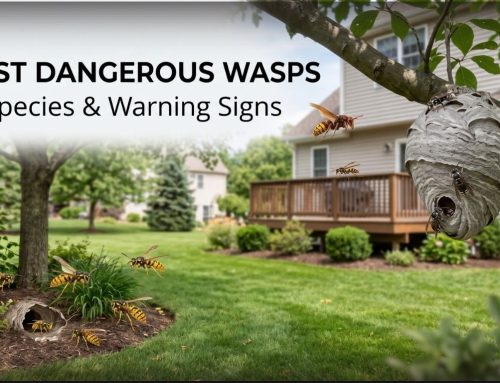
A homeowner who mistakes a stinging insect for a winged ant may approach a nest without appropriate precautions. Connecticut properties can host paper wasps, yellow jackets, hornets and other insects.
Green Pest Management CT’s Connecticut wasp and hornet identification guide can help when the insect in question has wings and the identification is unclear.
When the suspected nest is below ground, the ground-nesting wasp identification guide provides additional context.
Connecticut Ant Season: When Activity Changes
Connecticut’s four-season climate strongly influences insect activity.
Spring
As temperatures rise, ant activity becomes easier to notice. Colonies increase foraging, and homeowners may see workers exploring kitchens, bathrooms and structural edges.
Spring rain can also influence where ants forage and nest.
This is an effective time for exterior inspection because vegetation has not always reached full summer density.
Summer
Warm conditions support heavy ant activity.
Food and water remain major drivers indoors, while patios, gardens, lawns and landscaping can contain extensive exterior activity.
Humid weather also makes moisture management important.
Fall
Ant activity does not necessarily disappear with the first cool nights.
Colonies can continue foraging while conditions allow it, and homeowners may notice movement associated with seasonal changes.
Fall maintenance—correcting gaps, maintaining weather stripping and addressing moisture—helps prepare buildings for many overwintering pests.
Winter
Outdoor activity falls dramatically in cold Connecticut weather, but indoor ant activity is not impossible.
Consistent winter sightings can be especially useful diagnostic information because a heated building provides a very different environment from frozen outdoor soil.
Repeated indoor activity during cold periods warrants investigation rather than assuming the ants simply wandered inside that day.
Prevention Checklist for the Whole Property
Effective prevention works best when homeowners consider the building and surrounding landscape as one system rather than treating rooms independently.
Use this practical checklist:
- Keep kitchen counters, floors and appliance edges free of food residues; store pantry goods and pet food securely.
- Repair plumbing leaks and investigate unexplained dampness around sinks, bathrooms, basements, roofs and windows.
- Empty garbage and recycling regularly, cleaning sugary residues from containers where practical.
- Inspect weather stripping, utility penetrations, window frames and appropriate exterior joints for pest access.
- Trim vegetation that creates unnecessary direct contact with the structure while preserving appropriate landscaping practices.
- Keep firewood and moisture-prone materials appropriately managed rather than pressed against exterior walls.
- Monitor ant trails before disrupting them so you can identify likely entry areas.
- Inspect garden plants for aphids or other honeydew-producing pests when ants concentrate on vegetation.
- Use pesticides only where the label permits and keep products secured from children and pets.
- Arrange a professional inspection when activity persists, involves suspected carpenter ants, appears from inaccessible structural areas or repeatedly returns despite correcting obvious conditions.
DIY Ant Control vs Professional Pest Control
DIY management can be reasonable for a small, clearly identified ant problem when the homeowner can remove the attraction and safely follow product directions.
For example, cleaning a food spill, correcting a minor sanitation issue and monitoring a simple trail may solve a short-lived foraging problem.
Professional pest control becomes more useful as uncertainty increases.
| Situation | DIY may be reasonable | Professional inspection is preferable |
| Few ants linked to a known food spill | Yes | Usually unnecessary initially |
| Simple exterior entry point | Often | If activity persists |
| Repeated kitchen infestation | Limited | Recommended |
| Ants from wall voids | Difficult | Recommended |
| Suspected carpenter ants | Identification can be difficult | Recommended |
| Multiple rooms affected | Often inefficient | Recommended |
| Moisture-damaged wood involved | Requires broader diagnosis | Recommended |
| Treatment repeatedly fails | Stop repeating same approach | Recommended |
| Species is uncertain | Monitor/photograph | Professional ID can help |
| Children or pets complicate treatment placement | Extra caution needed | Professional guidance useful |
Professional pest management should still emphasize diagnosis. Applying more pesticide is not automatically a better treatment.
Green Pest Management CT’s broader professional pest service information can help homeowners understand when an inspection makes more sense than continuing to experiment with DIY products.
Professional Ant Treatment: What Should the Process Look Like?
A thorough professional service generally starts with questions rather than immediate treatment.
The technician needs to understand where the ants appear, how long the activity has occurred, when it is most noticeable and what homeowners have already applied.
Inspection follows.
Interior inspection may include active trails, food and water sources, plumbing areas, baseboards, windows and suspected structural entry points. Exterior inspection may examine the foundation perimeter, landscaping, utility lines and visible foraging routes.
Identification then informs the management strategy.
Treatment can include sanitation recommendations, exclusion, moisture corrections, targeted baiting and appropriately labeled residual products where suitable. Not every infestation requires every technique.
Monitoring matters afterward because ant control is a process. A reduction in visible workers can be encouraging, but the result should be evaluated over time.
If activity continues, the strategy may require adjustment rather than simply repeating the original application.
Integrated Pest Management for Ants
IPM gives homeowners a useful framework for thinking about pest control because it starts with evidence.
The process is essentially: identify the organism, understand why it is there, modify favorable conditions, monitor activity and use targeted control methods where necessary.
For ants, that means sanitation without assuming sanitation is the whole answer. It means sealing useful entry points without imagining every microscopic crack can be eliminated. It means using bait or other pesticide products strategically rather than automatically spraying every surface.
It also means tolerating harmless outdoor ant activity when there is no reason to intervene.
The University of Connecticut provides Connecticut-focused home and garden information that can help homeowners understand local insects, landscapes and plant health. University extension resources are especially useful when ants are associated with garden pests or plant problems.
Ant Baits vs Sprays: Which Is Better?
Neither category is universally better.
A bait is useful when the biology and feeding behavior of the target ant make colony transfer practical. Baits can be particularly valuable because they take advantage of normal foraging behavior.
The drawback is that ants must accept the bait. Food preferences can change, and poor placement can make a product ineffective.
Residual insecticide treatment has a different role. Properly selected and applied products can help manage particular entry routes or exterior activity.
The mistake is treating products as interchangeable.
Applying a strong repellent directly around an active bait station can undermine the baiting strategy. Spraying an indoor counter repeatedly without investigating the source can also turn ant control into a cycle of short-term suppression.
Professional IPM chooses tools based on biology and evidence.
Ants, Fruit Flies and Drain Flies: Don’t Treat the Wrong Pest
Small pests around kitchens and bathrooms frequently get confused.
Fruit flies are small flies commonly associated with fermenting organic material. Drain flies have a different appearance and biology and can be associated with organic material in drains or other wet areas.
Ants are crawling social insects with an entirely different colony structure.
If insects are flying around produce, inspect our guide explaining where fruit flies come from. For insects clustered around drains, the comparison of drain flies, gnats and fruit flies can prevent unnecessary ant treatments.
Pest identification is not an academic detail. Applying the wrong treatment wastes time while the actual breeding or nesting source continues.
Ants vs Stinging Insects Around Connecticut Yards
Outdoor activity needs additional caution because ground holes can be occupied by very different insects.
Yellow jackets, for example, can establish colonies in ground cavities and defend the nest vigorously. A homeowner expecting harmless ants can create a dangerous situation by disturbing such a site.
Observe from a safe distance.
Ant traffic usually consists of insects crawling along trails. Persistent wasp-like insects rapidly flying into and out of one ground opening point to a very different problem.
For help recognizing those insects, consult the yellow jacket identification and behavior guide.
If there is a confirmed stinging-insect nest in a high-traffic location, avoid improvising around it. The wasp and hornet safety assessment explains risk factors that should influence the response.
Local Ant Control in Fairfield County, Connecticut
Connecticut ant management needs to account for local housing, landscaping and climate rather than using generic advice designed for an entirely different region.
Fairfield County communities combine dense neighborhoods, wooded properties, coastal influence and varied housing stock.
Greenwich and Stamford
Greenwich properties can include heavily landscaped yards, mature trees and large building footprints, all of which increase the amount of exterior perimeter that needs inspection.
Stamford combines urban, suburban and wooded conditions. Attached structures, multifamily settings and commercial activity can complicate source identification because pest activity is not always confined to one isolated exterior wall.
Darien, Westport and Fairfield
Coastal and near-coastal communities can experience humid conditions, and homes with decks, mature landscaping or water-intrusion history deserve careful moisture inspection when ants repeatedly appear indoors.
Outdoor kitchens, patios and entertaining areas also create seasonal food resources.
Wilton and New Canaan
Wooded properties may naturally support abundant outdoor ant populations.
The objective should not be to eliminate ants from the entire property. Focus on structural entry, persistent indoor activity and colonies creating specific problems.
Trees and vegetation should be evaluated as part of the overall pest-management environment, particularly when branches create direct contact with buildings.
Norwalk
Norwalk’s mix of coastal, residential and denser urban environments creates varied pest conditions.
As elsewhere in Fairfield County, an inspection should identify the conditions specific to the property rather than assuming every neighborhood has the same source.
Green Pest Management CT can evaluate ant activity in Greenwich, Stamford, Darien, Westport, Fairfield, Wilton, New Canaan, Norwalk and surrounding areas using a property-specific approach.
Homeowner Mistakes That Make Ant Problems Harder
The first common mistake is responding to every sighting with immediate spraying. That destroys evidence about where workers travel and does not necessarily address the colony.
Another is assuming ants mean the house is dirty. Sanitation matters, but clean homes can experience ant infestations because water, nesting sites and access routes still exist.
Homeowners also sometimes seal the first crack they see before understanding whether it is an active route. Exclusion works best as part of a broader plan.
Overusing homemade remedies creates additional problems. Mixing household chemicals can be dangerous, and “natural” ingredients can still irritate skin, damage surfaces or harm plants.
Finally, many people stop looking once visible activity declines. If the original moisture or access problem remains, another infestation can follow.
The strongest long-term solution combines pest treatment with building maintenance.
Safety Advice for Homes With Children and Pets
Pesticides are tools and need to be treated accordingly.
Use only products labeled for the intended pest and application site. Follow instructions regarding placement, ventilation, preparation and re-entry when applicable.
Store products in their original containers with labels intact. Never transfer pesticides into beverage bottles, food containers or unlabeled jars.
Bait stations should be positioned according to label instructions and where children or animals cannot improperly access them.
Avoid placing products where pets eat or drink unless the label specifically permits that placement and all restrictions are followed.
For poisoning concerns involving a pesticide, use the emergency directions on the product label and appropriate professional resources. The EPA provides information on pesticide safety and poisoning prevention.
How Much Does Professional Ant Control Cost?
There is no responsible universal price for ant control because the scope can vary substantially.
A minor foraging problem in an accessible area is not the same service as persistent carpenter-ant activity associated with a structure. Property size, infestation extent, species, nesting location, treatment requirements and follow-up needs can all affect the scope of work.
For that reason, this guide does not provide generic cost figures.
A professional inspection or consultation can establish what is actually happening before treatment recommendations are made. Homeowners should ask what the proposed service includes, what conditions they need to correct and whether follow-up monitoring is part of the plan.
When Should You Call an Ant-Control Professional?
Occasional outdoor ants generally do not require professional treatment.
Indoor activity deserves more attention when workers continue appearing after accessible food sources have been removed and obvious moisture problems addressed.
Repeated sightings across several rooms, ants appearing from walls, persistent winter activity, suspected carpenter ants and activity associated with deteriorated wood are stronger reasons to arrange an inspection.
A professional can also help when DIY methods produce a repeating cycle: ants disappear, return and are treated again without the source ever being established.
That is particularly important in a Location-Specific Ant Hub approach. If the same infestation appears successively in a bathroom, bedroom and kitchen, those sightings may be different expressions of one larger structural problem rather than three independent infestations.
How to Prepare for a Professional Ant Inspection
Do not erase every piece of evidence immediately before the technician arrives.
If possible, take clear photographs of the ants and trails. Record the rooms involved, approximate times when activity is greatest and where workers disappear.
Tell the technician about pesticide sprays, baits or home remedies already used. Previous treatment can change ant behavior and is relevant diagnostic information.
Make areas beneath sinks and around active trails reasonably accessible. There is generally no need to empty the entire house unless your pest professional specifically asks you to prepare an area.
If you have known plumbing, roof, window or foundation moisture problems, mention them. Those details can shorten the investigation considerably.
Location-Specific Ant Hub: Quick Decision Guide
If ants are in the kitchen, investigate food, water and entry routes. If they are in the bathroom, prioritize moisture and plumbing. Bedroom activity requires careful trail tracing and inspection of exterior walls, windows and adjoining spaces.
Basement ants justify foundation and moisture inspection. Wall activity may require professional identification, especially when large ants or damp wood are involved.
For yards and gardens, first decide whether treatment is necessary at all. Outdoor ants performing normal ecological functions can often be left alone.
In a vehicle, remove food residues and determine whether the car repeatedly contacts an outdoor colony.
Across every location, the same principle applies: identify the pest, identify the resource and identify the route before choosing the control method.
Frequently Asked Questions
Why do I suddenly have ants in my Connecticut house?
Sudden ant activity can result from seasonal foraging, changing weather, available food or water, or a newly exploited entry route. Watch where workers travel and check for moisture, food residues and exterior access before treating.
How do I get rid of ants in the kitchen permanently?
There is no single product that guarantees permanent elimination. Clean food residues, secure food and pet supplies, correct leaks, identify active entry points and use an appropriate colony-management strategy. Persistent activity may require professional inspection.
What is the best approach to ants in bathroom removal?
Start with moisture. Inspect plumbing, caulk, condensation and damp cabinetry while tracing where ants enter and leave. Treating visible workers alone often fails when the underlying moisture or entry condition remains.
Why am I finding ants in the bedroom at night?
They may be foraging through an exterior wall, window or structural void, or they may be attracted to food or moisture in or near the room. Repeated nighttime activity—especially involving large ants—deserves closer identification.
How do I handle ants in car removal?
Remove trash and food, vacuum beneath seats and mats, clean sugary residues and inspect where the car is parked. A nearby outdoor colony may be entering the vehicle. Avoid indiscriminate pesticide spraying inside the passenger compartment.
Should I eliminate every ant colony in my yard?
No. Ants are normal parts of outdoor ecosystems. Focus ants in yard elimination efforts on colonies creating a specific problem, entering the home or interfering significantly with use of the property.
What is the safest approach to ants in garden control?
Determine why ants are concentrating on plants and check for aphids or other honeydew-producing insects. Around edible plants, use only pesticide products specifically labeled for that use and follow the complete label.
Does seeing large black ants mean I have carpenter ants?
Not necessarily. Size and color alone are not sufficient for reliable species identification. Persistent large-ant activity indoors, particularly around moisture-compromised wood, is a good reason to obtain professional identification.
Should I use ant bait or spray?
It depends on the species, infestation and location. Baits can target colony behavior, while appropriately labeled residual treatments have other uses. Random spraying around active bait can interfere with some strategies, so avoid combining products without understanding their roles.
When should I contact Green Pest Management CT?
Consider scheduling an inspection when ants repeatedly return, appear in multiple locations, emerge from structural areas, may be carpenter ants or remain active despite sanitation, moisture correction and reasonable DIY measures. Green Pest Management CT serves Greenwich, Stamford, Darien, Westport, Fairfield, Wilton, New Canaan, Norwalk and surrounding Fairfield County areas.
Conclusion
A successful ant-control plan starts with a deceptively simple question: where are the ants?
That location helps define the investigation. Kitchen ants direct attention toward food, water and appliance areas. Bathroom ants make moisture and plumbing important. Ants in bedrooms, basements and walls may reveal access routes or structural conditions. Outdoor ants require an entirely different decision: whether control is necessary in the first place.
The central lesson of this Location-Specific Ant Hub is that visible ants are evidence, not the whole problem.
Effective management combines identification, trail observation, sanitation, moisture correction, exclusion, monitoring and targeted control. That is the practical foundation of Integrated Pest Management and a much stronger approach than repeatedly killing individual workers.
Connecticut’s seasonal climate and Fairfield County’s varied housing and landscaping make property-specific inspection particularly important. What works for an apartment in Stamford may not address the conditions around a wooded New Canaan property, a Greenwich home with extensive landscaping or a coastal property in Westport, Fairfield or Norwalk.
When an infestation keeps returning, involves suspected carpenter ants, appears to originate inside the structure or cannot be confidently identified, professional assessment can replace guesswork with evidence.
Green Pest Management CT provides pest-management services for homeowners throughout Greenwich, Stamford, Darien, Westport, Fairfield, Wilton, New Canaan, Norwalk and surrounding Fairfield County communities. To address a recurring ant problem, schedule an inspection and have the activity evaluated where it is actually occurring not merely where the last worker happened to appear.