How to Get Rid of Ants in the Kitchen: Complete Guide
To get rid of ants in kitchen, don’t start by spraying every ant you can see. First, remove accessible food and water, observe where the ant trail enters and exits, clean competing food residues, correct leaks, and use a properly labeled ant bait or other targeted control method when appropriate. Persistent activity may require an inspection to identify the species, nest location, and entry route.
That approach sounds slower than reaching for a spray bottle, but it addresses how an ant colony actually works. The insects walking across your countertop are workers. The colony supporting them may be outdoors, beneath a slab, around a foundation or in a structural void.
In Connecticut homes, ant pressure changes with temperature, rainfall, humidity, and food availability. Kitchens in Greenwich, Stamford, Darien, Westport, Fairfield, Wilton, New Canaan and Norwalk can become attractive because they provide water, food and protected access in the same room.
This guide explains how to identify kitchen ants, trace their source, use DIY control safely, prevent their return and recognize when Green Pest Management CT or another qualified pest professional should investigate.
How Do You Get Rid of Ants in Kitchen?
The most effective kitchen ant strategy combines sanitation, inspection, moisture control, exclusion, and targeted treatment.
Use this sequence:
- Watch the ants briefly and identify their trail.
- Photograph or collect a specimen if identification is uncertain.
- Remove exposed food, crumbs, grease and sugary residues.
- Clean beneath appliances and around pet feeding areas.
- Repair leaking faucets, drains or plumbing.
- Identify where ants enter around windows, doors, cabinets, pipes and walls.
- If using ant bait, choose a product labeled for the target location and follow the label exactly.
- Avoid spraying repellent insecticide directly around a bait placement.
- Monitor activity rather than expecting every worker to vanish immediately.
- Arrange a professional inspection if the ants repeatedly return, appear from structural voids or may be carpenter ants.
The U.S. Environmental Protection Agency recommends reading and following the entire pesticide label. Homeowners can review the EPA’s pesticide safety guidance before using pest-control products in or around a home.
What Are Kitchen Ants?
“Kitchen ant” is not one species. It simply describes ants found foraging or nesting in or around a kitchen.
Ants are social insects. Colonies can contain reproductive individuals and workers responsible for functions such as finding food, caring for immature ants and maintaining the nest. Workers establish routes between useful resources and the colony.
That explains the familiar line of ants across a backsplash or countertop.
The ants you see may not live in your kitchen at all. They could be coming through a tiny construction gap from an outdoor nest.
This distinction matters because wiping out the visible workers can leave the source untouched.
For problems elsewhere in a property, Green Pest Management CT’s location-specific Connecticut ant hub covers bathrooms, bedrooms, yards, gardens, cars and other common activity zones.
Signs of a Kitchen Ant Infestation
A single ant does not necessarily indicate a serious indoor infestation. Ants can enter accidentally or forage individually before recruiting additional workers.
Repeated patterns provide more useful information.
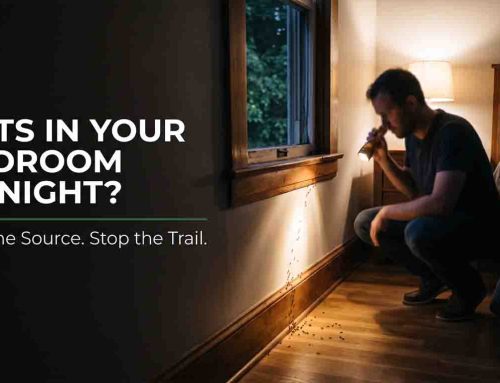
Watch for visible trails along countertops or walls, recurring activity near the sink, workers emerging from one crack or plumbing gap, activity beneath appliances and ants repeatedly returning shortly after cleaning.
Finding ants inside pantry products is another clear problem.
Follow the Traffic
Before wiping away an active trail, watch it for several minutes if practical.
Where are the workers going?
One direction may lead toward food while the opposite direction points toward the colony or building entry route.
Common kitchen access points include gaps around:
- Sink plumbing
- Windows and doors
- Baseboards
- Countertop backsplashes
- Exterior walls
- Utility penetrations
- Cabinets
- Floor-wall junctions
This is one of the simplest professional inspection principles homeowners can use successfully: let pest behavior provide evidence.
Make Sure the Insects Are Actually Ants
Correct identification should come before pesticide use.
Worker ants generally have elbowed antennae and a distinctly constricted body. Reproductive ants can have wings, which creates confusion with other insects.
If insects suddenly appear with wings around a window, use the flying ant versus wasp identification guide to narrow the possibilities.
Termites can also be mistaken for winged ants. If identification remains uncertain, save a specimen instead of guessing.
Ants vs Fruit Flies in a Kitchen
Small flying insects hovering around produce are not ants.
Fruit flies commonly become associated with fermenting organic material, including overripe fruit and food residues. Their breeding source requires a completely different control strategy.
If you see flying insects rather than a trail of crawling workers, the fruit fly authority guide is a better diagnostic starting point.
Ants vs Drain Flies and Gnats
Activity concentrated around a sink can also produce confusion.
Ants may visit a sink for water but generally approach by crawling. Drain-associated flies have different biology and may breed in organic material in suitable wet areas.
Our comparison of drain flies, gnats and fruit flies helps distinguish these common kitchen pests.
Correct identification prevents homeowners from treating an ant trail while an unrelated fly continues breeding nearby.
Why Do Ants Keep Coming Into the Kitchen?
Ants generally enter kitchens for three broad reasons: resources, access and suitable environmental conditions.
Food
An ant does not need a dirty kitchen to find food.
A few drops of a sweet drink behind an appliance, grease around a stove or crumbs beneath a toaster can be enough to support persistent foraging.
Common resources include sugar, syrup, grease, cooking oils, baked goods, pet food and improperly secured garbage.
Different ant species and colonies can favor different foods, and preferences may shift.
Water
Water is easily overlooked.
Check beneath the sink, around the dishwasher, refrigerator supply line and other plumbing. Look for condensation as well as active leaks.
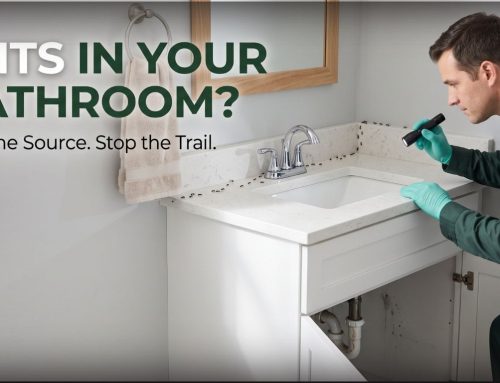
Ants around a sink do not necessarily live in the drain. It may simply be the most reliable water source available to foragers.
Access
Very small openings can provide entry.
Kitchens contain multiple utility penetrations because of plumbing, electricity and appliances. Exterior-wall kitchens also have windows, doors and building joints that can connect indoor activity with an outside nest.
Nearby Nesting Conditions
Mulch, landscaping, moisture-compromised wood, pavement edges and soil around foundations can support ant activity outside.
The most effective kitchen ant control often begins outdoors because that is where the colony or primary route may be located.
Why Are Ants a Problem in Kitchens?
Most kitchen ant infestations are primarily nuisance and sanitation concerns, but some situations deserve greater attention.
Ants moving across food-contact and preparation areas are obviously undesirable. Repeated activity also tells you that pests have a reliable route into the living space.
A persistent infestation can reveal an uncorrected building issue such as a gap or moisture source.
Carpenter ants deserve additional attention. They excavate wood to make nesting galleries rather than eating the wood, and activity may be associated with damp or compromised wooden materials.
A large dark ant is not automatically a carpenter ant. Identification needs more than color.
If large ants repeatedly appear from walls, window frames or structural areas, especially during periods when outdoor activity is low, consider a professional inspection.
How to Get Rid of Ants in the Kitchen Step by Step
A good ant-control plan should work systematically instead of treating each worker as a separate problem.
Step 1: Observe Before Cleaning
Watch the trail.
Note where ants appear, where they disappear and what they are feeding on. Take a photograph before disturbing the trail.
If activity primarily occurs at a particular time, write that down too.
Information collected now can prevent unnecessary treatment later.
Step 2: Remove Competing Food Sources
Once you understand the route, clean the kitchen thoroughly.
Pay particular attention to areas often missed during ordinary cleaning:
- Beneath the toaster and coffee equipment
- Under or beside the refrigerator
- Beneath the stove where accessible
- Pantry corners
- Pet feeding stations
- Trash and recycling areas
- Sticky bottle exteriors
- Cabinet shelves holding sugar or baking products
Store vulnerable foods in tightly closed containers.
Refrigerate suitable ripe produce when appropriate and clean spills promptly.
If flying insects remain after ant activity is addressed, investigate separate food-related pests. The guide to where fruit flies come from explains why merely killing adults does not eliminate their source.
Step 3: Remove Unnecessary Water Sources
Dry the sink and counters when practical, but concentrate on persistent moisture rather than normal kitchen use.
Repair leaking fixtures.
Check plumbing beneath cabinets for dampness or staining. A slow leak behind stored cleaning products can remain unnoticed for months.
Moisture-damaged wood should be evaluated and repaired as needed, independent of whether ants are present.
Step 4: Identify the Entry Route
Follow workers toward wall edges, windows or cabinet penetrations.
Then inspect the corresponding exterior area where possible.
The exterior trail may lead along the foundation, siding edge, utility line or vegetation.
Do not assume the first hole you find is the nest. It may simply be a doorway between a colony and the kitchen.
Step 5: Decide Whether Bait Is Appropriate
Ant bait can be useful because it works with colony behavior instead of only killing visible foragers.
Worker ants encounter the bait and, depending on the species and product, may carry food back toward other members of the colony.
The bait needs to be sufficiently attractive and appropriately placed.
Always use products exactly according to their labels, especially around kitchens, children and pets.
The EPA explains that a pesticide label provides legally enforceable use directions. More product is not necessarily more effective, and applying pesticides to unlabeled locations is not appropriate.
Step 6: Don’t Spray Around Active Bait
One frequent DIY mistake is placing bait and then spraying the workers approaching it.
A repellent product can discourage ants from accessing a bait you need them to encounter.
If baiting is the selected strategy, let that strategy work as intended and follow the manufacturer’s instructions.
Avoid mixing different pesticides or homemade chemicals.
Step 7: Monitor the Results
Ant control is not always instantaneous.
Observe whether the volume of activity changes and whether the route moves.
If ants disappear briefly and repeatedly return, reassess the source rather than continually adding more product.
Persistent failure often indicates identification, placement or source problems.
Step 8: Seal Useful Entry Points at the Right Time
Once the infestation is understood and controlled, exclusion can help reduce future access.
Appropriate targets can include deteriorated seals and unnecessary openings around utilities, doors and windows.
Do not indiscriminately plug building openings intended for ventilation or drainage.
Sealing too early can also make it harder to understand an active trail. Investigate first and coordinate exclusion with the control plan.
Kitchen Ant Bait vs Spray vs Sanitation
No single method solves every infestation.
| Method | What it does well | Main limitation |
| Cleaning/sanitation | Removes food competition and attraction | Does not necessarily affect the colony |
| Moisture correction | Removes an important resource | Does not directly eliminate established ants |
| Ant bait | Can exploit colony foraging behavior | Requires acceptance and correct placement |
| Labeled residual treatment | Can help manage selected routes or areas | Misuse may only suppress visible workers |
| Exclusion | Reduces future entry | Does not remove an existing colony by itself |
| Professional IPM | Combines identification and targeted methods | Requires access for proper inspection |
The strongest strategy often combines several methods.
That is the principle behind Integrated Pest Management, or IPM. The EPA’s Integrated Pest Management guidance describes this evidence-based approach to reducing pest problems while managing unnecessary risks.
DIY Remedies: What Should Homeowners Know?
Home remedies are popular because the ingredients are readily available, but “natural” does not automatically mean effective or harmless.
Vinegar solutions can clean some surfaces and disrupt visible trail residues, but cleaning a pheromone trail is not the same as eliminating the colony. Surface compatibility matters too.
Essential oils are another example. Some compounds can have repellent or insecticidal effects under particular conditions, but concentration, application and safety vary considerably.
Never assume an essential oil is automatically safe around pets or food.
The same applies to homemade pesticide mixtures. Do not mix chemicals simply because a social-media post recommends doing so.
For a broader discussion of what these methods can and cannot achieve, see Green Pest Management CT’s DIY and natural pest remedies guide.
Common Mistakes When Trying to Get Rid of Ants in the Kitchen
Treating before identifying the trail is the first major mistake. You lose potentially useful evidence.
The second is confusing an ant problem with a cleanliness problem. A beautifully maintained kitchen can have ants if a colony has access to water and a reliable entry path.
Another mistake is repeatedly killing workers while ignoring the colony.
Homeowners also commonly apply several different products simultaneously. One can interfere with another, particularly when a repellent is applied around bait.
Ignoring exterior conditions creates another blind spot. If workers continually travel from landscaping through a foundation gap, cleaning the countertop alone will not solve the route.
Finally, people often overlook moisture. In professional inspections, plumbing and damp structural areas can be as relevant as sugar and crumbs.
How to Prevent Ants From Coming Back
Prevention is easier when it becomes part of routine home maintenance rather than a reaction to each new ant.
Use this kitchen and perimeter checklist:
- Clean spills and food residue promptly.
- Vacuum or wipe crumbs from hard-to-reach appliance edges.
- Keep pantry food in secure containers where appropriate.
- Manage pet food and clean the feeding area regularly.
- Rinse or manage recycling that contains sugary residues.
- Repair plumbing leaks.
- Monitor dishwasher and refrigerator connections for moisture.
- Maintain door and window seals.
- Inspect appropriate utility penetrations.
- Keep landscaping from creating unnecessary direct contact with the house.
- Address damaged or persistently wet wood.
- Monitor recurring trails instead of relying exclusively on surface sprays.
These steps do more than help with ants. Removing food and moisture can reduce conditions favorable to several household pests.
Kitchen Ants and Connecticut’s Seasons
The ant problem you see in July can behave differently from the one you find in January.
Spring
Warming temperatures increase ant activity after Connecticut’s cold season. Colonies begin foraging more actively, making spring a common time to discover trails inside.
Rainfall can also change soil conditions and foraging routes.
Summer
Summer provides warm temperatures and abundant outdoor activity.
Kitchens can become especially attractive when food, sugary drinks and water are readily available. Outdoor patios and grilling areas can also support routes toward buildings.
Fall
Cooling temperatures do not immediately eliminate ant activity.
Workers can remain active while conditions permit. Fall is a useful time to maintain weather stripping, exterior seals and moisture conditions.
Winter
Consistent ant activity inside a heated Connecticut home during cold weather deserves attention.
When the outdoor environment is inhospitable, repeated indoor sightings may provide useful clues about protected nesting or structural activity.
Do not automatically assume winter ants came inside that morning.
Kitchen Ant Control in Fairfield County
Local conditions matter because Fairfield County contains a wide range of homes and landscapes.
Greenwich and New Canaan properties may have substantial landscaping and wooded edges that naturally support outdoor insect populations. The practical objective is controlling structural access rather than attempting to remove every ant from an entire property.
Stamford and Norwalk include denser residential environments as well as suburban areas. Attached or closely spaced structures can make pest source identification more complex.
Darien, Westport and Fairfield properties may combine mature landscaping, decks, patios and coastal or near-coastal humidity. Moisture deserves attention where repeated ant activity occurs near windows, kitchens or exterior walls.
Wilton’s wooded environments can also support extensive outdoor populations without those ants automatically being a structural infestation.
Across all of these communities, a property-specific inspection is more useful than assuming the same treatment should be applied to every Connecticut house.
DIY vs Professional Kitchen Ant Control
A small, recent trail connected with an obvious food source can often be investigated by the homeowner.
Professional inspection becomes more useful when the source is uncertain or the infestation persists.
Consider professional pest control when ants repeatedly return after sanitation and moisture correction, activity extends into several rooms, workers appear directly from walls, or carpenter ants are suspected.
It is also sensible when product placement is complicated by children, pets or sensitive household conditions.
Green Pest Management CT’s professional pest management service guide explains the broader benefits of inspection-led treatment.
Professional service should not simply mean applying more pesticide. A good pest-management strategy begins with identification and inspection.
What Happens During Professional Ant Treatment?
The process should begin with a discussion.
Where do you see the ants? When did they start? Are they active during particular times? Which products have already been applied?
That history matters.
Professional Inspection
A technician can inspect the active kitchen area, plumbing locations, food sources, access points and relevant exterior perimeter.
When appropriate, inspection may extend to basements, wall areas and moisture-compromised building materials.
Identification
Species or group-level identification informs treatment because ants do not all behave identically.
The technician may consider worker size, appearance, trails, nesting conditions and food preferences.
Treatment Plan
Depending on the findings, an IPM plan could include targeted baiting, appropriately labeled residual treatment, sanitation recommendations, moisture correction, exterior habitat management and exclusion.
Not every house requires every technique.
Monitoring and Prevention
The goal is sustained control rather than a short period with no visible workers.
If ants return, the location and timing of that renewed activity provide new diagnostic information.
Green Pest Management CT can help homeowners in Greenwich, Stamford, Darien, Westport, Fairfield, Wilton, New Canaan, Norwalk and surrounding Fairfield County communities identify the source and build an appropriate plan.
Pesticide Safety in a Kitchen
A kitchen requires more care than many other treatment areas because food, utensils and preparation surfaces are present.
Never assume a pesticide can be applied to counters because it is labeled for indoor use generally. The product label determines where and how it can legally and safely be used.
Remove or protect food and utensils as required by the label. Keep children and pets away according to instructions.
Store pesticides in their original containers rather than transferring them into food or beverage containers.
If exposure occurs or poisoning is suspected, follow the product’s emergency instructions and contact the appropriate medical or poison-control resources. EPA provides additional information about pesticide incidents and safety.
When Kitchen Ants May Point to a Bigger Pest Problem
Sometimes the kitchen is merely the most visible part of a larger infestation.
If ants also appear in an upstairs bathroom or bedroom, do not automatically treat each room independently. They may share a structural route.
Our main Connecticut ant location guide explains how the diagnosis changes between kitchens, bathrooms, bedrooms, yards, gardens and vehicles.
Be equally careful outdoors.
If “ants” seem to be flying repeatedly into a single ground opening, confirm their identity before approaching. Ground-nesting yellow jackets and other stinging insects need completely different safety precautions.
Green Pest Management CT’s ground-nesting wasp identification guide is a useful reference for suspicious outdoor nest activity.
Expert Advice: Treat the Colony, Conditions and Route
Successful ant management has three targets rather than one.
First is the colony. A strategy needs to account for the population producing the workers you see.
Second are the conditions. Food, moisture or favorable nesting material can support continued activity.
Third is the route. Ants need a way to move between their colony and the kitchen.
Address only one of these and the problem can recur.
This three-part model is a useful way to understand Integrated Pest Management. It also explains why two homeowners using the exact same store-bought ant product can have completely different results.
The product is only one part of the solution.
Frequently Asked Questions
What is the fastest way to get rid of ants in the kitchen?
Immediately remove accessible food and spills, but take time to observe the active trail first. For lasting control, identify the source and use an appropriately labeled colony-control strategy rather than only killing visible workers.
Why do ants keep coming back after I clean the kitchen?
Cleaning removes food but may not remove moisture, entry points or the colony itself. Ants can continue exploring a clean kitchen if they have established access or another resource such as water.
What attracts ants to a clean kitchen?
Water, pet food, hidden grease, tiny food residues and structural access can all attract or support ant activity. Some ants may also simply be traveling through the room from an established route.
Should I spray ants on my kitchen counter?
Avoid indiscriminate spraying, particularly on food-preparation surfaces. Follow pesticide labels exactly. If you are using bait, spraying ants around the bait may interfere with the strategy.
Where should I look for an ant nest in my kitchen?
Start by following workers toward their exit route. Inspect around plumbing, windows, doors, baseboards, appliances and exterior-wall penetrations. The colony may be outdoors or elsewhere in the structure rather than inside the kitchen itself.
Why are ants around my kitchen sink?
Water may be attracting them. Check for dripping fixtures, damp cabinets, dishwasher leaks and plumbing penetrations. Their presence beside the sink does not necessarily mean they are nesting in the drain.
Does vinegar get rid of kitchen ants permanently?
Vinegar can be useful for cleaning some surfaces and disturbing visible trail residues, but that does not necessarily eliminate the colony. It should not be treated as a guaranteed permanent ant treatment.
How do I know if kitchen ants are carpenter ants?
Color and size alone are not enough for reliable identification. Repeated sightings of large ants around damp wood, windows or structural voids warrant professional identification.
When should I call pest control for kitchen ants?
Call when activity repeatedly returns, appears from walls or structural areas, spreads into multiple rooms, may involve carpenter ants or continues despite reasonable sanitation, moisture correction and properly used DIY methods.
Does Green Pest Management CT provide ant inspections in Fairfield County?
Green Pest Management CT serves homeowners in Greenwich, Stamford, Darien, Westport, Fairfield, Wilton, New Canaan, Norwalk and surrounding Fairfield County communities. Contact the team to discuss persistent ant activity and schedule an appropriate inspection.
Conclusion
Learning how to get rid of ants in the kitchen starts with understanding that the insects on the countertop are usually the visible part of a larger system.
Watch where they travel before destroying the trail. Remove the food and water supporting activity. Investigate plumbing, cabinets, windows, exterior walls and utility penetrations. If bait or another pesticide is needed, select an appropriate labeled product and follow its directions rather than combining treatments at random.
Then address prevention.
A lasting ant-management strategy deals with three things together: the colony, the conditions supporting it and the route ants use to reach the kitchen.
That approach is especially useful in Connecticut, where seasonal temperatures, rainfall, humid summers, landscaping and varied Fairfield County housing can all influence ant behavior.
For a minor trail associated with a known food spill, careful DIY management may be enough. When ants repeatedly return, appear from inaccessible structural areas or suggest carpenter-ant activity, continuing to spray individual workers is unlikely to answer the important question: where are they actually coming from?
Green Pest Management CT provides inspection-led pest management for Greenwich, Stamford, Darien, Westport, Fairfield, Wilton, New Canaan, Norwalk and surrounding Fairfield County areas. If your kitchen ant problem keeps returning, schedule an inspection so the source—not only the ants you can see—can be evaluated.