Insects That Look Like Wasps: 15 Amazing Lookalikes Explained
Many insects that look like wasps cannot sting at all. Hoverflies, wasp-mimicking beetles, clearwing moths, and some other flies use colors or shapes that can closely resemble yellow jackets or hornets. Flying ants, bees, and solitary wasps cause additional confusion because they share some anatomical features with familiar social wasps.
For Connecticut homeowners, identification matters. A hoverfly feeding on flowers generally needs no control, while repeated yellow jackets entering a hole beside a walkway can indicate a defensive colony. A group of winged ants emerging indoors points to an entirely different issue.
The quickest identification clues are wings, antennae, eyes, waist shape, and behavior. True flies have one functional pair of wings; adult wasps have two pairs. Beetles have hardened front wing covers. Winged ants have elbowed antennae and a distinctive nodal waist. And repeated traffic into a fixed opening can reveal a nest even when individual insects are difficult to see.
Below are 15 common or notable wasp lookalikes, along with practical identification tips for homeowners in Greenwich, Stamford, Darien, Westport, Fairfield, Wilton, New Canaan, Norwalk, and surrounding Fairfield County.
What Are Wasp Mimics?
A wasp mimic is an insect whose appearance or behavior resembles a wasp even though it belongs to another insect group.
The resemblance is often not accidental.
One mechanism is Batesian mimicry, in which a relatively harmless species resembles an animal predators have learned to avoid. An insect without a functional sting may gain protection by looking like something that can sting.
Yellow, orange, black, reddish, and white warning patterns occur across many insect groups.
For a bird or other predator, a rough resemblance may be enough. Unfortunately for homeowners, that means color alone is a poor identification tool.
Green Pest Management CT’s complete wasp mimic and confusion guide explores this mimicry in greater depth.
Quick Identification: Is It Really a Wasp?
Before looking at individual species, compare the main insect groups:
| Feature | Wasp | True fly | Winged ant | Beetle | Moth |
| Functional wing pairs | 2 | 1 | 2 | Hind pair used for flight; hardened forewings | 2 |
| Antennae | Noticeable | Often short | Elbowed | Variable | Often prominent |
| Eyes | Moderate | Often very large | Moderate | Variable | Variable |
| Waist | Often distinctly narrow | Usually less constricted | Pinched with node(s) | Not wasp-like | Usually not wasp-like |
| Key clue | Waist + wings + behavior | Large eyes, one wing pair | Elbowed antennae | Hard wing covers | Scaled/clear wings depending on species |
Do not try to hold a live insect still so you can count its wings. Use a clear photograph taken with zoom.
Green Pest Management CT’s Connecticut wasp identification guide is useful if the insect appears to be a genuine wasp.
15 Insects That Look Like Wasps
1. Hoverflies
Hoverflies are probably the classic answer to “What bug looks like a wasp but doesn’t sting?”
Many species in the family Syrphidae display bold yellow, orange, black, or brown markings that imitate wasps or bees. Some are convincing yellow jacket lookalikes.
They cannot sting.
Many hoverflies are beneficial. Adults commonly visit flowers and contribute to pollination, while larvae of some species feed on aphids and other small insects.
Their flight provides an excellent clue. Hoverflies can remain almost stationary in the air before darting abruptly in another direction.
Look closely at a photograph and you may also see the typical fly anatomy: one functional wing pair, relatively short antennae, and large eyes.
A yellow-and-black insect hovering over flowers should therefore not automatically trigger a pesticide application.
2. Thick-Headed Flies
Thick-headed flies in the family Conopidae contain some remarkably convincing wasp mimics.
Many have elongated bodies, narrow-looking abdomens, and yellow or orange markings. Their shape can look more wasp-like than that of a typical house fly.
They are still true flies.
That means adults possess one functional pair of wings rather than the two pairs found in wasps.
Several species are associated with other insects during their immature development, and adults can be encountered around flowers.
For a homeowner, the important point is straightforward: a wasp-shaped body does not necessarily mean a stinger is present.
3. Soldier Flies
Some soldier flies have elongated bodies, dark wings, or contrasting markings that lead homeowners to mistake them for wasps.
Again, the one-pair-of-wings rule identifies them as flies.
Their behavior can also help. A soldier fly is not maintaining a paper nest full of defensive workers and will not display social-wasp colony defense.
If wasp-like flies are appearing indoors repeatedly, however, identification still matters because different fly species develop in different materials.
The fly versus gnat identification guide explains why indoor flying insects should be diagnosed by breeding source instead of appearance alone.
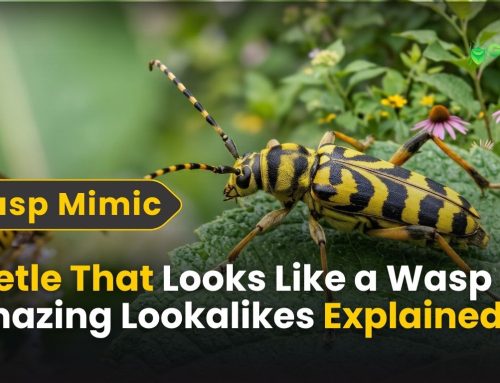
4. Wasp-Mimicking Longhorn Beetles
A beetle that looks like a wasp may be surprisingly convincing at first glance.
Some longhorn beetles have long bodies and yellow, orange, black, or reddish bands resembling wasp warning patterns. Long antennae can make the illusion even stronger.
Look at the insect’s back.
Beetles have hardened front wings called elytra. These wing covers normally meet along a line running down the middle of the back. The functional flight wings are folded underneath.
A wasp has membranous wings rather than hard beetle wing covers.
Longhorn beetles vary greatly in their biology, so finding one does not by itself indicate structural damage. Identification should precede any control decision.
5. Other Wasp-Mimicking Beetles
Longhorns are not the only beetles that can imitate wasps.
Different beetle families include species with narrow bodies, warning-like markings, and active movement that may fool a homeowner during a quick sighting.
The same structural check applies.
If the back is covered by two firm wing cases rather than exposed membranous wings, you are looking at a beetle rather than a wasp.
This is one reason pest professionals do not identify insects by color alone.
“Yellow and black” describes a visual pattern, not a biological category.
6. Winged Ants
Flying ant vs. wasp is one of the more important residential identification questions because a mistake can change the entire pest-control strategy.
Ant colonies periodically produce winged reproductive males and females, called alates. During dispersal, these insects may appear suddenly around windows, foundations, siding, landscaping, or indoor rooms.
Their wings and narrow body can suggest a small wasp.
The antennae provide a strong clue.
Winged ants have distinctly elbowed antennae. Their waist also contains one or more characteristic nodes.
True wasps have a different waist structure and do not possess the distinctly elbowed ant antennae.
Why indoor winged ants matter
One winged ant outdoors may simply be participating in a natural dispersal event.
Numerous winged ants repeatedly emerging from a wall, window area, trim, or another interior location can justify professional inspection for the source.
Spraying the visible alates without understanding where they came from may not address the underlying colony.
7. Termite Swarmers
Termites do not resemble wasps as closely as hoverflies do, but homeowner identification often moves through the same chain: “Is that a wasp, flying ant, or termite?”
Termite reproductives have two pairs of wings of roughly similar length, relatively straight or bead-like antennae, and a body without the strongly pinched ant or wasp waist.
Winged ants have elbowed antennae, a constricted waist, and front wings larger than their hind wings.
This distinction deserves attention because a termite swarming event associated with a building can carry very different property implications from an outdoor wasp sighting.
If numerous winged insects appear indoors, save a dead specimen or take clear photographs for identification.
8. Clearwing Moths
Some clearwing moths are impressive wasp mimics.
Instead of the broad, obviously scaled wings people associate with moths, their wings may contain transparent areas. Combine those with narrow bodies and yellow, black, orange, or reddish coloration and the result can look remarkably wasp-like.
Moths belong to the order Lepidoptera, however, and have different wing structure, antennae, and life cycles.
Certain clearwing moth larvae develop in plant tissue or wood associated with specific host plants. Accurate identification therefore may point toward a plant-health concern rather than a stinging-insect problem.
9. Carpenter Bees
A large carpenter bee flying around a deck or roofline is frequently called a hornet.
The confusion becomes stronger because male carpenter bees may hover around wood, approach people, and appear territorial.
There is an important safety detail: male carpenter bees cannot sting.
Females can sting but generally do so only when handled or seriously provoked.
Carpenter bees typically have robust bee-like bodies and are associated with nesting tunnels excavated in wood. They do not build a social paper hornet nest.
Use the hornet versus carpenter bee identification guide if large insects are hovering around exterior wood.
10. Bumblebees
Bumblebees can also be mistaken for large wasps or hornets from a distance.
Most are noticeably hairier and more robust than yellow jackets and hornets. Their fuzzy body helps collect pollen.
Bumblebees are social bees and females can sting, so they should not be treated as harmless flies. However, their nesting behavior and ecology differ from those of social wasps.
For side-by-side characteristics, see Green Pest Management CT’s bumblebee versus hornet identification guide.
11. Honey Bees
Yellowish or golden coloration can cause honey bees and yellow jackets to be confused, especially when insects are moving quickly around food or flowers.
Honey bees tend to appear hairier and more muted in coloration than the sharp, bright markings typical of many yellow jackets.
Their sting biology also differs.
A worker honey bee typically leaves its barbed stinger in human skin, whereas wasps such as yellow jackets can generally sting repeatedly.
Bees are important pollinators, making correct identification especially important before pest-control decisions.
The bee versus wasp identification guide covers these distinctions.
12. Bee Flies
Bee flies are another true-fly group that may be confused with bees or wasps.
Many have fuzzy bodies and hover around flowers. Their flight can look purposeful and their long mouthparts may appear intimidating.
They are not hornets.
As true flies, they have one functional pair of wings. A clear photograph often shows the large eyes and body characteristics that separate them from Hymenoptera.
They illustrate why “bugs that look like wasps” is really a broad identification problem involving many insect orders.
13. Robber Flies
Robber flies are predatory flies that capture other insects.
Some are large, fast, and intimidating. Certain species mimic bees or wasps in shape or coloration.
Their strong flight can cause people to mistake them for hornets.
Despite their predatory behavior toward other insects, they are flies, not social wasps. They do not establish defensive paper colonies.
They should still not be handled. Many predatory insects can defend themselves if physically restrained.
For a homeowner, however, a robber fly passing through the landscape generally does not require the response appropriate for a yellow jacket nest.
14. Cicada Killers
Cicada killers are an important twist because they are actually wasps—but homeowners commonly confuse them with hornets or yellow jackets.
These large solitary wasps nest in soil and provision their offspring with cicadas.
Their size makes them look dangerous. Their social behavior tells a different story.
Unlike yellow jackets, cicada killers do not operate as a large defensive worker colony. Males can patrol nesting areas conspicuously but cannot sting. Females can sting, although they generally avoid doing so unless handled or severely provoked.
If large wasps are flying over bare soil or lawn edges, use the ground-nesting wasp identification guide rather than assuming there is a yellow jacket colony.
15. Parasitoid Wasps
Some genuine wasps look so unusual that people assume they must belong to another insect group.
Parasitoid wasps can be tiny, extremely slender, or equipped with very long ovipositors.
That long structure is often mistaken for an enormous stinger. In many species, however, its purpose is to deposit eggs in or on hosts, sometimes through wood or plant material.
Many parasitoid wasps present little practical sting risk to humans and are beneficial natural enemies of other insects.
The parasitoid wasp information hub provides a closer look at their biology, while the non-stinging wasp guide explains human sting risk.
What Real Wasp Activity Looks Like
Individual appearance is only part of identification. Behavior around a nest can be even more useful.
Experienced pest professionals pay particular attention to repeated directional flight.
One yellow-and-black insect visiting a flower tells you relatively little. Many similarly sized insects repeatedly disappearing into the same siding gap, ground hole, soffit, tree cavity, or shrub strongly suggest nesting activity.
Watch from a safe distance for traffic around rooflines, decks, exterior wall gaps, stone walls, lawn openings, sheds, hollow trees, and dense landscaping.
Do not stand at the entrance to count insects.
If you suspect an active colony, the wasp and hornet Safety & Threat Assessment can help determine the appropriate next step.
Flying Ant vs. Wasp: Quick Answer
For an at-a-glance comparison:
| Feature | Flying ant | Wasp |
| Antennae | Elbowed | Usually not distinctly elbowed |
| Waist | Constricted with node(s) | Narrow but differently structured |
| Wings | Front pair larger | Two pairs; proportions vary |
| Colony | Ant colony | Solitary or social depending on wasp |
| Typical concern | Ant colony/source | Sting risk depends on species/nest |
Do not confuse either one with termite swarmers, which have straighter antennae and a less constricted waist.
Horse Fly vs. Hornet: Quick Answer
Horse flies and hornets can both be large and noisy, but they are anatomically very different.
A horse fly has one functional pair of wings and conspicuously large compound eyes. Female horse flies of blood-feeding species bite using specialized mouthparts.
A hornet is a social wasp with two pairs of wings. Female workers sting with a venom-injecting stinger.
Horse flies do not build social paper hornet nests.
If you are trying to identify a biting fly, Green Pest Management CT’s yellow fly versus deer fly guide provides additional comparisons.
Why So Many Bugs Look Like Wasps
Mimicry gives vulnerable insects a potential survival advantage.
Predators can learn that certain colors or body patterns are associated with insects capable of defending themselves. Harmless organisms displaying similar warning patterns may be attacked less frequently.
This explains why unrelated flies, moths, and beetles repeatedly converge on wasp-like appearances.
From a pest-control perspective, this biological strategy creates a practical problem: visual similarity does not mean two insects have similar behavior, nesting habits, hazards, or treatment requirements.
That is why Integrated Pest Management begins with identification.
The EPA’s Integrated Pest Management guidance describes the broader approach of using pest biology, monitoring, prevention, and appropriate controls to manage problems while reducing unnecessary interventions.
Risks of Misidentifying Wasp Lookalikes
Misidentification can create two opposite problems.
First, homeowners may unnecessarily kill beneficial insects. Hoverflies, bees, parasitoid wasps, and solitary predatory wasps can contribute to pollination or natural pest suppression.
Second, a genuine social-wasp colony can be underestimated.
Mistaking yellow jackets for harmless flies near a ground hole can lead someone to walk directly into a defensive zone.
Misidentifying activity inside siding can also lead to another common mistake: sealing an entrance while a social-wasp colony remains active within the structure. Trapped workers can potentially seek alternate routes.
Correct identification protects both people and beneficial organisms.
Prevention Tips for Wasps and Other Problem Flying Insects
Prevention depends on the insect involved, so there is no universal treatment for everything that resembles a wasp.
For actual social-wasp problems, homeowners can reduce food sources by keeping garbage containers closed and cleaning outdoor food and sugary drink spills.
Monitor eaves, sheds, railings, decks, play structures, and other protected sites for early nest construction.
Before mowing or trimming around an unfamiliar patch of insect activity, observe it from a distance.
Repair suitable structural gaps when you have confirmed they are inactive. Do not seal active wasp entry points without a control plan.
For general wasp prevention, Green Pest Management CT’s hornet and wasp control guide provides additional homeowner strategies.
DIY Identification vs. Professional Inspection
DIY identification works best with a good photograph and safe observation.
Take photos using zoom rather than moving close to a suspected colony. Note the insect’s approximate size, colors, flight behavior, and where it repeatedly goes.
Look at the wings, antennae, eyes, and waist in the photograph.
Professional inspection becomes worthwhile when many insects emerge inside the home, activity repeatedly leads to one structural opening, a ground colony is beside a high-use area, or species identification remains unclear.
A household member with a serious insect-venom allergy is another reason to avoid experimental DIY nest identification.
Green Pest Management CT’s flying insect control service guide explains how identification affects the treatment strategy.
How Professional Pest Identification Works
Professional inspection starts with evidence rather than assumptions.
A technician may evaluate the insect’s anatomy, flight path, nest or breeding evidence, entry locations, time of activity, property conditions, and where insects are concentrated.
The solution follows the identification.
A hoverfly outdoors may require no treatment. Winged ants emerging indoors call for assessment of the ant source. A fly problem may require finding breeding material. A genuine yellow jacket colony may require targeted nest treatment.
This is Integrated Pest Management in practical form: identify, assess risk, choose the least disruptive effective response, and address conducive conditions where possible.
If treatment uses pesticides, products must be used according to their labels. Homeowners can review the EPA’s consumer guidance on safe pest control.
Seasonal Information for Connecticut
Connecticut seasons strongly affect which lookalikes are visible.
In spring, social-wasp queens start colonies while carpenter bees, ants, and other insects become increasingly active. Winged ants can appear during appropriate environmental conditions.
By summer, Fairfield County landscapes support abundant insect activity. Hoverflies visit flowers, solitary wasps hunt, moths and beetles emerge, and social-wasp colonies grow.
Late summer into early fall is particularly important for wasp identification because mature yellow jacket and hornet colonies can overlap with high outdoor activity around patios, pools, lawns, and cookouts.
Cold weather dramatically reduces outdoor flying-insect activity. Persistent insects appearing indoors during winter deserve identification based on their actual source rather than assumptions about outdoor wasps.
Local Wasp Lookalikes in Fairfield County
The variety of properties across Fairfield County creates plenty of opportunities for mistaken identification.
Greenwich, Wilton, and New Canaan have many wooded and landscaped properties where mature trees, flowers, soil, and structural wood support diverse insect life.
Darien, Westport, and Fairfield homes often combine landscaped yards with decks, pools, sheds, outdoor dining areas, and flowering plants—all places where bees, wasps, flies, and mimics may cross paths with people.
Stamford and Norwalk include everything from dense residential areas to wooded suburban properties, so a wasp-like insect might be associated with flowers, exterior construction, wall voids, soil, garbage, or nearby vegetation.
Green Pest Management CT uses the same principle across all these communities: identify the insect before deciding whether pest control is appropriate.
Common Mistakes to Avoid
Avoid identifying an insect from color alone. Yellow-and-black coloration appears in many unrelated species.
Do not swat or spray beneficial flower visitors merely because they resemble yellow jackets.
Never stand over a ground hole or climb a ladder to obtain a closer picture of a suspected nest.
Do not seal a structural opening if active social wasps are using it.
And avoid trying to prove that a mysterious insect is harmless by catching it in your hand. Some low-aggression solitary wasps are still capable of stinging when restrained.
For difficult nest situations, the DIY versus professional hornet removal guide explains when distance is the safer option.
Frequently Asked Questions
What insects look like wasps but cannot sting?
Hoverflies are a common example. Some wasp-mimicking beetles, clearwing moths, and other true flies also resemble wasps without possessing a wasp stinger.
What is the easiest way to tell a hoverfly from a wasp?
Look for one functional pair of wings, very large fly-like eyes, relatively short antennae, and characteristic hovering. Wasps have two pairs of wings and generally more conspicuous antennae.
What beetle looks like a wasp?
Several longhorn beetles and other beetle species display wasp-like body shapes and yellow, orange, or black markings. Hardened front wing covers reveal that they are beetles rather than wasps.
How can I tell a flying ant vs. wasp?
Flying ants have elbowed antennae and a distinctly nodal waist. Wasps have a different waist structure and typically lack the strongly elbowed ant antennae.
How do I tell a horse fly vs. hornet?
Horse flies have one functional pair of wings and very large eyes. Female horse flies bite. Hornets have two pairs of wings, more obvious antennae, and female workers can sting.
Are bugs that look like wasps dangerous?
Some are harmless, some can bite, and some are genuine stinging insects. Identification matters. Hoverflies pose essentially no sting risk, while yellow jackets can defend an active colony.
Why would an insect evolve to look like a wasp?
Wasp-like coloration can discourage predators. A harmless insect may gain protection when predators mistake it for a species capable of delivering a painful sting.
What does repeated wasp-like activity at one hole mean?
Numerous insects repeatedly entering the same opening can indicate a colony or nesting site. Keep your distance until the insect is identified because underground yellow jackets can defend their nest vigorously.
Should I spray an insect if I think it is a wasp?
Not based on appearance alone. Identify the insect and determine whether it poses an actual pest or safety problem first. Many wasp lookalikes are beneficial.
When should I call a professional for wasp-like insects?
Professional inspection is useful when many insects repeatedly use one structural or ground opening, insects emerge indoors, a suspected social-wasp nest is near people, or safe identification is not possible.
Conclusion: Identify Insects That Look Like Wasps Before Treating Them
Insects that look like wasps include far more than yellow-and-black flies. Hoverflies, thick-headed flies, soldier flies, longhorn beetles, flying ants, clearwing moths, carpenter bees, bumblebees, honey bees, bee flies, robber flies, and other insects can all create confusion.
Some cannot sting. Others can bite. Some are beneficial pollinators or predators. And several are genuine wasps with very different behavior from defensive yellow jacket or hornet colonies.
Use anatomy and behavior together: check wing structure, antennae, eye size, waist shape, body covering, flight pattern, and nesting evidence. Most importantly, watch from a safe distance for repeated traffic into one location.
For homeowners in Greenwich, Stamford, Darien, Westport, Fairfield, Wilton, New Canaan, Norwalk, and surrounding Fairfield County, Green Pest Management CT can provide a professional flying-insect identification and pest-control inspection when an unknown wasp-like insect is appearing repeatedly or a suspected colony is too close to people for safe DIY identification.