Types of Wasp Nests: All Shapes & Materials Explained
You Found a Nest But What Kind Is It?
Picture this: You’re trimming hedges in your backyard in Westport, CT, and suddenly you hear a low, angry buzzing. You pull back a branch and come face-to-face with a large, papery gray structure hanging just inches from your face. Your heart races. Is it a beehive? A hornet nest? A wasp nest?
This happens to homeowners across Greenwich, Stamford, Darien, New Canaan, Wilton, and Westport, Connecticut every single spring and summer. And the problem isn’t just startling it’s dangerous.
Here’s the truth: not all wasp nests look the same, and not all of them are in the same locations. Some hang from eaves, some hide underground, some cling to your walls inside mud tubes. Knowing exactly what you’re dealing with is the first step to staying safe and taking action before a small problem turns into a full-blown infestation.
In this guide, we’ll break down every major type of wasp nest, explain what they look like, where they’re found, who builds them, and what you should do when you discover one.
Don’t wait until someone gets stung. Contact Green Pest Management CT for a professional nest inspection today.
Why Identifying Types of Wasp Nests Matters
Before you grab a can of spray or a garden hoe, you need to understand exactly what type of nest you’re dealing with. Here’s why it matters:
- Different species build different nests — and some are far more aggressive than others
- Location determines danger level — a ground nest is easier to disturb accidentally
- Nest size tells you colony size — larger nests = larger colonies = greater risk
- Treatment methods vary by nest type and location
According to the CDC, stinging insect attacks send over 500,000 people to emergency rooms every year in the United States. Many of those incidents happen because someone disturbed a nest without knowing what species they were dealing with.
For a comprehensive look at wasp and hornet behavior and identification, check out the Wasp & Hornet Behavior Hub it’s packed with expert information to help you make smart decisions.
The Main Types of Wasp Nests (And Who Builds Them)
1. Paper Wasp Nests Open Comb, Umbrella Shape
What does a paper wasp nest look like?
If you’ve ever seen a small, gray, honeycomb-like structure hanging from your porch ceiling, fence post, or under a window sill — that’s almost certainly a paper wasp nest.
Key characteristics:
- Open-faced with visible hexagonal cells (no outer envelope)
- Umbrella or upside-down cone shape
- Attached by a single stalk (petiole)
- Gray or tan in color, made from chewed wood fiber
- Usually small — roughly the size of a tennis ball to a fist
- One layer of comb, completely exposed
Where are they found?
- Under eaves, deck railings, porch ceilings
- Inside garages and sheds
- Behind shutters or inside grills
Who builds them?
Paper wasps (genus Polistes) are the architects. They chew wood fiber, mix it with saliva, and create that distinctive papery material. They’re semi-social insects and usually less aggressive than yellow jackets — but they will sting if their nest is threatened.
For a deep dive into what exactly a paper wasp nest looks like and where they tend to build, visit our Paper Wasp Nest: What It Looks Like & Where guide.
2. Ground Wasp Nests Hidden Danger Underfoot
What types of wasps live in the ground?
This might surprise you: some of the most dangerous wasp nests are completely invisible from the surface. Ground wasp nests are built below the soil, often using existing rodent burrows or natural voids.
Key characteristics:
- Entrance is a small hole in the ground (about the size of a nickel)
- No visible structure above ground
- Can house thousands of wasps in peak season
- Disturbing them — even by mowing the lawn — can trigger a massive attack
Common ground-nesting wasps:
- Yellow jackets (Vespula and Dolichovespula species) — most common in CT
- Eastern cicada killer wasps — large but mostly non-aggressive
- Ground hornets (European hornets occasionally)
- Digger wasps
If you’re trying to identify a ground nest, you’ll want to look at our detailed Ground Wasp Nest Pictures: ID & What To Do page for visual guidance.
Never pour water or gasoline into a ground nest. It doesn’t eliminate the colony and creates serious safety hazards. Call a professional.
For specific treatment options, our Ground Hornet Treatment in CT page covers expert-level approaches used by licensed pest management professionals.
3. Mud Wasp / Mud Dauber Nests Pipe-Organ Architecture
Mud dauber nests are some of the most distinctive types of wasp nests you’ll encounter. These are built by solitary wasps, meaning there’s no colony just a single female constructing and provisioning her nest.
Key characteristics:
- Cylindrical tubes of dried mud, often stacked side by side (resembling an organ pipe)
- Found on walls, under eaves, inside barns, garages, and attics
- Brown or gray mud color
- Usually 1–4 inches long per tube
- No aggressive colony inside — these nests are mostly abandoned after eggs hatch
Are mud dauber nests dangerous?
Mud daubers are remarkably docile. They rarely sting humans. However, their abandoned nests are sometimes taken over by more aggressive species like paper wasps.
Types of mud daubers in CT:
- Black and yellow mud dauber (Sceliphron caementarium)
- Blue mud dauber (Chalybion californicum)
- Organ-pipe mud dauber (Trypoxylon politum)
4. Honeycomb-Style Nests Layered and Enclosed
When people think of a “wasp nest”, they often picture the large, gray, football-shaped structures with a papery outer shell. These are enclosed honeycomb nests — the signature architecture of yellow jackets, bald-faced hornets, and European hornets.
Key characteristics:
- Layered internal combs surrounded by a thick papery envelope
- Can grow to the size of a basketball or larger by late summer
- Made from chewed wood pulp — weathered gray color
- Entrance hole at the bottom
- Can house 1,000 to 15,000+ workers depending on species and season
Who builds them?
- Bald-faced hornets build large, teardrop-shaped aerial nests
- Yellow jackets build similar nests both aerially and underground
- European hornets build nests inside tree cavities or wall voids
This type of nest is the most likely to produce severe stinging incidents because of the large colony size and high aggression level. For more on how to distinguish these, see our Hornet Nest vs Wasp Nest: Key Differences guide.
5. Tree Nests Camouflaged in Plain Sight
Tree nests are essentially the enclosed honeycomb nests we just described — but built within the branches or hollow trunks of trees. They’re common in wooded areas across Darien, New Canaan, and Wilton, CT.
Key characteristics:
- Attached to tree branches, often 10–30 feet off the ground
- Gray, papery exterior blends with bark and leaves
- Can be hard to spot until late fall when leaves drop
- Bald-faced hornets are the most common builder of aerial tree nests
Why tree nests are especially dangerous:
- High placement makes DIY removal extremely risky
- Vibrations from nearby activity (lawn mowers, leaf blowers) can trigger attacks
- Children playing nearby are at significant risk
Our Bald-Faced Hornet Identification & Removal guide explains exactly what to look for and what to do when you find one of these nests.
6. Wall Nest / Void Nest The Hidden Time Bomb
One of the most underestimated and dangerous types of wasp nests is the wall void nest. These are built inside walls, attics, ceiling cavities, or crawlspaces — completely out of sight.
Key characteristics:
- No visible nest from outside — only entry/exit activity near gaps or cracks
- Can grow to enormous size over a season (filling entire wall cavities)
- Common in older homes in Stamford and Greenwich, CT
- Most often built by yellow jackets or European hornets
Warning signs of a wall nest:
- Wasps entering and exiting through a gap in siding or a crack near window frames
- A faint buzzing sound inside a wall
- Wasp activity concentrated near one area of your home’s exterior
Why DIY fails here: Spraying into the entry hole without knowing nest location can force wasps through walls and into your living space. This is a job for professionals.
Learn more about the Difference Between a Wasp and Hornet Nest to better understand what you might be dealing with inside your walls.
7. Funnel-Shaped Nests The Wasp Nest With a Funnel
What is a wasp nest with a funnel?
Funnel weaver spiders are often confused with wasps, but there are actual wasp species that create funnel-like nest openings particularly yellow jackets building ground nests with distinctive funnel-shaped entrances, and some paper wasp variations.
Key characteristics:
- Narrowing, tube-like entrance (funnel shape) at ground level or in structures
- Often seen in yellow jacket ground nests
- The funnel acts as both entrance and defensive bottleneck
- Surrounding grass or soil shows signs of wear from heavy traffic
If you’re spotting a funnel at ground level with heavy insect activity, treat it as a yellow jacket nest and stay well back.
Wasp Nest Identification Chart
Use this quick-reference table to identify the types of wasp nests by appearance and location:
| Nest Type | Shape | Material | Location | Colony Size | Aggression |
| Paper Wasp | Open comb, umbrella | Chewed wood pulp | Eaves, railings, porches | 20–75 | Moderate |
| Yellow Jacket (aerial) | Enclosed, layered | Chewed wood pulp | Trees, shrubs, eaves | 1,000–5,000 | Very High |
| Yellow Jacket (ground) | Hidden, layered | Chewed wood pulp | Underground | 1,000–15,000 | Extremely High |
| Bald-Faced Hornet | Large, teardrop | Chewed wood pulp | Trees, buildings | 400–700 | Very High |
| European Hornet | Enclosed | Chewed wood pulp | Trees, wall voids | 200–400 | High |
| Mud Dauber | Tubes of mud | Dried mud | Walls, under eaves | Solitary | Very Low |
| Funnel (ground) | Funnel entrance | Soil/pulp | Underground | 500–5,000 | Extremely High |
For a more comprehensive chart, visit our Wasp Nest Identification Chart — it covers every species found in Connecticut.
Hornet Nest vs Wasp Nest What’s the Difference?
This is one of the most-asked questions we hear from homeowners in Stamford and Greenwich, CT.
Here’s the quick answer:
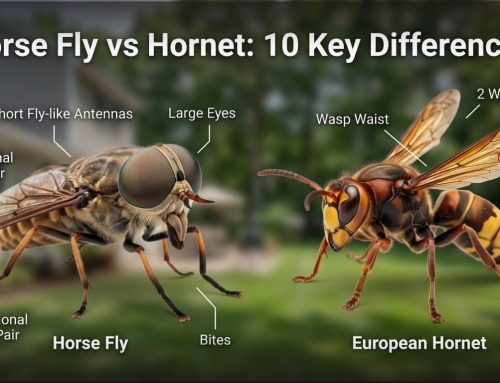
All hornets are wasps, but not all wasps are hornets. “Hornet” refers specifically to larger wasp species primarily the bald-faced hornet and European hornet in Connecticut.
| Feature | Wasp Nest (General) | Hornet Nest |
| Size | Small to medium | Large to very large |
| Shape | Open comb or enclosed | Always enclosed |
| Color | Gray/tan | Gray/brown |
| Location | Varied | Elevated or in cavities |
| Aggression | Moderate to high | High to very high |
For the full breakdown, read our Hornet Nest vs Wasp Nest: Key Differences article and the Wasps vs Hornets CT: Differences & Dangers guide.
Bee Hive vs Wasp Nest Don’t Make This Dangerous Mistake
How do you tell a bee hive vs wasp nest apart?
Misidentifying a beehive as a wasp nest (or vice versa) can lead to the wrong treatment approach — and serious consequences.
| Feature | Bee Hive | Wasp Nest |
| Material | Beeswax (yellow/golden) | Paper pulp (gray/tan) |
| Texture | Smooth, waxy | Rough, papery |
| Shape | Oval combs | Layered or open comb |
| Location | Tree hollows, wall voids | Eaves, ground, trees |
| Stickiness | Sticky (honey inside) | Dry |
Bees are protected pollinators if you find a bee hive, contact a local beekeeper rather than an exterminator. For more detailed identification help, see our Bee Hive vs Wasp Nest: How to Tell Apart guide, and for bee vs wasp ID overall, visit Bee vs Wasp Identification: How to Tell.
Where Are Wasps Nesting in Connecticut Right Now?
In Greenwich, Stamford, Darien, New Canaan, Wilton, and Westport, the peak season for wasp nest growth runs from June through September. Here’s where to check around your property:
Exterior locations:
- Under deck railings and porch rooflines
- Inside outdoor light fixtures
- Behind shutters and inside window frames
- Attic vents and soffits
- Tree branches and hollow trunks
- Soil near driveways, gardens, and lawn edges
Interior locations:
- Wall voids near exterior walls
- Attic spaces
- Inside unused equipment or vehicles in the garage
Pro Tip: Early morning and late evening are the best times to observe nest activity without provoking the colony wasps are less active in low temperatures. Learn more in our When Are Wasps Least Active? guide.
Why DIY Wasp Nest Removal Often Fails
We understand the temptation. You see the nest, you grab the spray can, and you go for it. Here’s why that approach often makes things worse:
- You don’t eliminate the queen — the colony rebuilds
- Aerosol sprays have limited range — large or hidden nests are untreatable this way
- Ground nests require deep treatment — surface sprays only agitate the colony
- Protective gear matters — most homeowners simply don’t have it
- Timing is critical — treating at the wrong time of day can trigger mass attacks
According to Wikipedia’s entry on Vespidae, yellow jackets and hornets can sting multiple times, unlike honey bees — making a failed nest removal attempt potentially life-threatening for someone with allergies.
For an honest comparison of your options, read our Hornet Nest Removal: DIY vs Professional guide.
Real Situations From Connecticut Homeowners
“I noticed a small paper wasp nest on my porch in Darien in June. I figured it was small enough to ignore. By August, it had grown to the size of a grapefruit and the wasps were getting aggressive every time we used the back door. Green Pest Management came out, took care of it safely, and I haven’t had a problem since.”
Homeowner, Darien, CT
“We had a ground nest in our backyard in Wilton that we didn’t even know about until my son stepped near it while playing. We called immediately and the technician found a massive yellow jacket colony just a foot underground.”
Parent, Wilton, CT
“The buzzing sound inside my wall in Stamford turned out to be a European hornet nest. I never would have guessed. The professionals treated it without damaging my walls and sealed the entry point.”
Homeowner, Stamford, CT
Pro Tips: What to Do When You Find a Wasp Nest
DO:
- Observe from a safe distance (at least 10–15 feet)
- Note the location, shape, and entry/exit points
- Check the Wasp & Hornet ID Encyclopedia Connecticut to try to identify the species
- Call a professional for any nest larger than a golf ball or located in a high-traffic area
- Keep children and pets away from the area immediately
DON’T:
- Swat at wasps near a nest
- Use water to flood a ground nest
- Block the entrance/exit of a wall nest
- Attempt removal without proper protection
- Ignore the nest and hope it goes away (colonies grow rapidly)
For immediate help in Connecticut, our Immediate Hornet Control in CT service is available when situations are urgent.
When a Nest Becomes an Emergency
Some situations require you to act right now, not tomorrow:
- Someone in your household is allergic to stings
- The nest is inside your home (wall void, attic)
- Children or pets have been near the nest
- The nest is at or near ground level in a high-traffic area
- The colony has been disturbed and wasps are aggressive
In these cases, do not wait. Visit our Hornet Exterminator Services page or contact our team directly for fast, professional response throughout Fairfield County and Hartford County, CT.
Also review our Hornet Control Guide: 15 Expert Tips while you wait — knowledge protects you.
FAQ Section Types of Wasp Nests
What are the most common types of wasp nests found in Connecticut?
In CT, the most common types of wasp nests include paper wasp nests (open comb, under eaves), yellow jacket ground nests (hidden underground), bald-faced hornet nests (large, enclosed, in trees), and European hornet nests (inside wall voids or tree cavities).
How do I identify a ground wasp nest?
Look for a small hole in the soil (about the size of a nickel) with high insect traffic — wasps flying in and out rapidly. There’s usually no visible above-ground structure. Yellow jackets are the most common ground-nesting wasp in Connecticut. See Ground Hornets: Identification & Treatment for more detail.
What does a paper wasp nest look like?
A paper wasp nest looks like an open, gray or tan honeycomb hanging from a single stalk. It has no outer covering, so the individual cells are clearly visible. It resembles an upside-down umbrella and is usually smaller than a fist.
What’s the difference between a hornet nest and a wasp nest?
Hornet nests are typically larger, always enclosed in a papery outer shell, and built by hornets (bald-faced or European). Wasp nests vary widely — they can be open-faced (paper wasps), underground (yellow jackets), or enclosed (yellow jackets, hornets). Visit our Wasp vs Hornet in CT Comparison Hub for the full breakdown.
Is a mud dauber nest dangerous?
No — mud daubers are solitary, non-aggressive wasps. Their mud tube nests rarely contain an active colony by the time you find them. However, abandoned mud dauber nests can be claimed by paper wasps, so don’t assume the nest is harmless without checking for activity.
What time of year are wasp nests most dangerous in CT?
Late summer (July–September) is when wasp nests are at peak size and colony populations are highest. Yellow jacket colonies in particular become more aggressive in late summer as natural food sources decline. Learn about the Wasp Lifespan & Lifecycle to understand seasonal behavior.
Should I remove a wasp nest myself or call a professional?
For small, accessible paper wasp nests with fewer than 10–20 workers, careful DIY treatment may be possible. For anything underground, inside walls, larger than a baseball, or near high-traffic areas, always call a professional. The risk of serious stinging incidents is simply too high for most homeowners to manage safely.
Take Action Before the Nest Gets Bigger
Here’s the reality: a wasp colony that starts with a single queen in April can grow to thousands of workers by August. What looks like a small problem today is a genuine hazard by the height of summer.
If you’ve spotted any of the types of wasp nests described in this guide whether it’s a tiny paper wasp nest on your porch, a suspicious hole in your lawn, or suspicious buzzing inside your walls don’t wait.
Green Pest Management CT serves homeowners throughout Greenwich, Stamford, Darien, New Canaan, Wilton, Westport, and surrounding communities with professional, safe, and effective wasp and hornet nest removal.
We identify the exact species, locate the full nest structure, apply targeted treatment, and help you prevent re-nesting all with products that are safe for your family and pets.
Contact Green Pest Management CT today and get professional protection for your home this season.
Also explore:
- Types of Wasps Explained: How to Identify
- Yellow Jacket Deep Dive: Everything You Need to Know
- How to Get Rid of Hornets: Nest Removal Guide
- Wasp vs Hornet vs Yellow Jacket: Full Comparison
Stay safe. Stay informed. And when in doubt — call the professionals.