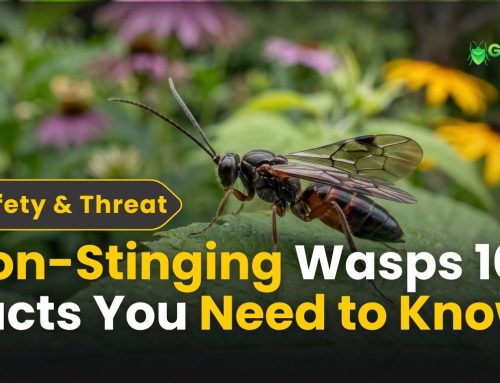
Hornet vs Carpenter Bee: How to Tell Them Apart
Introduction: That Big Buzzing Bug Is It a Hornet or a Carpenter Bee?
You’re enjoying your backyard in Westport or watering your garden in Darien when a large, buzzing insect hovers right in your face. Your first instinct? Run. But before you panic or reach for a can of spray, it helps to know exactly what you’re dealing with — because a hornet and a carpenter bee require very different responses.
Hornet vs Carpenter Bee are both large, intimidating insects, and they’re commonly confused by homeowners throughout Fairfield County. But they behave differently, nest differently, and pose different risks. Misidentifying one for the other can lead to the wrong treatment — or worse, leaving a real problem untreated.
In this guide, you’ll learn exactly how to tell a hornet apart from a carpenter bee, what each insect does to your property, when to worry, and when it’s time to stop guessing and call a professional.
What Is a Hornet?
A hornet is a type of social wasp belonging to the genus Vespa or, in North America, the genus Dolichovespula. Unlike solitary insects, hornets live in colonies that can number in the hundreds sometimes thousands of workers. Each colony is governed by a queen, and the workers are fiercely protective of their nest.
In Connecticut, the two most commonly encountered hornets are:
- The Bald-Faced Hornet (Dolichovespula maculata) — technically a yellowjacket relative, but widely called a hornet due to its size and aggressive behavior
- The European Hornet (Vespa crabro) — the only true hornet species established in the United States
Both species build paper nests from chewed wood fibers, and both will sting repeatedly if they feel their colony is threatened. If you’ve spotted a football-shaped gray nest hanging from a tree, eave, or shed in Greenwich or Norwalk, there’s a strong chance you’re looking at a bald-faced hornet nest. You can learn more about bald-faced hornet identification and removal and compare how different hornet nests differ from wasp nests.
What Is a Carpenter Bee?
Carpenter bees (Xylocopa species) are large, solitary bees that are often mistaken for bumblebees or hornets because of their size. However, they’re a completely different type of insect with a completely different lifestyle.
Unlike hornets, carpenter bees don’t live in colonies. Each female drills her own individual tunnel into untreated or weathered wood, creating a gallery where she lays her eggs. They’re called carpenter bees precisely because of this wood-boring behavior they’re essentially the contractors of the insect world, building their own nurseries from scratch.
The males are frequently seen hovering aggressively near wood surfaces, which can be alarming. But here’s the thing: male carpenter bees have no stinger. Their intimidating hovering behavior is all bluff. Females can sting, but they almost never do unless physically handled.
Hornet vs Carpenter Bee: Side-by-Side Comparison
This is the question most homeowners in Stamford, Wilton, and New Canaan are really asking when they come across a large flying insect near their home. Here’s a clear breakdown:
| Feature | Hornet | Carpenter Bee |
| Size | ¾ inch to 1½ inches | ½ inch to 1 inch |
| Body Shape | Slender, defined waist | Robust, rounded abdomen |
| Color | Black and white OR yellow and brown | Black with yellow thorax; shiny black abdomen |
| Abdomen | Banded markings | Mostly shiny and hairless |
| Nesting | Paper nests in trees, eaves, walls | Tunnels in wood |
| Colony | Social — hundreds of workers | Solitary — one bee per tunnel |
| Aggression | Highly aggressive near nest | Males bluff, females rarely sting |
| Sting Risk | High — can sting multiple times | Low — females only, rarely |
| Wood Damage | No | Yes — structural damage over time |
| Threat Level | Medical risk, especially if allergic | Property damage risk |
How to Identify a Hornet by Appearance
If you’re trying to make a quick identification in your backyard, focus on these features:
Body Shape and Size
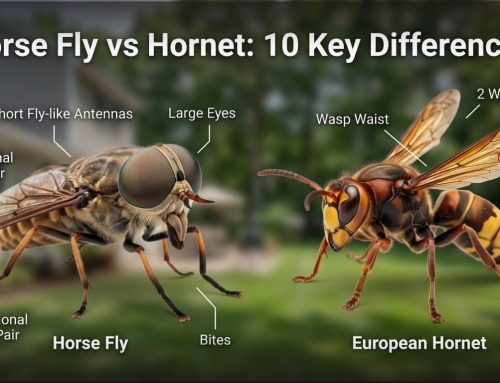
Hornets tend to be larger and longer than most bees, with a distinctly narrow waist (called a petiole) that connects the thorax and abdomen. This pinched waist is a hallmark of wasps and hornets. Bald-faced hornets are typically ¾ to 1 inch long, while European hornets can reach up to 1½ inches.
Coloring
- Bald-faced hornets have a black body with white or ivory markings on the face and abdomen hence the “bald-faced” name.
- European hornets are more yellow-brown with reddish-brown markings, somewhat resembling a large yellowjacket.
For a deeper look at how to visually separate these species, the wasp and hornet ID guide for Connecticut covers the most common local species in detail.
Behavior
Hornets are fast, purposeful fliers. They don’t hover in one spot for long. Near their nest, they become visibly more agitated and will patrol a perimeter. If you’re seeing insects flying in and out of a papery, enclosed structure that’s a colony insect, not a solitary bee.
How to Identify a Carpenter Bee by Appearance
That Shiny Black Abdomen
This is the easiest way to tell a carpenter bee apart from nearly every other large flying insect in Connecticut. The abdomen of a carpenter bee is smooth, shiny, and almost entirely black. A bumblebee which is frequently confused with carpenter bees has a fuzzy, yellow-and-black abdomen. If the back end of the insect looks like polished black metal, you’re probably looking at a carpenter bee.
Fuzzy Yellow Thorax
The upper body (thorax) of a carpenter bee is covered in dense yellow fuzz, which gives it a somewhat bumblebee-like appearance from certain angles. For a proper comparison, the bumblebee vs hornet identification guide is worth reviewing if you’re still unsure.
The Hovering Behavior
Carpenter bees particularly males hover almost motionlessly in front of wooden surfaces, decks, fences, fascia boards, and pergolas. They may fly directly at your face if you approach, but this is a territorial display, not an attack. Female carpenter bees, who do have stingers, are typically too busy drilling and provisioning their tunnels to bother with people.
The Telltale Hole
Look for a perfectly round hole, roughly the diameter of a finger, bored into unpainted or weathered wood. That’s your confirmation. Carpenter bees don’t eat the wood — they excavate it to create nesting chambers. You may also notice a yellowish sawdust-like residue (frass) below the entry hole.
Nesting Habits: A Key Difference
Where Hornets Build Their Nests
Hornets build above-ground paper nests from chewed wood pulp mixed with saliva. You’ll find them:
- Hanging from tree branches
- Tucked under eaves and overhangs
- Inside wall voids and attic spaces
- In dense shrubbery
The bald-faced hornet’s nest looks like a large gray football. European hornets often nest in hollow trees, wall cavities, or attics. Either way, these nests house active, defensive colonies. Disturbing one unintentionally even with a lawnmower or weed trimmer can trigger a rapid attack response.
Our hornet nest removal guide outlines what homeowners should and should not attempt on their own.
Where Carpenter Bees Nest
Carpenter bees prefer soft, untreated wood. In Fairfield County neighborhoods, the most common nesting sites include:
- Wooden decks and deck railings
- Fascia boards and eaves
- Outdoor pergolas and gazebos
- Unpainted fence posts
- Wood siding and window frames
Each female creates her own tunnel, typically 6 to 10 inches deep, with individual chambers for eggs. The same sites are reused and expanded year after year, meaning what starts as a single hole can eventually become a network of galleries that weakens structural timbers.
Risks and Dangers: Which Is More Dangerous?
Hornet Risks
Hornets represent a genuine safety risk, particularly for households with children, pets, or anyone with a venom allergy. A disturbed hornet colony can send dozens of workers into attack mode within seconds. Unlike honeybees, hornets can sting multiple times without dying. A person who is allergic to insect venom can experience anaphylaxis — a life-threatening reaction from even a single sting.
If you’ve found a nest near your home in Greenwich, Stamford, or any area of Fairfield County, it’s not a situation to handle with a can of hardware store spray. For more on what makes these insects particularly hazardous, the hornet behavior hub provides useful context on colony aggression triggers.
Carpenter Bee Risks
Carpenter bees are far less dangerous to people but significantly more damaging to property. While an individual hole might seem harmless, repeated use of the same nesting sites over multiple seasons causes cumulative structural damage. Soft, compromised wood also becomes attractive to woodpeckers, which will tear into the wood further to access carpenter bee larvae dramatically accelerating the damage.
The sting risk from carpenter bees is genuinely low. Female stings are rare and typically only happen if the bee is trapped or squeezed.
Hornet vs Wasp vs Carpenter Bee: Don’t Confuse Them
Since we’re on the topic of identification, it’s worth briefly addressing some other comparisons that Connecticut homeowners commonly ask about.
Hornets vs Wasps: All hornets are technically wasps, but not all wasps are hornets. Hornets are larger and generally considered more aggressive. Yellowjackets, paper wasps, and mud daubers are all wasps that get confused with hornets regularly. The wasps vs hornets differences explained page breaks this down clearly.
Bee vs Hornet: Bees are generally fuzzier, more rounded, and less aggressive than hornets. Honeybees and bumblebees rarely sting without direct provocation. The hornets vs bees guide covers this distinction in depth.
Hornet vs Wasp Nests: The physical structures they build are quite different — hornets build enclosed, papery globes, while paper wasps build open, umbrella-shaped combs. Understanding nest differences can help you confirm your identification before taking any action.
Connecticut Seasonal Patterns: When Are They Most Active?
In Connecticut, both hornets and carpenter bees follow predictable seasonal patterns that are shaped by the region’s distinct climate.
Spring (March–May)
Carpenter bees emerge first, typically when daytime temperatures consistently reach 70°F. In Fairfield County, that often means late April into May. Mated females from the previous year overwinter in old tunnels and become active quickly, starting new galleries or expanding old ones. This is when you’ll first notice hovering males near wooden structures.
Hornet queens also emerge in spring after overwintering alone. A newly mated queen begins building a small, golf ball-sized nest entirely on her own the beginning of what will become a large colony by late summer.
Summer (June–August)
This is peak activity for both species. Hornet colonies grow rapidly through July and August. A bald-faced hornet nest that was the size of a softball in June can be football-sized or larger by August, housing several hundred workers. This is when hornet stinging incidents are most common in Greenwich, Norwalk, and surrounding areas.
Carpenter bees are actively nesting and provisioning through midsummer. You’ll see less hovering as females focus on egg-laying, but the wood damage continues.
Fall (September–November)
Hornet colonies begin to break down in fall. New queens and males are produced for mating. Once temperatures drop consistently, workers and the old queen die off. The nest is abandoned.
Carpenter bees mate in fall, and new females seek overwintering spots often the tunnels they were born in. This is why treatment timing matters so much.
Winter
Neither hornets nor carpenter bees are active in Connecticut winters. However, abandoned hornet nests occasionally become reused the following season particularly by European hornets and carpenter bee tunnels almost always see returning occupants in spring.
Prevention Tips for Connecticut Homeowners
Preventing Carpenter Bees
- Paint or seal all exposed wood. Carpenter bees strongly prefer unfinished, weathered wood. A quality exterior paint or wood stain dramatically reduces their interest.
- Use hardwoods where possible. Carpenter bees prefer softer woods like pine, cedar, and redwood. Hardwoods like oak are less attractive targets.
- Fill old holes. At the end of the season, plug abandoned tunnels with steel wool and caulk before repainting. This removes ready-made real estate for next spring.
- Hang decoy nests. There’s some evidence that carpenter bees avoid areas where they perceive other bees have already claimed territory, though results vary.
Preventing Hornets
- Inspect your property early. In May and June, look for small, early-stage nests under eaves, in shrubbery, and around outbuildings. A small nest removed early is far safer than a large one removed in August.
- Seal entry points. European hornets in particular love attic spaces and wall cavities. Seal gaps around fascia boards, soffits, and roof eaves.
- Avoid leaving food and sweet beverages outside. Hornets are attracted to sugary drinks, protein-rich foods, and fruit. Clean up outdoor dining areas promptly.
- Keep trash cans sealed. Garbage is a reliable food source for foraging hornets late in the season.
For a comprehensive list of deterrence strategies, the hornet deterrence guide is a solid resource.
DIY vs Professional Treatment: When to Call a Pro
When DIY Is Reasonable
A lone carpenter bee hovering near your deck in early spring isn’t necessarily a five-alarm situation. If you can identify a single active hole, treat it carefully at night with an appropriate dust insecticide, seal the entry point at season’s end, and repaint the wood you may be able to manage a limited infestation on your own.
A very small, newly started hornet nest (think golf ball-sized, in an accessible location, away from foot traffic) can sometimes be treated with a long-range wasp spray at night when the colony is least active. However, even small nests carry risk, and this approach requires care.
When to Call a Professional
Call a professional pest control company without hesitation if:
- The hornet nest is large (bigger than a softball)
- The nest is inside a wall, attic, or other enclosed space
- Anyone in the household has a known allergy to insect stings
- The nest is near a door, window, or high-traffic area
- Carpenter bee damage is extensive across multiple locations
- You’ve been stung or had a close call trying to treat it yourself
Our hornet exterminator services are designed specifically for situations like these — where the risk of doing it yourself outweighs any potential savings. You can also review our expert hornet control tips to understand what professional-grade treatment actually involves.
How Green Pest Management CT Handles These Insects
Green Pest Management CT serves homeowners throughout Fairfield County, including Greenwich, Stamford, Darien, Westport, Fairfield, Wilton, New Canaan, and Norwalk. Our approach is rooted in Integrated Pest Management (IPM) principles, which means we focus on targeted, effective treatments with the lowest necessary impact on the surrounding environment.
For hornet infestations, our technicians conduct a full property inspection to locate all active nesting sites — including hidden ones inside wall voids or attic spaces. We use professional-grade products that are both effective and applied with precision, reducing unnecessary chemical exposure.
For carpenter bee problems, we assess the extent of existing wood damage, treat active galleries, and provide practical recommendations for wood repair and prevention to stop future infestations from taking hold.
Whether you’re dealing with a hornet nest hanging from a tree in your Greenwich backyard or carpenter bee damage across your Westport deck, the process starts with an accurate identification which is exactly what we’ve built this guide to help you do.
For immediate situations, our emergency hornet removal service is available when you can’t wait.
Other Pest Identification Questions We Hear from CT Homeowners
While hornets and carpenter bees are some of the most common identification questions we receive, our customers throughout Fairfield County also frequently ask about:
Fly identification telling apart a stable fly from a house fly, or a yellow fly from a deer fly, makes a real difference in how you respond. Stable flies bite; house flies don’t. Yellow flies and deer flies can both deliver painful bites, but they’re found in different environments.
Gnat and small fly identification the differences between a fruit fly, a drain fly, and a fungus gnat are subtle but important. Fruit flies are attracted to fermenting food and sugary residue. Drain flies breed in the organic buildup inside pipes. Fungus gnats come from overwatered houseplant soil. Misidentifying one leads to treating the wrong source. Our fruit fly authority hub and drain fly identification guide cover these distinctions thoroughly.
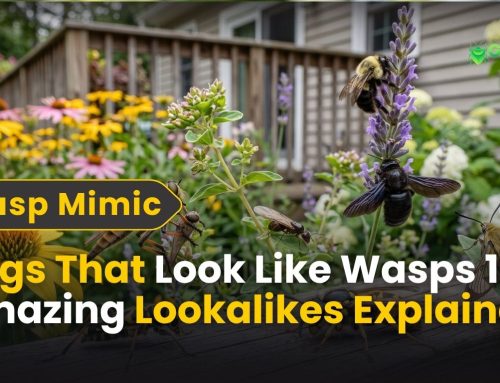
Flying insects that look like wasps hoverflies, sawflies, and certain moth species can mimic wasp coloring as a defense mechanism. Our flying insects that look like wasps guide helps sort through the common mimics.
Accurate identification is the foundation of any effective pest control response — which is why our pest comparison content hub exists as a resource for Connecticut homeowners who want to understand what they’re dealing with before making any decisions.
Frequently Asked Questions
What is the easiest way to tell a hornet from a carpenter bee?
Look at the abdomen. Carpenter bees have a smooth, shiny, hairless black abdomen. Hornets have banded markings either black and white or yellow and brown and a noticeably narrow waist. If the insect is hovering in front of wood and you can see a round hole nearby, it’s almost certainly a carpenter bee.
Are carpenter bees dangerous?
Carpenter bees are not particularly dangerous to people. Male carpenter bees cannot sting at all. Females can sting but almost never do unless they’re physically handled or trapped. The real danger from carpenter bees is the structural damage they cause to wood over time.
Are hornets dangerous?
Yes, hornets can be genuinely dangerous, especially near their nests. They can sting multiple times and will defend the colony aggressively if disturbed. For anyone with a venom allergy, a hornet encounter can become a medical emergency. You can read more about how harmful hornets can be and understand hornet sting treatment if an incident occurs.
Do carpenter bees damage houses?
Yes. While a single carpenter bee hole looks minor, the damage compounds over time. Females expand existing tunnels year after year, and woodpeckers often tear into infested wood to reach the larvae, causing significant additional damage to siding, eaves, decks, and wooden trim. Homes in Fairfield County with a lot of exposed cedar or pine are particularly vulnerable.
Can hornets and carpenter bees live in the same area?
They can coexist in the same yard, though they’re not directly interacting. Hornets may actually prey on carpenter bees as a food source, particularly toward late summer when the colony is large and requires more protein. Our page on what eats wasps and hornets covers predator-prey dynamics in more detail.
When is the best time to treat a hornet nest?
Late evening or early morning when temperatures are cooler and the majority of the colony is inside the nest. In Connecticut, treatment is most effective in spring when colonies are small, or in late fall after the colony has died off naturally. Learn more about the best time to treat a hornet nest.
Should I block a carpenter bee hole?
Not while bees are actively using it. Blocking an active tunnel traps bees inside and can cause them to chew through nearby wood to escape creating more damage. Wait until fall after bees have stopped using the gallery, then fill with steel wool, caulk, and repaint.
Can I remove a hornet nest myself?
Small nests in accessible, low-traffic areas can sometimes be treated by homeowners using long-range aerosol sprays at night. However, large nests, nests in enclosed spaces like attics or wall voids, and situations involving allergy risk should always be handled by a licensed pest control professional. For guidance, read our hornet nest DIY vs professional guide.
How do I know if it’s a hornet nest or a wasp nest?
Hornet nests are fully enclosed with a papery outer shell, shaped like a teardrop or football. Wasp nests particularly paper wasp nests are open-celled and umbrella-shaped, with visible hexagonal chambers. Our wasp nest identification chart covers every common nest type found in Connecticut.
What flying insects do Connecticut homeowners commonly confuse with hornets?
Yellowjackets, European hornets, bald-faced hornets, large paper wasps, and even some species of hoverflies are regularly mistaken for one another. The Connecticut wasp and hornet ID encyclopedia is one of the most thorough local resources for sorting through these look-alikes.
Conclusion: Know What You’re Dealing With Before You Act
The difference between a hornet and a carpenter bee isn’t just academic it shapes how you respond, what risks you face, and what kind of damage might be happening to your property right now. Hornets are a safety issue. Carpenter bees are a property damage issue. They require different approaches, different timelines, and sometimes different professionals.
If you’re in Stamford, Greenwich, Norwalk, Darien, Westport, Wilton, New Canaan, or anywhere in Fairfield County, and you’re not 100% sure what’s buzzing around your home — that uncertainty itself is a good reason to get a professional set of eyes on the situation.
Green Pest Management CT is built around helping Connecticut homeowners make informed decisions. Whether that means giving you the knowledge to handle something yourself, or stepping in when the situation calls for professional treatment, we’re here to help you protect your home and your family.
If you’ve spotted something that doesn’t quite match either description, or if you’d like a professional inspection of your property, reach out to Green Pest Management CT. Accurate identification is always the first step and it’s always worth getting it right.
For more identification help, explore our full wasp vs hornet comparison hub and our professional service hub to learn how we protect Connecticut homes year-round.