Least Aggressive Wasps: 10 Gentle Species You Should Know
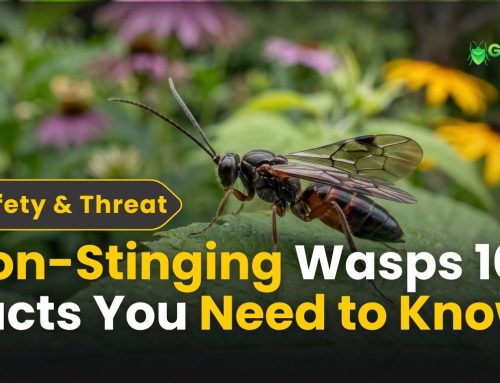
The least aggressive wasps are generally solitary species that do not have a large colony to defend. Mud daubers, potter and mason wasps, many parasitoid wasps, cicada killers, and several solitary hunting wasps usually avoid conflict with people unless trapped, handled, or directly threatened. Male wasps cannot sting at all.
That does not mean every calm-looking wasp is harmless. Yellow jackets, hornets, and paper wasps can also forage peacefully away from their nests, then behave very differently when their colony is disturbed. For Connecticut homeowners, nest location and social behavior often tell you more about sting risk than body size or color.
Knowing that difference is useful in Greenwich, Stamford, Darien, Westport, Fairfield, Wilton, New Canaan, Norwalk, and throughout Fairfield County, where beneficial solitary wasps and defensive social wasps can share the same landscape.
This guide identifies 10 generally low-risk wasp groups, explains stings versus bites, allergies and pain, first aid, Connecticut seasonality, prevention, and when Green Pest Management CT recommends professional identification rather than unnecessary treatment.
What Does “Least Aggressive Wasp” Actually Mean?
Entomologists do not divide wasps into official “aggressive” and “gentle” categories. Aggression is a convenient homeowner term for several different behaviors, including nest defense, territorial flight, hunting, and an insect’s response to being physically threatened.
For pest-management purposes, a low-risk wasp is generally one that has little incentive to sting people during normal outdoor activity.
Social structure is especially important.
Yellow jackets may have many workers invested in protecting one colony. A solitary wasp is largely responsible for itself and its offspring and does not have hundreds of nestmates responding to the same disturbance.
This comparison is more practical than an arbitrary aggression score:
| Wasp group | Lifestyle | Typical human sting risk |
| Tiny parasitoid wasps | Usually solitary | Very low |
| Mud daubers | Solitary | Low |
| Potter/mason wasps | Solitary | Low |
| Cicada killers | Solitary | Generally low |
| Great golden digger wasps | Solitary | Generally low |
| Great black wasps | Solitary | Generally low |
| Thread-waisted wasps | Mostly solitary | Low |
| Sand wasps | Mostly solitary | Generally low |
| Spider wasps | Solitary | Low if left alone |
| Paper wasps away from nests | Social | Often low while foraging; defensive near colony |
| Yellow jackets | Social | Higher around nests |
| Hornets | Social | Higher around nests |
Because identification matters, homeowners can compare unfamiliar insects with Green Pest Management CT’s Connecticut wasp and hornet identification encyclopedia.
1. Parasitoid Wasps: Among the Lowest-Risk Wasps Around Homes
Many parasitoid wasps are excellent examples of insects that look more threatening than they are.
These species reproduce by placing eggs in or on other arthropods. Their offspring develop using that host rather than being raised in a large social nest.
Many parasitoids are tiny and present essentially no practical sting hazard to people.
Some species have a conspicuous ovipositor—the egg-laying structure from which the stinger evolved in other wasps. A long ovipositor can look like an enormous stinger, but its primary purpose may be depositing eggs into a host hidden inside wood or plant tissue.
Green Pest Management CT’s parasitoid wasp resource center explains their biology and value in natural pest suppression.
For homeowners specifically concerned about sting risk, the guide on whether parasitic wasps sting people provides additional context.
2. Mud Daubers: Solitary Wasps That Usually Avoid People
Mud daubers collect mud and use it to construct nests on protected surfaces.
Depending on the species, these nests may look like individual mud tubes or irregular masses. Females capture spiders, immobilize them, and provision nest cells for their developing young.
That predatory lifestyle sounds formidable, but mud daubers usually have little reason to interact aggressively with people.
They do not maintain the large defensive worker force found in a yellow jacket colony.
Females are capable of stinging, so “calm” should never be interpreted as an invitation to handle one. In normal outdoor circumstances, however, their human sting risk is generally low.
When an old mud structure appears around a shed, garage, porch, or attic space, identification should come before spraying.
3. Potter and Mason Wasps: Small Solitary Hunters
Potter and mason wasps are another generally low-risk group.
Some species create small pot-like mud nests; others use available cavities. Females provision their nests with prey, often caterpillars, for their larvae.
These wasps can therefore play a useful role in suppressing other insect populations.
They are capable of defending themselves physically, but they are not protecting a large social colony.
A potter wasp visiting flowers in a Westport garden or hunting caterpillars around a Greenwich landscape does not require the same response as yellow jackets pouring from a hole beside a walkway.
This distinction—species plus behavior plus nest type—is central to Integrated Pest Management.
4. Cicada Killers: Large Does Not Mean Aggressive
Cicada killers are among the most intimidating solitary wasps a homeowner may see.
Their size alone can lead people to assume they rank with the most dangerous wasps. Behavior tells a different story.
Female cicada killers excavate nesting burrows and capture cicadas as food for their offspring. Females can sting, but they generally do not aggressively defend territory against people like social yellow jackets.
Male cicada killers are often much more conspicuous. They may patrol nesting areas, chase other insects, and investigate people passing through their territory.
There is an important fact behind all that posturing: male wasps cannot sting.
Why cicada killers cause confusion
Several individual females may nest in the same area where soil conditions are favorable. To a homeowner, a busy nesting aggregation can resemble a social colony.
It is not the same organizational system.
The ground-nesting wasp identification guide can help homeowners distinguish solitary activity from potentially hazardous yellow jacket colonies.
Never identify either type by placing your face near the entrance.
5. Great Golden Digger Wasps: Noticeable but Usually Peaceful
Great golden digger wasps are conspicuous solitary wasps that visit flowers and hunt insects.
Their bright coloration and substantial size attract attention, yet normal foraging behavior is generally not directed toward people.
Females create underground nests and provision them with prey for their offspring. No large social worker force exists to defend a central colony.
This is one reason gardens can contain surprisingly large wasps without automatically having a stinging-insect problem.
A professional familiar with Integrated Pest Management asks whether an insect presents an actual risk before recommending control.
If a solitary nesting site does not conflict with people, intervention may not be necessary.
6. Great Black Wasps: Big, Dark, and Generally Low-Risk
A large black wasp moving through flowers can understandably make a homeowner cautious.
Great black wasps are solitary hunters. Females collect prey for their developing young and commonly visit flowers as adults.
Although females can sting, their normal behavior does not involve protecting a large communal colony.
Give them space and avoid handling them.
Their appearance also illustrates why color is unreliable as a danger assessment. “Large and black” does not automatically mean hornet, while a relatively small yellow jacket may be associated with a highly defensive underground colony.
Identification should combine morphology, nesting pattern, and behavior rather than relying on one color feature.
7. Thread-Waisted Wasps: Slender Beneficial Hunters
Thread-waisted wasps include a variety of slender-bodied solitary hunters.
Many collect caterpillars, crickets, or other arthropods as provisions for offspring. Adults may also be seen feeding at flowers.
Like other solitary species, they generally have little reason to engage people.
The extremely narrow waist is visually dramatic but does not indicate sting severity or aggression.
If you see one moving among flowers, observe it rather than swatting it. An insect focused on foraging or hunting does not necessarily represent an active pest problem.
A recurring theme in professional pest identification is that behavior often provides better context than appearance alone.
8. Sand Wasps: Ground Nesters That Are Usually Low-Risk
Sand wasps are solitary or loosely aggregating ground-nesting wasps commonly associated with suitable exposed soil.
They hunt other insects to provision their offspring.
Several individuals may use the same favorable habitat, so activity can look busy even though there is no single large worker colony operating underground.
Again, compare that with yellow jackets.
A yellow jacket colony may have many workers repeatedly using one entrance and defending the colony as a unit. Sand wasps operate differently.
Because homeowners can easily confuse different ground nesters, avoid treating holes based on appearance alone.
Green Pest Management CT’s complete ground-nesting wasp guide explains what flight and entrance patterns can reveal.
9. Spider Wasps: Usually Uninterested in Humans
Spider wasps hunt spiders for their offspring.
Some members of this broad family are famous for exceptionally painful stings, which might seem strange in an article about the least aggressive wasps.
There is no contradiction.
Pain potential and likelihood of being stung are different measurements.
A solitary hunting wasp can possess an effective sting for subduing prey yet have little reason to use it against a human who leaves it alone.
This distinction also exposes the problem with online lists that rank wasp danger entirely by sting-pain scores.
The insect that can theoretically deliver an extremely painful sting may present less everyday residential risk than a common yellow jacket colony directly underneath someone’s lawn mower.
Never handle spider wasps, but there is usually no reason to panic when a solitary individual passes through a yard.
10. Paper Wasps Away From Their Nest: Usually Calm, but With an Important Warning
Paper wasps require a qualification.
Unlike the preceding solitary groups, paper wasps are social and can defend their colony. They therefore should not be considered harmless.
However, paper wasps encountered foraging away from a nest often show little interest in people.
A worker visiting a flower and a worker standing on an occupied comb are two different encounters.
Paper wasps commonly create open comb nests with exposed hexagonal cells. Around Connecticut homes, these can occur beneath eaves, porch ceilings, railings, sheds, and other protected surfaces.
When the nest is positioned above a busy doorway or next to a deck, ordinary household activity may repeatedly enter its defensive zone.
Green Pest Management CT’s paper wasp nest identification guide helps homeowners identify these colonies without disturbing them.
Least Aggressive Wasps vs. Non-Stinging Wasps
These terms should not be treated as synonyms.
A non-stinging wasp either lacks the ability to sting or poses essentially no practical sting capability to people. Male wasps, for example, do not have stingers.
A low-aggression wasp may have a functional stinger but rarely use it against humans.
The difference can be summarized simply:
A male cicada killer cannot sting.
A female cicada killer can sting but usually does not.
A female yellow jacket can sting and may do so repeatedly when defending a colony.
For a deeper explanation, Green Pest Management CT’s non-stinging wasp identification guide covers this distinction in detail.
Wasp Sting vs. Bite: What Actually Happens?
Wasps have mandibles, so they can physically bite or grasp.
But the injury homeowners normally describe as a wasp “bite” is usually a sting.
Female stinging wasps use a modified ovipositor to inject venom. Social species including paper wasps, yellow jackets, and hornets generally retain their stinger after an encounter and can potentially sting again.
That differs from a worker honey bee, whose barbed stinger commonly remains in human skin.
If you are unsure whether an insect is a bee or wasp, use the bee versus wasp identification guide rather than trying to catch it.
Least Aggressive vs. Most Dangerous Wasps
Danger around a residential property comes from several factors rather than an insect’s reputation.
The most important variables include social behavior, nest-defense intensity, colony size, likelihood of accidental disturbance, number of stings, and the victim’s sensitivity to venom.
Yellow jackets are an important Connecticut example.
An underground colony may remain invisible until a homeowner runs a mower directly over the entrance. Once disturbed, multiple workers can respond.
Bald-faced hornets also defend social nests, while European hornets can establish colonies in cavities.
See Green Pest Management CT’s guide to the most dangerous wasps and their warning signs for a detailed risk comparison.
The best safety question is not “Which wasp looks scariest?”
It is “Is this a social colony, and how likely is someone to disturb it?”
Sting Pain Scale: Does a Painful Sting Mean an Aggressive Wasp?
No.
Sting pain describes the effect of venom and the experience of the person being stung. Aggression describes behavior. The two do not have a simple relationship.
Entomologist Justin Schmidt’s research comparing sting pain made the concept of a Hymenoptera pain scale widely familiar, but a pain ranking should not be used as a medical-danger scale.
A low-risk solitary species may possess a very painful sting used primarily for prey or self-defense.
Meanwhile, a sting that initially seems less painful can still trigger a severe allergic reaction in someone sensitive to venom.
For human safety, allergy symptoms and number of stings matter more than assigning the pain a number.
Wasp Sting Allergies: Even a Low-Aggression Wasp Deserves Respect
A wasp’s reluctance to sting does not make its venom irrelevant if a sting actually occurs.
Severe allergic reactions can develop after insect stings.
The American Academy of Allergy, Asthma & Immunology’s guidance on stinging-insect allergies explains symptoms associated with venom allergy and anaphylaxis.
Emergency warning signs can include:
- Trouble breathing or wheezing
- Significant swelling of the tongue or throat
- Widespread hives or itching away from the sting
- Faintness, severe dizziness, or collapse
- Rapidly progressing systemic symptoms
Call 911 for suspected anaphylaxis.
If someone has been prescribed epinephrine because of an insect-venom allergy, use it according to their medical emergency plan. Antihistamines are not a replacement for epinephrine when anaphylaxis is occurring.
The fact that an insect is normally one of the least aggressive wasps does not alter the appropriate response to a severe allergic reaction.
Wasp Sting Treatment and First Aid
If you are stung, first move away from the location. This is particularly important if you are uncertain whether a social colony is nearby.
Once safely away, inspect the sting site. Wasps generally do not leave a stinger behind. If a stinger from an unidentified insect is visibly present, remove it promptly.
Wash the area gently with soap and water.
A cold pack wrapped in cloth and applied for short periods can help with local pain and swelling. Avoid scratching irritated skin.
Monitor the entire body rather than looking only at the sting site.
For additional general medical guidance, see the Mayo Clinic’s insect bite and sting first-aid information.
Green Pest Management CT also provides a more detailed wasp sting treatment guide.
Signs and Identification: Is the Wasp Actually Low-Risk?
No homeowner should determine whether a wasp is safe by touching or trapping it.
Instead, observe behavior from a reasonable distance.
Low-risk solitary species often appear individually while hunting, feeding at flowers, or tending separate burrows.
Social colonies often show concentrated traffic.
Watch for:
- Numerous similarly sized insects using one entrance
- Repeated traffic into siding or a soffit
- Workers disappearing into one ground hole
- Multiple adults on an open paper comb
- A growing enclosed paper nest
- Defensive flight around one fixed location
- Several sting incidents in the same area
These warning signs deserve more caution.
The wasp and hornet behavior hub provides additional identification through behavior.
Why Are Wasps Around My Connecticut Home?
Wasps appear around residential properties because yards provide suitable nesting sites, prey, flowers, water, and food.
That can be beneficial.
Gardens supporting caterpillars and other insects provide hunting opportunities for solitary wasps. Flowering plants supply nectar for adult insects.
Exposed or sandy soil can attract certain ground nesters.
At the same time, structural gaps, hollow trees, old animal burrows, eaves, sheds, dense shrubs, and protected cavities can provide nesting sites for social species.
Human food is another attractant, particularly for yellow jackets.
Garbage, outdoor meals, sugary drinks, fallen fruit, and food residue can increase encounters.
The presence of wasps therefore does not answer the question of whether pest control is necessary. Identification and nest location do.
Connecticut Seasonal Activity
Connecticut’s cold winters and warm summers strongly influence wasp behavior.
Spring
Queens of annual social species emerge from protected overwintering sites and establish new nests. Solitary species begin appearing according to their individual life cycles.
Summer
Wasp diversity becomes highly visible.
Solitary hunters may become noticeable around gardens and lawns while social colonies steadily grow.
Seeing several kinds of wasps in a landscaped Greenwich, Wilton, or New Canaan property during summer is not automatically evidence of an infestation.
Late summer and early fall
Social colonies may reach substantial size.
This is when homeowners often become more aware of yellow jackets around garbage, cookouts, decks, and outdoor gatherings.
Established nests also contain more workers than they did earlier in the season.
Late fall and winter
Cold weather ends many annual social colonies. Newly produced queens of certain species survive winter in protected places and begin new colonies later.
Different solitary wasps overwinter in different developmental stages.
For activity timing, the guide to when wasps are least active provides further context.
Least Aggressive Wasps in Fairfield County Landscapes
Fairfield County contains a wide variety of habitats within residential neighborhoods.
Greenwich, Wilton, and New Canaan properties may include wooded areas, extensive gardens, exposed soil, stone walls, and mature trees. These conditions can support beneficial solitary insects as well as social species.
Stamford and Norwalk properties may have tighter human-insect interaction because outdoor spaces, neighboring buildings, walkways, and structural nesting opportunities can be closer together.
Darien, Westport, and Fairfield often combine landscaped yards, decks, pools, sheds, gardens, and mature vegetation.
In each community, Green Pest Management CT uses the same practical approach: identify the insect, determine whether a colony exists, assess its location relative to people, and recommend intervention only where appropriate.
A solitary wasp hunting caterpillars in a garden and a yellow jacket colony inside the siding are not equivalent pest-control problems.
Prevention Without Killing Beneficial Wasps
Responsible prevention does not require eliminating beneficial wasps from the landscape.
Integrated Pest Management, or IPM, focuses on preventing unacceptable pest risks while minimizing unnecessary controls.
The EPA’s Integrated Pest Management information supports an identification- and prevention-based approach.
Around your property, use a simple prevention checklist:
- Keep outdoor garbage containers securely covered.
- Clean spills and food residue after outdoor meals.
- Inspect eaves, decks, sheds, and play structures.
- Check shrubs before pruning.
- Observe lawns before mowing over unfamiliar insect activity.
- Avoid swatting solitary wasps visiting flowers.
- Teach children not to disturb insect nests.
- Keep people and pets away from active social colonies.
- Repair appropriate building gaps when confirmed inactive.
- Maintain awareness of repeated flight into structural openings.
Do not seal an opening while social wasps are actively using it. A live colony trapped within a building void may search for another way out, potentially toward occupied rooms.
DIY Observation vs. Professional Pest Control
A solitary wasp flying through the garden usually does not require an exterminator.
Observation, sanitation, and appropriate preventive maintenance are reasonable DIY steps.
Active colony removal is different.
A professional inspection is appropriate when repeated worker traffic leads to one structural opening, an underground colony is next to a walking or mowing route, a nest is near a doorway or children’s area, or treatment would require ladder or roof work.
A property occupied by someone with a diagnosed insect-venom allergy also deserves a lower tolerance for risky nest locations.
Avoid spraying pesticides indiscriminately at solitary beneficial wasps. The EPA provides consumer information on safe pesticide practices, including following product labels.
For higher-risk colonies, Green Pest Management CT’s DIY versus professional hornet removal comparison explains why access and colony location matter.
What a Professional Inspection Looks For
Professional pest identification starts with observation.
A technician assesses body characteristics, flight patterns, nest architecture, entry points, the number of insects involved, and how the surrounding area is used.
If the insect is a harmless or low-risk solitary wasp, widespread pesticide treatment may not be justified.
If inspection reveals an active yellow jacket, hornet, or paper-wasp colony threatening a high-use area, targeted control may be appropriate.
With colonies inside structural voids, treatment should address the colony before inappropriate sealing. Once activity has stopped, exclusion may help reduce future entry.
This sequence is a practical application of IPM: identify, assess, control when justified, and prevent recurrence.
Homeowners with a hazardous nest can use Green Pest Management CT’s professional wasp and hornet removal services rather than approaching the colony themselves.
Common Mistakes to Avoid
One mistake is assuming every large wasp is dangerous. Another is assuming every wasp described online as “gentle” is safe to pick up.
Do not handle unidentified insects.
Avoid standing over a ground opening to determine what is inside. Do not knock paper nests down while occupied, spray colonies from ladders, or block active structural entrances.
Never use fire, gasoline, or improvised chemicals to treat a nest.
The safest approach is proportional to the actual risk. Beneficial solitary wasps can usually be left alone; active defensive colonies close to people warrant a different strategy.
Frequently Asked Questions
What are the least aggressive wasps?
Many parasitoid wasps, mud daubers, potter wasps, cicada killers, great golden digger wasps, great black wasps, and other solitary hunters are generally low-aggression toward humans. They lack the large social colony-defense behavior associated with yellow jackets.
What is the difference between a non-stinging wasp and a gentle wasp?
A non-stinging wasp cannot effectively sting a person, while a gentle or low-aggression wasp may possess a functional stinger but rarely use it against people. Male wasps cannot sting, whereas female cicada killers can but generally avoid doing so.
Are cicada killer wasps aggressive?
They can look aggressive because males patrol territories and approach movement. Male cicada killers cannot sting. Females can sting but generally avoid conflict when left alone.
Are paper wasps aggressive?
Paper wasps may forage without bothering people, but they can defend their nest. A colony directly beside a doorway or deck therefore presents more risk than an individual feeding on flowers.
Are yellow jackets among the least aggressive wasps?
No. Yellow jackets are social wasps capable of vigorous colony defense and repeated stinging. Their ground and structural nests can also be accidentally disturbed.
Do gentle wasps still sting?
Some do. Many solitary female wasps possess functional stingers but seldom sting people unless trapped, stepped on, or handled. Low aggression is not the same as an inability to sting.
Does a wasp bite or sting?
Wasps have mandibles, but the familiar defensive injury to humans is generally a venomous sting. Female social wasps can potentially sting repeatedly.
Which is more dangerous, a hornet or a solitary wasp?
An active hornet colony generally creates a higher residential sting risk than one solitary wasp because multiple workers can defend the nest. Individual allergy, sting number, and exact circumstances still determine medical risk.
What should I do if a low-aggression wasp stings me?
Move away, wash the site, use a cloth-wrapped cold pack, and monitor for allergic symptoms. Call 911 for difficulty breathing, significant tongue or throat swelling, fainting, or other signs of anaphylaxis.
When should I call pest control about wasps?
Arrange professional identification when numerous workers use one location, a social nest is close to people, insects are entering the house, the colony requires dangerous access, or a person on the property has a serious venom allergy.
Conclusion: The Least Aggressive Wasps Usually Have No Colony to Defend
Many of the least aggressive wasps are solitary hunters or parasitoids that play useful roles in Connecticut landscapes. Mud daubers, potter wasps, cicada killers, digger wasps, and many parasitoid species generally have little interest in people when left undisturbed.
The most useful distinction is not simply “gentle versus aggressive.” It is solitary versus social, foraging versus nest defense, and harmless activity versus unacceptable exposure.
Yellow jackets, hornets, and paper wasps can behave calmly away from their nests but deserve significantly more caution around an active colony. Conversely, a large solitary wasp hunting in a garden may be beneficial and require no treatment.
For homeowners in Greenwich, Stamford, Darien, Westport, Fairfield, Wilton, New Canaan, Norwalk, and surrounding Fairfield County areas, Green Pest Management CT can provide a professional wasp identification and safety inspection when you cannot determine whether the insects around your property are beneficial solitary wasps or a colony that requires professional pest management.