Safety & Threat Assessment: 15 Essential Risks & Safety Tips
A wasp or hornet near a Connecticut home does not automatically mean you are in immediate danger. The real risk depends on the insect species, whether a colony or nest is nearby, how close people are to that nest, and whether anyone exposed has a history of severe reactions to insect venom.
The most important safety rule is simple: do not disturb a suspected wasp, yellow jacket, or hornet nest. Social wasps can defend a colony together, and unlike honey bees, many wasps can sting more than once.
If someone has trouble breathing, swelling of the tongue or throat, faintness, widespread hives, or other signs of a severe allergic reaction after a sting, treat it as a medical emergency and call 911. Use prescribed epinephrine promptly when available and follow the person’s emergency allergy plan.
For homeowners in Greenwich, Stamford, Darien, Westport, Fairfield, Wilton, New Canaan, Norwalk, and surrounding Fairfield County communities, this guide provides a practical Safety & Threat Assessment for stinging insects. It covers sting versus bite, potentially dangerous species, sting pain, allergies, first aid, identification, prevention, common mistakes, and when professional pest control makes more sense than DIY removal.
Important: This article provides general pest-safety information, not individualized medical advice. For medical questions after a sting, contact a qualified healthcare professional.
Quick Safety & Threat Assessment
Before attempting to identify or control a flying insect, evaluate the situation from a safe distance.
| Situation | General threat level | Recommended response |
| One wasp feeding on flowers | Low | Give it space and observe |
| Occasional wasps around food | Low to moderate | Remove attractants and watch for repeated traffic |
| Several insects repeatedly entering one opening | Moderate to high | Suspect a nest; avoid the opening |
| Visible paper nest away from people | Variable | Keep people away and assess location/species |
| Ground nest beside lawn or walkway | High | Mark the area from a distance and avoid it |
| Nest near a door, deck or play space | High | Consider professional inspection |
| Wasps entering a wall or roof void | High | Do not seal the opening |
| Multiple stings | Medical concern | Move to safety and assess symptoms |
| Breathing difficulty or throat swelling | Emergency | Call 911 immediately |
The presence of a nest matters more than the appearance of a single insect. A solitary wasp on a flower and dozens of yellow jackets defending a ground colony require completely different responses.
For visual identification, Green Pest Management CT’s Connecticut wasp and hornet identification encyclopedia provides a useful starting point.
What Is a Wasp and Hornet Safety & Threat Assessment?
A stinging-insect Safety & Threat Assessment is the process of determining how likely an insect or colony is to sting people and how serious the consequences could be.
It is not simply a question of whether an insect looks intimidating.
A practical assessment considers:
- Species or likely insect group
- Whether the insect is solitary or social
- Presence, size, and location of a colony
- Observable nest-defense activity
- Number of people regularly passing near the nest
- Children, pets, contractors, or landscaping crews using the area
- Known insect-venom allergies
- Height and accessibility of the nest
- Whether insects are inside a wall or occupied room
- Whether previous DIY treatment has disturbed the colony
- Time of year and colony development
- Escape routes if defensive insects emerge
- Need for ladders or other hazardous equipment
Experienced pest professionals pay particular attention to flight patterns. One wasp wandering across a yard may mean very little. A steady stream of insects disappearing into the same siding gap, stone-wall opening, soffit, shrub, or hole in the lawn is much more significant.
That distinction prevents unnecessary pesticide use while helping identify situations that deserve prompt professional attention.
Sting vs. Bite: What Is Actually Hurting You?
One of the most common homeowner questions is whether hornets and wasps bite or sting.
For humans, the medically significant injury from most familiar wasps and hornets is a sting.
Female wasps possess a modified egg-laying structure that functions as a stinger. Venom is delivered through that structure into the skin.
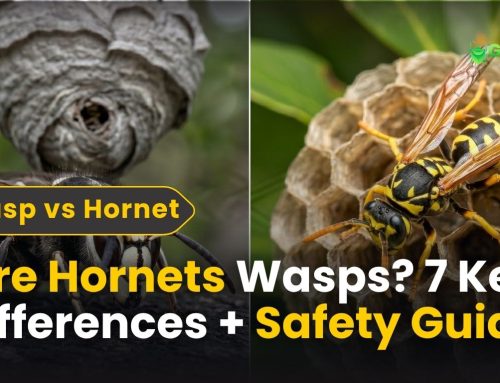
Wasps also have mandibles. They use them to manipulate nest material, capture or process prey, feed, and perform other behaviors. Some can bite, but when someone reports being “bitten” by a yellow jacket or hornet, a sting is generally the more likely explanation.
Can a wasp sting more than once?
Yes.
This is an important difference between many wasps and honey bees. A honey bee worker typically leaves its barbed stinger in human skin and dies afterward. Wasps, yellow jackets, and hornets generally do not leave their stingers behind and can potentially sting repeatedly.
That makes remaining near an actively defended nest dangerous.
Does a hornet bite or sting?
Hornets are wasps. Their primary defensive weapon against people is a venomous sting.
For a closer comparison, see the hornet sting versus wasp sting guide.
15 Essential Risks & Safety Tips
1. Nest Defense Is Usually the Biggest Risk
Many encounters occur not because a wasp is hunting a person but because someone unknowingly approaches or disturbs a colony.
Mowing over an underground yellow jacket nest, pruning a shrub containing a paper nest, leaning equipment against a structure, pressure washing near an entry point, or allowing children to play near a colony can rapidly turn an unnoticed nest into a defensive situation.
Social wasps have something valuable to defend: their colony.
A lone foraging insect often has little reason to engage with you. Disturbing a colony can trigger defensive behavior by multiple workers.
Homeowners should therefore look for repeated flight to one point rather than trying to judge risk exclusively from an insect’s color or size.
2. Yellow Jackets Can Present a Significant Residential Threat
When homeowners ask about the “most dangerous wasps,” there is no universally most dangerous species in every situation.
Risk depends on exposure, colony location, behavior, number of insects, and individual sensitivity to venom.
Around homes, yellow jackets deserve particular caution because many species live in social colonies and vigorously defend their nesting areas. Colonies can occur underground or in structural voids, making them easy to disturb accidentally.
Late summer can also bring increased human-yellow jacket encounters around outdoor food, sweet drinks, garbage, recycling, patios, and cookouts.
Our yellow jacket deep-dive guide explains their identification and behavior in greater detail.
3. Bald-Faced Hornet Nests Should Not Be Approached
The bald-faced hornet is actually a type of yellow jacket rather than a true hornet.
Workers are distinctive, with black bodies and white or ivory markings. Colonies build enclosed gray paper nests that may become conspicuous in trees, shrubs, and around structures.
These nests can become substantial during the season, and workers defend the immediate colony area.
Finding one does not mean it must be approached for a closer photograph.
Use distance and zoom rather than walking underneath it. More identification information is available in Green Pest Management CT’s bald-faced hornet identification and removal guide.
4. European Hornets Require Respect Too
European hornets are large social wasps established in parts of the United States, including the Northeast.
Their size can alarm homeowners, but body size by itself is not a complete measure of danger. Nest location and defensive circumstances are more meaningful.
European hornets may nest in hollow trees, wall voids, attics, or other cavities.
Anyone uncertain whether they are seeing a European hornet or yellow jacket can use the yellow jacket versus European hornet comparison rather than relying on size alone.
5. Paper Wasps Are Often Less Confrontational Away From Their Nest
People searching for “least aggressive wasps” are usually trying to determine whether an insect can safely be left alone.
Aggressiveness is not a fixed ranking.
Paper wasps frequently forage without causing problems, but they can defend their exposed comb nests when people get too close. Their nests commonly consist of visible open cells attached by a stalk rather than an enclosed paper envelope.
Eaves, porch ceilings, deck rails, shutters, sheds, play structures, and sheltered exterior surfaces can provide nesting locations.
Learn what these colonies look like with the paper wasp nest identification guide.
A paper nest over a rarely used corner of a large property represents a different exposure level than one directly above a family’s front door.
6. Many Wasps Are Solitary or Have Little Interest in Stinging People
Not every insect with a narrow waist should be treated as a dangerous social wasp.
Connecticut yards contain numerous beneficial insects, including solitary and parasitoid wasps. These species play important ecological roles as predators or parasites of other insects.
For most homeowners, many parasitoid wasps pose little practical sting concern.
Green Pest Management CT’s guide explaining whether parasitic wasps sting people and the broader parasitoid wasp information hub can help prevent beneficial insects from being mistaken for dangerous pests.
This is one reason Integrated Pest Management, or IPM, begins with identification rather than automatic pesticide application.
7. Ground Nests Create an Accidental-Contact Hazard
Aerial paper nests are sometimes easy to avoid. Underground colonies are different.
People often discover them while:
- Mowing
- String trimming
- Gardening
- Raking
- Playing in the yard
- Walking a dog
- Moving outdoor furniture
- Maintaining landscape beds
Repeated wasp traffic into a small ground opening deserves attention. Do not stand beside the entrance to investigate.
Instead, observe from well away from the flight path.
The Connecticut ground-nesting wasp guide covers common nesting situations, while the ground-nesting wasp identification guide helps distinguish different insects that use soil.
Also remember that ground-nesting insects are not automatically yellow jackets. Some native bees and solitary wasps nest in soil and have very different behavior.
Correct identification matters before deciding on control.
8. Wall-Void Nests Should Not Simply Be Sealed Shut
This is one of the most important structural pest-control lessons for homeowners.
If yellow jackets or hornets are repeatedly entering a crack in siding, flashing, soffits, roofing, or another building opening, do not automatically plug the hole while the colony remains active.
Closing the visible entrance does not necessarily eliminate the colony.
In some situations, trapped insects can search for another route and potentially emerge into occupied parts of the structure.
A professional inspection should determine the likely nest location, species, construction conditions, and treatment approach before exclusion work is completed.
This is a classic example of why pest control and home repair need to occur in the correct sequence.
9. Sting Pain Does Not Equal Medical Danger
People understandably want to know whether a hornet sting hurts more than a wasp sting.
Pain varies considerably.
It can depend on the species, sting site, number of stings, individual response, and circumstances. Entomologist Justin Schmidt’s published work on sting pain helped popularize comparative sting-pain rankings, but such scales describe pain experiences rather than a person’s probability of anaphylaxis.
That distinction matters.
A lower-pain sting can still trigger a severe allergic reaction in a susceptible person. A very painful local sting can occur without a life-threatening systemic reaction.
Do not use pain intensity alone as a safety test.
10. Allergy Is More Important Than Most Online “Danger Rankings”
For someone allergic to insect venom, a sting from a relatively ordinary species may be far more medically important than an impressive-looking hornet.
According to the American Academy of Allergy, Asthma & Immunology, severe systemic reactions to insect stings can involve symptoms beyond the sting site.
Emergency warning signs can include:
- Trouble breathing, wheezing, or throat tightness
- Swelling involving the tongue or throat
- Widespread hives or itching away from the sting
- Dizziness, fainting, or marked weakness
- Rapid progression of symptoms
- Significant gastrointestinal symptoms occurring as part of a broader allergic reaction
Call 911 for suspected anaphylaxis. If the person has prescribed epinephrine, use it according to their emergency plan rather than waiting to see whether the reaction worsens.
Epinephrine is the first-line treatment for anaphylaxis; antihistamines are not a substitute for epinephrine in a severe reaction.
11. Multiple Stings Increase the Concern
Even without a known allergy, numerous stings can result in greater venom exposure and warrant medical attention.
Children and other people with smaller body mass may be particularly vulnerable to a large number of stings.
If multiple insects begin attacking, the immediate goal is escape.
Do not remain next to the nest swatting at insects. Move quickly into a secure building or vehicle, protecting the face and eyes as you leave. Avoid jumping into water; stinging insects may remain in the vicinity.
Once safe, assess the number of stings and symptoms and seek medical guidance when appropriate.
12. DIY Spraying Can Turn a Manageable Nest Into a Defensive Event
Aerosol cans can create a false sense of control.
Several things can go wrong:
- The species is misidentified.
- The visible opening is not the actual nest.
- The product does not reach the colony.
- The person must approach too closely.
- Wind affects application.
- The colony becomes defensive.
- A ladder is required.
- Spray drifts toward people, pets, plants, water, or unintended surfaces.
Pesticides should always be used in accordance with the product label.
The U.S. Environmental Protection Agency provides consumer information about using pesticides safely and emphasizes appropriate precautions.
Green Pest Management CT also provides a DIY versus professional hornet control comparison for homeowners deciding which situations are reasonable to handle themselves.
13. Ladder Work Can Be More Dangerous Than the Insects
A nest under a second-story eave creates two hazards: stinging insects and a fall.
A person on a ladder has limited ability to retreat when insects become defensive. Sudden movements caused by a sting can also cause loss of balance.
Do not improvise nest removal from an extension ladder, roof edge, unstable chair, or similar position.
High nests are strong candidates for professional evaluation because appropriate equipment and application methods can reduce unnecessary exposure.
14. Children, Pets, and Workers Change the Risk Calculation
Threat assessments should consider who uses the property, not only where the nest is located.
A nest in an isolated tree at the edge of an acreage may present little immediate exposure. The same colony beside a pool gate, school-bus path, front entrance, patio, dog run, or children’s play set deserves much greater attention.
Remember other people who may unknowingly encounter it:
- Landscapers
- Delivery workers
- Housekeepers
- Contractors
- Pool technicians
- Guests
- Neighbors
- Utility personnel
Once a nest is known, keep people away from the area until it has been appropriately evaluated.
15. Correct Identification Prevents Unnecessary Risk and Treatment
Large flying insects are routinely mistaken for one another.
Common confusion includes:
- Hornets versus bees
- Yellow jackets versus paper wasps
- Carpenter bees versus hornets
- Bald-faced hornets versus other wasps
- Hover flies versus stinging insects
- Solitary ground wasps versus social ground colonies
The wasp versus hornet comparison hub and hornets versus bees guide can narrow the possibilities.
Identification should be done from a safe distance whenever a colony may be present.
Signs You May Have an Active Wasp or Hornet Nest
The nest itself is not always visible.
One of the strongest signs is directional traffic: multiple insects repeatedly flying to and from exactly the same location.
Watch for activity around:
- Rooflines and soffits
- Fascia gaps
- Siding penetrations
- Attic vents
- Stone walls
- Deck framing
- Railings
- Porch ceilings
- Shrubs and dense hedges
- Hollow trees
- Sheds
- Abandoned rodent burrows
- Holes in lawns and planting beds
What does a wasp nest look like?
It depends on the species.
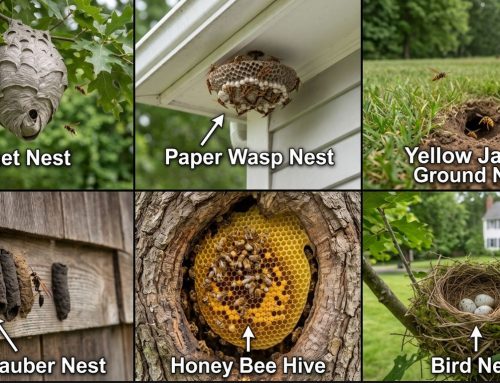
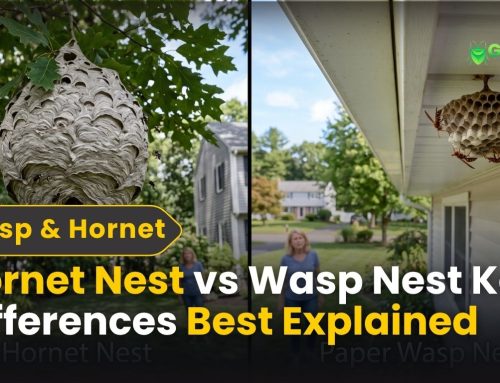
Paper wasps typically produce open combs with visible hexagonal cells. Bald-faced hornets make enclosed, layered paper nests. Yellow jackets can occupy subterranean cavities or concealed structural spaces.
The guide to types of wasp nests and wasp nest identification chart provide useful visual distinctions.
Bees require a different assessment
Do not assume every cluster of flying insects should receive wasp treatment.
Bees are important pollinators, and different insects may require different management approaches. Use the bee versus wasp identification guide if you are uncertain.
Why Do Wasps and Hornets Nest Around Connecticut Homes?
Residential properties unintentionally provide the three things insects need: food, water, and shelter.
Protected structural voids and landscape features can make excellent nesting sites. Common conducive conditions include gaps around construction materials, hollow trees, old burrows, protected overhangs, sheds, decks, and dense vegetation.
Food availability can also bring foragers into closer contact with people.
Outdoor food and garbage
Yellow jackets are particularly noticeable around cookouts and outdoor eating areas.
Keep garbage covered, clean spilled drinks, rinse recyclables when appropriate, and do not leave sugary foods or protein scraps exposed longer than necessary.
Structural gaps
Small openings around rooflines and exterior construction can allow insects into voids.
Exclusion is useful prevention, but timing matters. Seal potential entry points when they are confirmed inactive rather than trapping an active social-wasp colony inside a structure.
Landscape habitat
Flowering plants naturally attract pollinating and predatory insects. That is not inherently a pest problem.
The objective of IPM is not to create an insect-free yard. It is to reduce unacceptable risk while preserving beneficial organisms whenever practical.
Which Wasps Are Most Dangerous?
There is no scientifically useful single winner for the “most dangerous wasp” around every Connecticut home.
A more useful ranking evaluates the situation.
Social yellow jackets and related colony-forming wasps can pose considerable residential risk because multiple workers may defend a nest. Bald-faced hornet colonies can also defend their nesting area. European hornets should be treated cautiously around a colony.
Paper wasps can sting when their nest is threatened but may be less problematic when simply foraging away from the colony.
Many solitary and parasitoid wasps are comparatively low-risk to people and can be beneficial.
For Connecticut homeowners, the potentially most dangerous situation is usually not the biggest insect. It is a well-established social colony located where accidental human contact is likely.
For further species comparisons, see which is worse, a hornet or a wasp.
What Are the Least Aggressive or Non-Stinging Wasps?
“Non-stinging wasp” can be misleading because the enormous diversity of wasps includes species with very different anatomy and behavior.
Many tiny parasitoid wasps are functionally harmless to people and do not represent a normal household sting threat. Some solitary wasps technically can sting but generally reserve their venom for prey and have little reason to defend territory against humans.
That is very different from social wasps defending a colony.
The guide to what parasitic wasps are explains why these insects are often beneficial.
When identification is uncertain, avoid grabbing, trapping, or handling the insect to test whether it can sting.
Hornet Sting and Wasp Sting Pain Scale
No pain scale can reliably predict your medical outcome.
Stings are often described as immediately sharp, burning, or hot. Local pain may be followed by redness, itching, tenderness, and swelling.
Individual perceptions vary significantly.
A practical safety scale is more useful for homeowners than trying to assign a precise pain number:
| Reaction | What it may look like | General response |
| Mild local | Pain, limited redness or swelling | Basic first aid and monitoring |
| Large local | Swelling extending well beyond immediate sting area | Contact a healthcare professional for guidance, especially if severe |
| Systemic allergic | Hives or symptoms away from sting site | Seek urgent medical assessment |
| Suspected anaphylaxis | Breathing/throat problems, faintness or rapidly progressing multisystem symptoms | Epinephrine if prescribed and call 911 |
| Numerous stings | Multiple venom exposures | Seek prompt medical advice/assessment |
The key principle is that allergy severity and pain severity are not the same thing.
Wasp Sting Treatment and First Aid
For an uncomplicated local reaction, basic sting first aid can help reduce discomfort.
First, move away from the area where the sting occurred. This is especially important if a colony is nearby.
Then:
- Check the skin. Wasps generally do not leave a stinger, but if a stinger is visibly present after an uncertain insect sting, remove it promptly.
- Wash the area with soap and water.
- Apply a cold pack wrapped in cloth for short intervals to help with pain and swelling.
- Avoid scratching, which can damage skin and contribute to secondary infection.
- Monitor for symptoms developing elsewhere in the body.
The Mayo Clinic’s insect sting first-aid guidance offers additional general medical information.
Green Pest Management CT also has a dedicated hornet sting treatment guide focused specifically on this issue.
When is a sting an emergency?
Call 911 when symptoms suggest anaphylaxis, including difficulty breathing or significant throat/tongue swelling, fainting, or rapidly progressing systemic symptoms.
Someone with a diagnosed insect-venom allergy should follow the emergency plan provided by their healthcare professional and use prescribed epinephrine as directed.
People who have experienced significant systemic reactions should discuss future risk with an allergist.
Common Sting-Treatment Mistakes
One common mistake is focusing exclusively on the appearance of the sting site while ignoring symptoms occurring elsewhere.
Another is assuming no danger exists because the person has been stung safely in the past. Allergic responses are not something homeowners should attempt to predict from prior encounters alone.
Other questionable approaches include cutting the skin, attempting to suck out venom, applying unknown chemicals, or relying on internet remedies instead of established first-aid recommendations.
When symptoms are serious, medical care matters more than identifying the exact insect.
Connecticut Seasonal Patterns
Fairfield County’s changing seasons strongly influence wasp and hornet activity.
Spring: colony establishment
Overwintered queens emerge as temperatures warm and begin searching for nesting sites.
Early nests can be small and easy to overlook. This is a useful season to inspect eaves, sheds, decks, railings, and other familiar nesting locations without approaching active colonies.
Early summer: colony growth
Worker populations increase and colonies become more active.
Homeowners may begin noticing repeated traffic into ground holes or structural openings.
Regular observation can reveal problems before a large colony and summer household activity intersect.
Late summer into early fall: frequent conflict
This is often an important period for wasp encounters in Connecticut.
Established colonies may contain many workers, while people are simultaneously spending time outdoors at decks, pools, patios, athletic areas, gardens, and cookouts.
Food-scavenging yellow jackets may also become especially noticeable around garbage and outdoor meals.
Late fall and winter
Freezing weather ends many annual social-wasp colonies. Newly produced queens of certain species survive winter in protected locations and establish new colonies the following year.
An old nest is generally not reused as an active colony in the same way the following season, although favorable properties may repeatedly attract new nests.
Do not assume a structural opening is safe to seal merely because activity seems lower on one cool day. Confirm inactivity.
For timing questions, the guide on when wasps are least active explains daily and seasonal considerations.
Local Safety Concerns in Fairfield County, Connecticut
Greenwich, Stamford, Darien, Westport, Fairfield, Wilton, New Canaan, and Norwalk combine wooded landscapes, mature trees, landscaped properties, dense residential neighborhoods, coastal influences in some communities, and a wide range of home designs.
Those conditions create plenty of potential interaction points with stinging insects.
Greenwich and Stamford
Older structures, mature landscaping, roof details, decks, wall voids, and wooded property edges can provide potential nesting sites. Densely used outdoor areas increase the importance of addressing colonies close to people.
Darien and Westport
Decks, porches, rooflines, sheds, pools, outdoor kitchens, hedges, and landscaped yards can create both nest habitat and regular human activity around nests.
Fairfield and Norwalk
Residential density can mean a nest affects more than one household. A colony near a shared boundary, sidewalk, driveway, or outdoor recreation area requires careful assessment of exposure.
Wilton and New Canaan
Larger wooded properties can contain ground cavities, hollow trees, stone walls, sheds, and less frequently traveled spaces where colonies remain unnoticed until landscaping or maintenance disturbs them.
Location alone does not determine whether treatment is needed. Nest location relative to people remains the critical consideration.
Preventing Wasp and Hornet Problems
Prevention works best when it reduces food, shelter, and accidental encounters without indiscriminately killing beneficial insects.
Homeowners can:
- Keep exterior trash containers closed and clean.
- Clean spilled sugary drinks and food after outdoor meals.
- Inspect eaves, porch ceilings, sheds, play structures, and railings periodically.
- Look for repeated insect traffic before mowing or trimming unfamiliar areas.
- Repair appropriate structural gaps when confirmed inactive.
- Avoid leaving pet food outdoors unnecessarily.
- Keep household members away from known nests.
- Teach children not to throw objects at nests.
- Inform landscapers and contractors about active colonies.
- Avoid swatting at solitary foraging wasps.
- Arrange professional identification when species or nest location is uncertain.
The EPA’s broader Integrated Pest Management principles support prevention, monitoring, accurate identification, and appropriately targeted controls rather than unnecessary pesticide use.
DIY vs. Professional Wasp and Hornet Control
Not every wasp sighting needs an exterminator.
A single insect visiting flowers can usually be left alone. An old, inactive nest also presents a different issue from a thriving colony.
Professional involvement becomes much more appropriate when the consequences of a DIY error increase.
| Situation | DIY observation/prevention | Professional assessment |
| Single foraging wasp | Usually reasonable | Usually unnecessary |
| No nest and no repeated activity | Usually reasonable | Optional |
| Ground colony beside walkway | High-risk DIY situation | Recommended |
| Active nest above a doorway | Avoid disturbance | Recommended |
| Wall-void activity | Do not seal/spray blindly | Recommended |
| Large aerial colony | Keep clear | Recommended |
| Ladder required | Avoid DIY | Recommended |
| Household venom allergy | Avoid exposure | Strongly recommended |
| Species uncertain | Observe remotely | Useful |
A fuller discussion is available in the hornet nest removal DIY versus professional guide.
What Professional Stinging-Insect Control Involves
Professional treatment should be based on inspection rather than automatically spraying the first insect found.
Professional inspection
A technician evaluates flight activity, likely species, nest location, structural conditions, human exposure, and potential treatment challenges.
Observing where insects enter and leave is particularly valuable with hidden colonies.
Identification
Identifying the pest guides the control strategy.
The treatment appropriate for a ground yellow jacket colony may differ from an exposed paper-wasp nest or insects occupying a structural cavity.
Risk control
The area surrounding the colony is considered before work begins.
Pedestrians, children, pets, neighbors, open windows, pools, food areas, ladders, electrical equipment, and other site conditions can affect the safest approach.
Targeted treatment
A pest-management professional selects a control method appropriate for the pest, site, and applicable product labeling.
Integrated Pest Management aims to solve the actual problem while avoiding unnecessary environmental exposure.
Follow-up assessment and exclusion
Activity may need to be monitored following treatment. Once a structural colony has been controlled and inactivity confirmed, appropriate entry points can potentially be repaired or sealed to reduce future problems.
Green Pest Management CT’s hornet exterminator services and safety guide explains what homeowners can expect from professional assistance.
What Not to Do Around a Wasp or Hornet Nest
Some of the highest-risk incidents begin with improvised attempts to remove a colony.
Avoid striking or shaking a nest. Do not direct a garden hose or pressure washer at it, block an active wall opening without a management plan, pour flammable substances into ground nests, burn a nest, or climb an unstable ladder to reach one.
Also avoid assuming darkness makes every DIY approach safe. Lower activity is not the same as zero activity, and equipment, nest position, insect identification, and treatment technique still matter.
For homeowners already dealing with an urgent colony near an entrance or occupied space, the emergency hornet removal guide provides additional precautions.
How to Assess a Nest Without Getting Too Close
You rarely need to stand directly beside a nest to collect useful information.
From a safe position, note:
- Where insects disappear into or emerge from.
- Whether the nest is aerial, underground, or structural.
- Approximate insect color and size.
- Whether there is an exposed comb or enclosed paper envelope.
- Whether activity is concentrated around one opening.
- What people or pets regularly use the surrounding area.
A photo taken with optical zoom can be useful, provided taking it does not require approaching the colony.
Do not obstruct the insects’ flight path for a photograph.
Green Pest Management CT’s Connecticut wasp and hornet ID guide can then be used to compare visible features.
Most Important Factors in a Professional Safety & Threat Assessment
Pest professionals typically care more about exposure and colony conditions than dramatic descriptions such as “huge hornet.”
A nest can be considered more urgent when it is close to a front entrance, children’s play area, busy walkway, deck, patio, pool, mailbox, work area, or lawn-maintenance route.
The same species nesting well away from routine activity may represent a different management decision.
That distinction is central to Integrated Pest Management: control should be based on actual risk and pest pressure rather than fear alone.
Special Considerations for People With Sting Allergies
A known venom allergy changes the threshold for accepting a nearby colony.
Someone with a history of systemic sting reactions should discuss preparedness and medical management with their physician or allergist. If prescribed epinephrine, they should keep it available according to medical instructions and understand how and when to use it.
Family members may also need to understand the emergency plan.
From a pest-management standpoint, a person with a known allergy should not perform nest treatment personally. A colony that might represent a moderate nuisance to another household can create a much greater consequence for that individual.
Medical risk and pest pressure have to be considered together.
Protecting Children and Pets
Children may see a paper nest as something interesting to poke, knock down, or spray with a toy.
Explain that nests should never be disturbed.
Where an active colony has been identified, create an exclusion area that does not force anyone to pass close to it. Keep pets away as well.
Dogs may dig at underground colonies or snap at individual insects. Veterinary care should be sought promptly when a pet experiences concerning facial or mouth swelling, breathing problems, collapse, repeated vomiting, multiple stings, or another serious reaction.
Veterinary questions should be directed to a veterinarian rather than treated using human medication without professional guidance.
Why “Aggressive Wasp” Can Be a Misleading Description
Homeowners frequently describe any wasp flying nearby as aggressive.
That behavior can have several explanations.
An insect may be foraging, collecting water, hunting prey, investigating an odor, navigating back toward a nest, or defending a colony.
True nest defense is the behavior that matters most for residential safety.
Repeated insects flying toward a person near a specific location, particularly after vibration or disturbance, is more concerning than one insect circling flowers.
Understanding this difference helps avoid unnecessary killing of beneficial wasps while maintaining appropriate caution around social colonies.
For more behavioral context, see Green Pest Management CT’s wasp and hornet behavior hub.
Why Integrated Pest Management Matters
Responsible pest control is not about applying the largest possible quantity of pesticide.
IPM combines identification, inspection, prevention, monitoring, exclusion, sanitation, and targeted treatment.
For stinging insects, this means asking:
What species is present? Is a colony actually established? Where is it? Who is at risk? Can exposure be reduced? Is treatment necessary? What method addresses the source rather than simply killing visible workers?
That framework is especially valuable in Fairfield County, where homeowners often want outdoor spaces protected without unnecessarily disrupting pollinators and beneficial insects.
When Should Connecticut Homeowners Call a Professional?
Consider scheduling a professional inspection when:
- Multiple wasps repeatedly enter the same location.
- An active nest is beside an entrance, patio, deck, pool, or play area.
- A colony is underground where people mow or walk.
- Wasps are entering siding, roofing, soffits, or wall voids.
- The nest requires ladder or roof access.
- Someone in the household has a known sting allergy.
- The species cannot be safely identified.
- DIY treatment has already failed.
- Insects have begun appearing inside the house.
- The colony is large or difficult to approach safely.
Green Pest Management CT serves homeowners throughout Greenwich, Stamford, Darien, Westport, Fairfield, Wilton, New Canaan, Norwalk, and surrounding Fairfield County communities.
Homeowners facing an active nest can contact Green Pest Management CT to schedule an inspection and discuss an appropriate pest-management approach.
Frequently Asked Questions
What is the difference between a wasp bite and a wasp sting?
A sting involves venom delivered through the insect’s stinger and is the primary defensive injury people experience from wasps. Wasps have mandibles and can use them, but reported painful encounters with yellow jackets, hornets, and paper wasps are usually stings.
Is a hornet sting more dangerous than a wasp sting?
Not automatically. Hornets are a type of wasp, and medical risk depends on the species, number of stings, sting location, and especially the person’s reaction to venom. Any sting can be serious for someone with a venom allergy.
What are the most dangerous wasps in Connecticut?
Social species defending established colonies are generally the greatest residential concern. Yellow jackets, bald-faced hornets, and other social wasps can become hazardous when nests are close to people. The nest’s location and a person’s allergy history may be more important than the species’ reputation.
Which wasps are least aggressive?
Many solitary and parasitoid wasps have little interest in confronting people. Paper wasps may also forage peacefully away from their nests but can defend the colony if approached. “Least aggressive” does not mean incapable of stinging.
Are there non-stinging wasps?
Some wasp species present essentially no practical sting threat to people, and numerous tiny parasitoid wasps are beneficial. However, identification can be difficult, so homeowners should not handle an unknown wasp to determine whether it stings.
What should I do immediately after a wasp sting?
Move away from the nest area, wash the site with soap and water, use a cloth-wrapped cold pack for discomfort, and monitor for allergic symptoms. If a stinger from an uncertain insect is present, remove it promptly. Trouble breathing, throat or tongue swelling, faintness, or other symptoms suggesting anaphylaxis require emergency care.
Can wasps sting multiple times?
Yes. Unlike a honey bee worker, which typically leaves its barbed stinger behind in human skin, wasps and hornets generally retain their stingers and can sting repeatedly.
Should I seal a hole where yellow jackets are entering my house?
Not while an active colony is still using it unless a qualified professional has determined that exclusion is appropriate as part of the treatment plan. Prematurely sealing an active entry can cause insects to seek alternate routes, potentially toward the home’s interior.
When are wasps and hornets most problematic in Connecticut?
Activity grows through the warmer months and encounters can become particularly common during late summer and early fall, when social colonies are mature and outdoor human activity remains high. Weather and species cause year-to-year variation.
When does a Safety & Threat Assessment indicate professional pest control is appropriate?
Professional help is particularly appropriate for nests close to people, underground colonies beside traffic areas, hidden wall or roof nests, colonies requiring ladder access, repeated indoor activity, large colonies, and properties where someone has a known insect-venom allergy.
Conclusion: Evaluate the Risk Before You Approach the Nest
The safest way to deal with wasps and hornets is not to assume every insect is dangerous or every nest can be handled with a spray can.
A sound Safety & Threat Assessment considers the species, colony location, behavior, number of insects, human exposure, individual allergy risk, and difficulty of treatment. Yellow jackets and other social wasps deserve particular caution around active colonies, while many solitary and parasitoid wasps represent little threat and provide ecological benefits.
For stings, remember the most important distinction: pain is not the same as medical danger. Watch for systemic allergic symptoms, and call 911 for suspected anaphylaxis.
For pest problems, look for the source rather than focusing only on individual insects. Repeated traffic into a lawn opening, soffit, wall gap, shrub, or other fixed location is a strong clue that a colony may be present.
Connecticut homeowners in Greenwich, Stamford, Darien, Westport, Fairfield, Wilton, New Canaan, Norwalk, and nearby Fairfield County communities who discover an active or difficult-to-access nest can contact Green Pest Management CT’s professional pest control team to arrange an inspection and determine an appropriate treatment and prevention strategy.