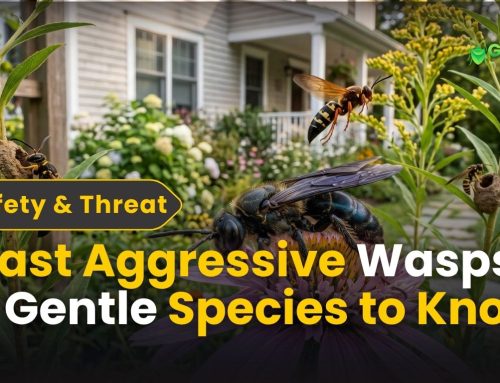
Hornets vs Bees: 7 Key Differences You Need to Know
Is That a Bee or a Hornet? The Answer Changes Everything
You’re walking through your garden in Fairfield and something large and striped lifts off from a nearby shrub. Your instinct is to freeze but what you do next depends entirely on what that insect actually is.
Hornets vs. bees is one of the most consequential identification mistakes a homeowner can make. Treat a bee colony like a hornet nest and you’ve potentially destroyed a protected pollinator population. Treat a hornet colony like a gentle bee hive and you risk a dangerous, potentially serious encounter with one of the most defensive stinging insects in Connecticut.
These two groups of insects share some surface similarities they’re both flying, both striped, and both capable of stinging. But they’re fundamentally different in body structure, behavior, nesting habits, ecological role, and the level of risk they pose on your property. This guide covers seven clear, practical differences to help you make the right call whether that’s leaving the nest alone, contacting a beekeeper, or reaching out to a professional pest management team.
The Quick Answer: Hornets vs. Bees
Bees and hornets belong to the same order of insects (Hymenoptera) but are otherwise quite distinct. Bees are fuzzy, pollen-collecting pollinators that feed on nectar and plant material. Hornets are smooth-bodied, predatory insects that hunt other insects and build enclosed paper nests. Bees are generally calm and defensive only when their hive is directly threatened. Hornets maintain an active territorial perimeter and will pursue threats significantly further from their nest.
The management approach for each is completely different which makes accurate identification the most important first step you can take.
For a broader look at how hornets compare to other stinging insects common in Connecticut, the wasp vs. hornet CT comparison hub and the wasps vs. hornets key differences guide provide additional context.
Difference 1: Body Surface The Fuzz Test
This is the single fastest way to distinguish a bee from a hornet, and it works almost every time.
Bees are furry. All bee species honeybees, bumblebees, mason bees, sweat bees have branched, feathery body hairs that trap pollen as they forage. This gives them a distinctly fuzzy or velvety appearance, especially around the thorax and abdomen. The hair is functional: it’s how bees collect and transport pollen from flower to flower, which is central to their ecological role as pollinators.
Hornets are smooth. Hornets and wasps have hard, shiny exoskeletons with minimal hair. They look sleek, angular, and almost lacquered compared to bees. If you can get a clear enough look at the insect in question even briefly this surface texture difference is immediately apparent.
This single observation point resolves most hornets vs. bees confusion quickly. Fuzzy body? Almost certainly a bee. Smooth, shiny body? Wasp or hornet.
For a more detailed look at what hornets actually look like up close, the what does a hornet look like guide provides species-level visual descriptions that are helpful for field identification in Connecticut.
Difference 2: Size and Body Shape
Once you’ve established fuzziness (or lack of it), size and body shape give you additional confirmation.
Bees
Honeybees (Apis mellifera) are relatively small about ½ inch to ⅝ inch long with an oval, somewhat tapered abdomen and a noticeably stocky build. They’re golden-amber to brown in color with lighter banding.
Bumblebees (Bombus species) are larger and rounder, ranging from ½ inch to over an inch depending on the species and caste. They’re the most bee-like looking insect you’ll encounter in Connecticut gardens plump, densely hairy, slow-moving, and distinctly un-threatening in flight. Their size sometimes causes them to be confused with hornets, but the dense body hair resolves that confusion quickly.
Carpenter bees (Xylocopa species) are similarly sized to bumblebees but have a distinctly shiny, hairless black abdomen which makes them look almost halfway between a bee and a wasp. They’re wood-borers rather than hive-builders, which creates a completely different type of property problem.
Hornets
Bald-faced hornets (Dolichovespula maculata) reach ¾ inch to just over an inch. They’re elongated, smooth, and have a defined waist that gives them a very different silhouette from a bumblebee of similar length.
European hornets (Vespa crabro) are the largest common stinging insects in Connecticut up to 1.5 inches long. Despite their impressive size, they’re sleeker and more elongated than a bumblebee, with that characteristic wasp-like narrowing at the waist.
Size and Build Comparison:
| Species | Length | Build |
| Honeybee | ½ – ⅝ inch | Compact, hairy |
| Bumblebee | ½ – 1+ inch | Round, very hairy |
| Carpenter bee | ¾ – 1 inch | Round, hairless abdomen |
| Bald-faced hornet | ¾ – 1 inch | Elongated, smooth |
| European hornet | 1 – 1.5 inches | Large, robust, smooth |
Difference 3: Color and Markings
Color is a supporting identifier not a definitive one on its own, but useful when combined with body surface and shape observations.
Honeybees display golden amber, brown, and black banding. Their coloring is warm and earthy rather than the sharp, vivid yellow-black of wasps.
Bumblebees are black and yellow with dense, fuzzy bands sometimes with orange or white markings depending on the species. Several bumblebee species are present in Connecticut, with varying color patterns, but the dense hair always gives them away.
Carpenter bees have a shiny, all-black abdomen with yellow or black hair on the thorax. The contrast between the furry thorax and the smooth, bare abdomen is distinctive.
Bald-faced hornets are black and white a stark, high-contrast pattern with white facial markings and white banding on the abdomen. There’s very little yellow in their coloring, which makes them easier to distinguish from bees than many people expect. The bald-faced hornet identification and removal guide provides detailed visual descriptions if you’ve spotted these insects on your Fairfield County property.
European hornets have a brown and yellow pattern more muted than yellow jackets but distinctly different from the warm amber tones of a honeybee. Their brownish thorax sometimes causes them to be mistaken for large flies or beetles at a distance.
Difference 4: Diet and Ecological Role
This difference is foundational to understanding why bees and hornets require completely different responses from homeowners.
Bees: Pollen, Nectar, and Pollination
Bees are herbivores. Their diet consists entirely of plant-based material nectar for adult energy and pollen for larval nutrition. This dietary dependence on flowers is what drives the pollination services that make bees ecologically indispensable.
According to the USDA Natural Resources Conservation Service, bees are responsible for pollinating approximately 75% of flowering plants and about 35% of the world’s food crops. In Connecticut’s agricultural and residential garden context, bees particularly native bumblebees and honeybees play a critical role in the health of vegetable gardens, orchards, and native plant communities across Fairfield County.
This ecological significance is the primary reason bee colonies are treated differently from hornet nests. Destroying a bee colony unnecessarily has real consequences beyond the immediate property.
Hornets: Insect Predators
Hornets are carnivores (as larvae) and omnivores (as adults). Workers hunt insects flies, caterpillars, other wasps, even honeybees to feed protein to developing larvae. Adults supplement their diet with sugary substances like tree sap, nectar, and overripe fruit.
Hornets do provide some ecological benefit as insect population controllers they suppress flies, caterpillars, and various garden pests. But their predatory nature, combined with their territorial behavior, means they don’t carry the same protected status or the same imperative to preserve the colony when it’s established in a dangerous location.
The do hornets eat wasps predator behavior guide explores hornet hunting behavior in more detail, including what they target and how this affects other insect populations on your property.
Difference 5: Nesting Structure, Location, and Scale
Nest identification is often the most reliable way to confirm whether you’re dealing with bees or hornets and it determines the urgency and approach of your response.
Bee Nests
Honeybee colonies build wax comb structures the familiar hexagonal honeycomb that most people have seen in pictures. In managed hives, this comb is housed in wooden boxes. In wild or feral colonies, honeybees establish themselves in tree cavities, wall voids, chimneys, and other enclosed spaces. If you’re hearing a sustained, low buzzing hum from inside a wall or ceiling in your Greenwich or Stamford home, a feral honeybee colony is a serious possibility.
Bumblebees nest in the ground or in small cavities under piles of debris, in abandoned rodent burrows, under dense vegetation, or inside hollow logs. Their colonies are much smaller than honeybee colonies (typically a few dozen to a few hundred individuals) and the nest itself is an irregular cluster of waxy cells without the structured comb of honeybees.
Carpenter bees don’t build a social nest at all each female drills her own gallery into untreated wood. You’ll identify carpenter bee activity by perfectly circular entry holes, about ½ inch in diameter, in deck railings, fascia boards, fence posts, and wooden siding.
Hornet Nests
Bald-faced hornets build the enclosed, football-shaped gray paper nests that are a familiar sight across Connecticut properties in late summer. These are suspended from tree branches, shrubs, and eaves. They’re constructed from chewed wood fiber mixed with saliva — an entirely different material from bee wax comb. For a visual comparison, the bee hive vs. wasp nest how to tell apart guide covers the structural differences clearly.
European hornets prefer enclosed cavity nesting inside hollow trees, wall voids, attics, and outbuildings. Their nests have the same enclosed paper structure as bald-faced hornet nests but are hidden inside structures rather than suspended visibly.
Key Nest Distinction: Bee nests are made of wax and contain stored honey or pollen. Hornet nests are made of paper-like material and contain no stored food products. This is immediately apparent if you can observe the nest material without disturbing it.
The hornet nest vs. wasp nest key differences guide and the types of wasp nests guide provide additional structural detail across species.
Difference 6: Aggression and Sting Behavior
This is arguably the most important practical difference and the one that most directly affects how you should respond to an encounter on your property.
Bee Stinging Behavior
Honeybees are defensive rather than aggressive. They sting to protect their colony, not to assert territory beyond it. A foraging honeybee away from the hive almost never stings she has no reason to. Stinging is a last resort for a honeybee because the honeybee’s barbed stinger detaches after use, causing the bee to die shortly afterward. This means every sting is a sacrifice, which makes honeybees genuinely reluctant stingers.
When a honeybee colony does sting defensively, it releases alarm pheromones that can recruit other workers. Mass defensive stinging from a disturbed honeybee colony is serious but it’s triggered by direct interference with the nest, not by proximity.
Bumblebees are even more tolerant. They rarely sting unless directly handled or accidentally sat on. Their stingers are smooth (not barbed), allowing them to sting multiple times, but they almost never do. Most people who have gardens in Westport, Darien, and New Canaan spend entire summers alongside active bumblebee populations with zero stinging incidents.
Hornet Stinging Behavior
Hornets are a different matter entirely. Unlike bees, hornets are not reluctant stingers. They don’t sacrifice their stinger it’s smooth and re-usable, allowing multiple stings from a single individual. And unlike bees, hornets defend a territorial perimeter that extends well beyond the physical nest.
Bald-faced hornets are particularly aggressive. They will actively pursue threats that approach their nest perimeter which can extend 10 feet or more from the nest structure itself. When alarmed, they release a pheromone that recruits other workers rapidly. Multiple stings from multiple individuals can occur within seconds of disturbing a bald-faced hornet nest.
European hornets are less immediately hair-trigger than bald-faced hornets but defend their colony vigorously when threatened. Their nocturnal activity also creates risk situations that bees don’t European hornets flying indoors through gaps in search of light can cause surprising, potentially dangerous encounters inside Fairfield County homes after dark.
For more on what triggers defensive hornet behavior, the are hornets territorial and what triggers them guide is detailed and practically useful.
Difference 7: What to Do When You Find Them
This is where the hornets vs. bees distinction translates into direct action and the two situations call for very different responses.
Finding Bees on Your Property
In a garden or on flowers: Do nothing. A foraging bee on flowers is not a threat and is performing a valuable ecological function. Leave it alone.
Small bumblebee nest in a low-traffic area: Consider leaving it alone until the colony ends naturally in fall. Bumblebee colonies are annual they don’t overwinter. By November, the colony will be gone on its own.
Feral honeybee swarm: A honeybee swarm (a cluster of bees without an established nest) is temporary and generally non-aggressive. Contact a local beekeeper many in Fairfield County are willing to collect swarms at no charge. The Connecticut State Beekeepers Association can connect you with local beekeepers who handle swarm relocations.
Established feral honeybee colony inside a wall void: This requires professional assessment. The colony needs to be removed not just killed to prevent the wax comb and honey from melting inside your wall and causing secondary structural and pest problems. A beekeeper in combination with a pest management professional is typically the right team for this situation.
Carpenter bee damage: Wood treatment and sealing entry holes (after the season ends) is the standard approach. A professional inspection can assess the extent of damage and recommend appropriate treatment options.
Finding Hornets on Your Property
Any hornet nest near a structure, entryway, play area, or high-traffic zone: Contact a professional. Don’t attempt DIY treatment of a hornet nest without full protective equipment and a clear plan and even then, hornet nest removal carries meaningful risk that most homeowners underestimate.
A hornet nest in a low-traffic tree location: Assess urgency based on proximity to human activity. A nest 30 feet up in a tree at the back of your property poses different risk than one at head height in a shrub next to your back door. A professional can help you make that risk assessment accurately.
European hornets entering your home at night: Identify and seal the entry points they’re using. Treating the colony in the wall void or tree cavity they’re nesting in requires professional treatment. The emergency hornet removal guide covers urgent situations and appropriate responses.
Green Pest Management CT provides professional hornet exterminator services throughout Greenwich, Stamford, Darien, Westport, Fairfield, Wilton, New Canaan, Norwalk, and surrounding Fairfield County communities. Their approach follows Integrated Pest Management (IPM) principles using targeted methods that eliminate the specific pest problem while preserving beneficial insects like bees wherever possible.
Complete Hornets vs. Bees Comparison Table
| Feature | Honeybee | Bumblebee | Bald-Faced Hornet | European Hornet |
| Body surface | Fuzzy, hairy | Very fuzzy, dense | Smooth, shiny | Smooth, shiny |
| Size | ½ – ⅝ inch | ½ – 1+ inch | ¾ – 1 inch | 1 – 1.5 inches |
| Color | Amber/brown/black | Black & yellow | Black & white | Brown & yellow |
| Waist | Less defined | Less defined | Narrow, defined | Narrow, defined |
| Nest material | Wax comb | Waxy cells in cavity | Paper (chewed wood) | Paper (chewed wood) |
| Nest location | Tree cavities, wall voids | Ground, cavities | Aerial, suspended | Enclosed cavities |
| Diet | Nectar, pollen | Nectar, pollen | Insects, sap | Insects, sap, fruit |
| Stinger | Barbed (dies after sting) | Smooth (rarely stings) | Smooth (multiple stings) | Smooth (multiple stings) |
| Aggression | Defensive only | Very low | Very high | High |
| Ecological role | Pollinator | Pollinator | Pest controller | Pest controller |
| Protect or remove? | Protect/relocate | Protect where possible | Remove if risk present | Remove if risk present |
Seasonal Patterns in Connecticut: When You’ll Encounter Each
Understanding when bees and hornets are most active helps Connecticut homeowners anticipate encounters and respond appropriately.
Spring (April–May)
Bumblebee queens emerge early and begin searching for nesting sites often ground cavities in garden beds, under decks, or in compost piles. Honeybee swarms from established colonies are most common in May and June as colonies grow and split.
Hornet queens emerge from overwintering sites and begin founding new colonies alone. Early season hornet nests are small and minimally defended this is the safest window for intervention if you locate an establishing nest.
Summer (June–August)
Both bee and hornet populations grow steadily. This is peak pollinator activity for bees if you’re seeing lots of fuzzy insects in your garden, most of them are beneficial. Hornet colonies expand rapidly, and bald-faced hornet nests become visibly large by mid-summer.
Late Summer and Fall (August–October)
Hornet colonies reach maximum size in August and September. This is the highest-risk window for hornet encounters across Greenwich, Stamford, Darien, Westport, and all of Fairfield County. Bee colonies are beginning to prepare for winter honeybee colonies reduce in size and become somewhat more defensive as they protect overwintering stores.
Winter (November–March)
Honeybee colonies overwinter as a cluster inside their hive, surviving on stored honey. Bumblebee colonies die off only new queens survive to overwinter in soil. Hornet colonies completely collapse workers die, and only mated queens survive by finding sheltered overwintering sites. Abandoned hornet nests are inactive through winter.
The wasp lifespan and lifecycle guide explains the colony lifecycle across stinging insect species in detail, which is useful context for understanding seasonal behavior differences.
Common Mistakes Homeowners Make with Bees and Hornets
Getting this wrong has real consequences both for your safety and for Connecticut’s pollinator populations. Here are the most frequent mistakes the team at Green Pest Management CT sees across Fairfield County properties:
Killing bees out of fear. If a large, fuzzy insect is hovering around your garden or lawn, it’s almost certainly a bumblebee and bumblebees are protected pollinators that rarely sting. Reaching for pesticide spray is almost never the right response to a bee encounter in a garden context.
Treating a hornet nest like a bee nest. Some homeowners, seeing a large cluster of flying insects near their property, assume “bees” and contact a beekeeper. A beekeeper arriving to collect what’s actually a bald-faced hornet colony is not a situation anyone wants. Identification first always.
Attempting DIY hornet nest removal without appropriate protection. This is one of the most common causes of serious stinging incidents. Even a small hornet nest can produce a significant defensive response when disturbed. Full protective equipment is not optional.
Leaving a feral honeybee colony inside a wall void untreated. A colony that’s killed without removal leaves behind wax comb and honey that will melt in summer heat, attract secondary pests (wax moths, small hive beetles, ants), and potentially cause structural damage. Removal not just extermination is the right approach for interior bee colonies.
Not contacting a beekeeper first for bee situations. Many beekeepers in Fairfield County will relocate swarms and accessible colonies for free or at minimal cost. This preserves the colony and solves your problem simultaneously.
Local Perspective: Bees and Hornets in Fairfield County
Connecticut’s Fairfield County communities present a genuinely mixed pest landscape when it comes to bees and hornets:
Greenwich and Darien with their extensive mature landscaping and native garden plantings, support robust pollinator populations. Bumblebees, mason bees, and honeybees are all common and beneficial on these properties. European hornets are also prevalent in hollow trees and older home wall voids in these communities.
Westport and Fairfield coastal communities with native plantings and rain gardens are particularly strong habitats for native pollinators. Homeowners in these areas should be especially careful about identification before taking any action near flying insects in garden areas.
Wilton and New Canaan, heavily wooded with significant undeveloped land adjacent to residential properties, see higher concentrations of bald-faced hornets. The forest edge habitat that characterizes these communities is ideal for bald-faced hornet nesting in shrubs and tree branches.
Stamford and Norwalk, more urbanized environments, see carpenter bee damage as a more common concern on older wooden structures, alongside yellow jacket and paper wasp activity near commercial areas and mixed-use developments.
For identification support specific to Connecticut species, the wasp and hornet ID encyclopedia for Connecticut and the CT wasp and hornet ID guide are comprehensive regional resources.
Frequently Asked Questions
What is the easiest way to tell a bee from a hornet?
Look at the body surface. Bees are fuzzy and hairy their body hair is dense and visible even from a short distance. Hornets have smooth, shiny exoskeletons with no significant hair. This single observation resolves most hornets vs. bees identification questions quickly and reliably.
Are hornets more dangerous than bees?
In terms of unprovoked aggression, yes. Hornets defend a larger territorial perimeter, sting more readily, and can sting multiple times without consequence to themselves. Bees particularly honeybees are reluctant stingers that sacrifice their stinger in the process, making defensive stinging a last resort. That said, mass defensive stinging from a severely disturbed bee colony is also serious.
Do bees or hornets sting more than once?
Hornets can sting multiple times their stingers are smooth and don’t detach. Honeybees have barbed stingers that lodge in skin and detach, causing the bee to die. Bumblebees have smooth stingers and can technically sting multiple times, but they almost never do.
Should I kill bees on my property?
Almost never. Bees are protected pollinators and ecologically valuable. Foraging bees away from a hive pose essentially no sting risk and should be left alone. For established colonies in inconvenient locations, contact a beekeeper for relocation rather than treating with pesticide. The Connecticut State Beekeepers Association can help connect you with local resources.
How do I know if I have a bee hive or a hornet nest inside my wall?
Listen and look. Honeybee colonies produce a sustained, low buzzing hum that’s often audible from inside the home. Hornet colonies in wall voids produce a sharper, higher-pitched buzzing. Honeybee colonies that have been established for a season may produce visible honey seepage through drywall in summer heat. If you see bees actively clustering around a single exterior entry point and hear buzzing from inside, a professional inspection is the appropriate next step.
Can bumblebees sting?
Technically, yes female bumblebees have smooth stingers and can sting multiple times. However, they almost never do. Bumblebees are among the gentlest stinging insects you’ll encounter. Stings typically only occur when a bumblebee is directly handled, squeezed, or accidentally trapped against skin.
What should I do if I find a bald-faced hornet nest near my home?
Do not approach it, disturb it, or attempt to spray it with commercial products without full protective equipment. Keep children and pets away from the area. Contact a professional pest management service for assessment and treatment. The hornet nest removal in CT guide explains the professional removal process in detail.
Are carpenter bees bees or wasps?
Carpenter bees (Xylocopa species) are true bees; they’re closely related to bumblebees. However, they’re solitary rather than social, and they bore into wood rather than building a communal hive. The problem they create, wood boring damage, requires a different response than either a social bee colony or a hornet nest.
Is a bumblebee the same as a hornet?
No they’re quite different despite sometimes being similar in size. Bumblebees are fuzzy, round, slow-moving pollinators. Hornets are smooth, elongated, fast-flying predators. The body surface difference is visible at close range and is the most reliable quick identifier.
When is the most dangerous time for hornet encounters in Connecticut?
Late summer, August through early October, represents the peak risk period across Fairfield County. Hornet colonies are at maximum size, food competition is increasing, and worker aggression is highest. This is when the most serious stinging incidents occur in Greenwich, Stamford, Darien, Westport, and surrounding communities.
Conclusion: Identification First Then the Right Response
The hornets vs. bees distinction is genuinely one of the most important pest identification calls a Connecticut homeowner makes. Getting it right means protecting your family from a genuinely dangerous insect, preserving the beneficial pollinators that make your garden function, and choosing a response that actually solves the problem rather than creating new ones.
The seven differences in this guide, body surface, size and shape, color, diet, nesting, aggression, and response protocol, give you a practical framework for making that identification confidently. Use them together rather than relying on any single factor, and you’ll get the right answer the vast majority of the time.
For properties across Greenwich, Stamford, Darien, Westport, Fairfield, Wilton, New Canaan, and Norwalk, the stinging insect season runs from spring through fall, with the most complex identification challenges and the highest-risk encounters clustered in late summer. Knowing the difference between what you want to leave alone and what you need to address professionally is the most valuable pest management knowledge a Fairfield County homeowner can have.
If you’ve found something on your property and aren’t confident in the identification, or if you’ve confirmed hornets and need professional support, Green Pest Management CT serves all of Fairfield County with expert identification and targeted treatment solutions. Their team approaches every situation with both the ecological awareness to protect beneficial insects and the professional capability to safely eliminate genuine threats.
You can also explore the complete pest identification and comparison content hub for additional guides covering wasps vs. hornets, fruit flies vs. drain flies, and other common Connecticut pest identification questions, all in one place.
For additional resources, visit the hornet control guide with 15 expert tips, the wasp hornet behavior hub, and the professional service lead hub for Connecticut-specific pest management support.