Hornet vs Wasp: 7 Key Differences Best Explained
You’ve Spotted Something. Now What?
You’re out on your deck in Darien on a warm August afternoon, and something large, striped, and fast is circling your head. Is it a wasp? A hornet? Does the difference actually matter?
It matters more than most people realize.
The hornet vs. wasp question isn’t just about trivia it’s about making the right call when you find a nest on your property. The wrong assumption can lead to the wrong treatment, a dangerous encounter, or an infestation that keeps coming back season after season. In Fairfield County, Connecticut, where wooded yards, mature trees, and coastal humidity create near-ideal conditions for stinging insects, this identification question comes up constantly from spring through fall.
This guide breaks down the seven most important differences between hornets and wasps size, color, body shape, nesting habits, aggression, diet, and sting risk — in plain, practical terms that help you make smart decisions. Whether you’re managing a property in Greenwich, Westport, Stamford, or Wilton, these are the distinctions that will actually help you.
The Short Answer: Are Hornets and Wasps the Same?
Technically, hornets are wasps but that’s where the casual overlap ends. Hornets belong to the genus Vespa and are the largest members of the broader wasp family (Vespidae). Think of it this way: all hornets are wasps, but most wasps are not hornets. The species you’re dealing with and how you respond to it depends on getting that identification right.
For a broader look at how these species compare in a Connecticut context, the wasps vs. hornets CT differences and dangers guide provides an excellent species-level breakdown specific to Fairfield County.
Hornet vs. Wasp: The Complete 7-Point Comparison
Difference 1: Size Hornets Are Noticeably Larger
This is the fastest field identification you can make, and it holds up consistently. In Connecticut, the most common wasps homeowners encounter include paper wasps (Polistes species) and yellow jackets (Vespula and Dolichovespula species). These range from roughly ½ inch to ¾ inch in length.
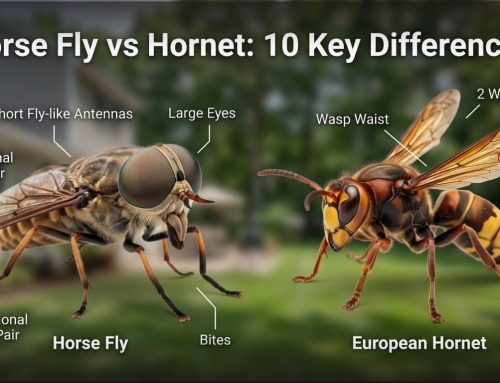
Hornets are meaningfully larger. The European hornet (Vespa crabro) the only true hornet species established in North America reaches up to 1.5 inches in length. The bald-faced hornet (Dolichovespula maculata) is technically a yellow jacket but is consistently referred to as a hornet due to its size and behavior, and it clocks in around ¾ inch to just over an inch.
Quick Size Reference:
| Species | Approximate Size |
| Paper wasp | ½ – ¾ inch |
| Yellow jacket | ⅜ – ⅝ inch |
| Bald-faced hornet | ¾ – 1 inch |
| European hornet | 1 – 1.5 inches |
If the insect you’re looking at seems noticeably large bigger than a typical yellow jacket size alone gives you a working hypothesis that you’re dealing with a hornet. Pair that with the other differences below to confirm.
Difference 2: Color and Markings Patterns That Distinguish Species
Color is one of the first things people notice, and while it’s not a definitive identifier on its own, it provides important supporting evidence.
Common wasps (paper wasps and yellow jackets) tend to display the classic bright yellow and black banding pattern most people associate with stinging insects. Yellow jackets have vivid, sharply defined yellow and black stripes. Paper wasps often show a mix of yellow, reddish-brown, and black, sometimes with an elongated, slender appearance.
European hornets are distinctively different they have a dark brown thorax, yellow and brown banded abdomen, and a yellowish face. Under dim light or at a distance, they can actually look brownish rather than the sharp black-and-yellow of yellow jackets, which sometimes causes people to mistake them for large flies or bees.
Bald-faced hornets are black and white an unusual combination that makes them easier to identify than most. The white facial markings and white-tipped abdomen are quite distinctive once you know what to look for. For visual identification help and comparison images, the bald-faced hornet identification and removal guide is worth bookmarking.
If you’re regularly encountering insects with orange coloring mixed into their markings, the are orange wasps dangerous guide addresses some of the less common species you might encounter in Connecticut.
Difference 3: Body Shape Build and Waist Structure
Beyond color, body shape provides reliable identification cues especially when you can observe an insect at rest or up close.
Wasps (particularly paper wasps) have a characteristically slender, elongated build with a very pronounced, narrow waist sometimes called a “petiole.” This thin connection between the thorax and abdomen is highly exaggerated in paper wasps, giving them that almost thread-waisted appearance.
Yellow jackets are more compact and stocky compared to paper wasps but still have a defined waist.
Hornets especially European hornets have a more robust, barrel-like abdomen compared to most wasps. They’re thicker through the thorax and abdomen, and while they still have a visible waist, the overall impression is of a heavier, more solid insect.
This body shape difference is particularly useful when you’re trying to distinguish hornets from large paper wasps, which can appear similar in color. The body parts of a wasp anatomy guide provides a detailed structural breakdown if you want to understand the anatomical differences in more depth.
Difference 4: Nesting Habits Location, Material, and Structure
Nest identification is one of the most reliable ways to confirm which species you’re dealing with and it’s critical because the nest location determines both the risk level and the appropriate treatment approach.
Paper wasp nests are open, upward-facing combs with visible hexagonal cells. They look like a small, gray paper umbrella suspended from a surface. You’ll find them under eaves, on porch ceilings, inside grills, under deck railings, and around window frames. These nests are relatively small typically housing fewer than 100 individuals and are not enclosed.
Yellow jacket nests can be aerial (inside attic voids, wall cavities, or shrubs) or subterranean (in the ground). Ground nests are a hallmark yellow jacket characteristic and a major concern on Fairfield County properties with expansive lawns and garden areas. The entrance hole is often barely noticeable until disturbed.
Bald-faced hornet nests are the classic football-shaped gray paper nests you’ll see suspended in trees, shrubs, or on the sides of structures. These enclosed, multi-layered nests are immediately recognizable and can grow to the size of a basketball by late summer.
European hornet nests are enclosed like bald-faced hornet nests but are frequently built inside enclosed spaces tree cavities, hollow logs, wall voids, attic spaces, and barns. They’re less likely to build an exposed aerial nest than bald-faced hornets.
Understanding these differences is essential before you approach any nest. The hornet nest vs. wasp nest key differences guide and the types of wasp nests guide cover nest identification in detail, including visual comparisons across species.
For ground-based nests specifically which surprise more Connecticut homeowners than almost any other pest situation the wasp nest in the ground identification guide explains what to look for and how to respond safely.
Difference 5: Aggression and Defensive Behavior
This is arguably the most practically important difference between hornets and wasps and the one that determines how much urgency you should attach to a nest on your property.
Paper wasps are the most tolerant of the commonly encountered social stinging insects in Connecticut. They’ll defend their nest if directly disturbed, but they’re not inclined to aggressively pursue people who simply walk nearby. Many homeowners live alongside small paper wasp nests under eaves for an entire season without incident.
Yellow jackets are substantially more aggressive, particularly from August through October when colonies peak in size and food competition increases. Yellow jackets are the species most likely to cause mass stinging incidents at outdoor events they’re attracted to food and sweet drinks and will sting without much provocation when defending their colony.
Hornets especially bald-faced hornets maintain an active defensive perimeter that can extend 10 feet or more from the nest. They release alarm pheromones when threatened, which recruits other workers to join the defense. This recruitment behavior is what makes hornet encounters potentially dangerous even for people without venom allergies. A single disturbed hornet can trigger a response from dozens of nestmates within seconds.
European hornets are somewhat less immediately aggressive than bald-faced hornets but still defend their nest vigorously when disturbed. Their size alone means each sting delivers more venom than a typical wasp sting.
The are hornets more aggressive than wasps guide provides a detailed behavioral comparison, and the are hornets territorial and what triggers them guide explains exactly what behaviors provoke defensive responses useful reading before you decide how to approach a nest situation.
Difference 6: Diet What They’re Actually Hunting
Both hornets and wasps are predatory insects, but their dietary preferences differ in ways that affect where you encounter them and how they behave around humans.
Paper wasps primarily hunt soft-bodied insects caterpillars, flies, and other arthropods which they chew up to feed to their larvae. Adult paper wasps also consume nectar and sugary plant material. They’re genuinely useful pest controllers in gardens.
Yellow jackets become more of a nuisance around food because their diet includes both protein (insects, meat) and sugars (fruit, nectar, human food and drinks). This dietary flexibility is why yellow jackets show up at picnics and outdoor dining events they’re opportunistic feeders. By late summer, when natural food sources decline, this behavior intensifies.
European hornets are predominantly insect hunters they capture flies, grasshoppers, yellow jackets, and even honeybees. They’re also known to feed on tree sap and fruit, and they’re notably attracted to light at night, which is why European hornets are often found buzzing around porch lights in Connecticut communities like Greenwich, Wilton, and New Canaan after dark. This nocturnal light attraction is a behavioral trait almost unique to European hornets among Connecticut stinging insects.
Bald-faced hornets are primarily insect predators and are less attracted to human food than yellow jackets. They do feed on sugary substances but are less likely to crash your backyard barbecue than yellow jackets.
For a deeper look at hornet predatory behavior, including whether hornets eat wasps, that behavioral guide provides some genuinely interesting field insights.
Difference 7: Sting Characteristics and Risk
Both hornets and wasps can sting multiple times — unlike honeybees, which have barbed stingers that detach after a single use. But the sting experience and risk profile differ significantly between species.
Paper wasp stings are painful but typically less severe than hornet stings. Most healthy adults recover from a paper wasp sting within a few hours with standard first aid.
Yellow jacket stings are sharper and more intensely painful than paper wasp stings for most people. Because yellow jackets can sting repeatedly and do so readily, encounters with large colonies can result in multiple stings which elevates the risk even for people without allergies.
Hornet stings are generally considered the most painful of the common Connecticut stinging insects. European hornets deliver more venom per sting due to their size. Bald-faced hornets have been noted for their particularly painful sting, which some accounts describe as causing a burning sensation that radiates beyond the sting site. Both hornet species can sting multiple times.
For anyone with a known venom allergy, any stinging insect encounter carries serious risk. But for the general population, the greater size, larger colonies, and more aggressive defense behavior of hornets make them the higher-risk species compared to most wasps.
If you or a family member experiences a sting, the treatment of hornet sting guide covers appropriate first aid responses, and the hornet sting vs. wasp sting differences guide explains what to expect from each species.
Hornet vs. Wasp: Complete Comparison Table
| Feature | Paper Wasp | Yellow Jacket | Bald-Faced Hornet | European Hornet |
| Size | ½ – ¾ inch | ⅜ – ⅝ inch | ¾ – 1 inch | 1 – 1.5 inches |
| Color | Yellow/brown/reddish | Bright yellow & black | Black & white | Brown & yellow |
| Body | Slender, elongated | Compact | Robust | Large, robust |
| Nest type | Open comb | Aerial or ground | Enclosed, aerial | Enclosed, in cavities |
| Aggression | Low–Moderate | High | Very High | High |
| Sting | Painful | Sharp, repeated | Very painful | Very painful |
| Diet | Insects, nectar | Insects, sugars | Insects, sap | Insects, sap, fruit |
| Nocturnal? | No | No | Yes (attracted to light) | Yes |
Why Connecticut Homeowners Deal with Both and Why It Matters Seasonally
Connecticut’s mix of forested neighborhoods, mature tree canopy, coastal humidity, and residential landscaping creates ideal conditions for both wasps and hornets throughout Fairfield County. Understanding when each species peaks in activity helps you plan your response.
Spring (April–May): Queen wasps and hornets emerge from overwintering sites and begin founding new colonies. Nests are small often just a few cells and less defended. This is the safest window for early intervention.
Early Summer (June–July): Colony populations grow steadily. Nests become more established and workers more protective. You’ll start noticing consistent flight patterns near nest entrances.
Late Summer (August–September): This is peak season for both wasps and hornets in Connecticut. Yellow jacket colonies can reach several thousand individuals by late August. Bald-faced hornet nests reach their maximum size. Aggression levels across all species are at their highest.
Fall (October–November): Colonies begin to collapse as temperatures drop. New queens mate and disperse to find overwintering sites. Workers become more erratic and defensive as the colony nears its end this late-season aggression is responsible for many of the worst sting incidents in Fairfield County each year.
Winter: Colonies die off entirely (in most species). Only mated queens survive. Abandoned nests, while inactive, can be used by other species or recolonized in subsequent seasons.
For additional context on seasonal patterns and the best timing for treatment, the best time to treat a hornet nest guide and the when are wasps least active guide both offer practical timing advice.
Common Mistakes Homeowners Make with Hornets and Wasps
After years of treating stinging insect problems across Greenwich, Stamford, Darien, Westport, and Fairfield County, the team at Green Pest Management CT sees the same mistakes come up repeatedly. Here’s what to avoid:
Mistake 1: Treating a hornet nest like a paper wasp nest.
The aggression difference is significant. What works for a small paper wasp nest under an eave will not work and can be genuinely dangerous when applied to a hornet colony. Never approach a hornet nest without full protective equipment.
Mistake 2: Treating a sealed nest entrance without eliminating the colony.
If you spray foam or caulk around an active entrance without treating the colony first, you may force workers deeper into a wall void or redirect them to create new exit points inside the home. Always treat first, then seal.
Mistake 3: Treating nests at the wrong time of day.
The best time to treat any stinging insect nest is at night or in the very early morning when workers are inside and less active. Midday treatment, when foragers are active, significantly increases sting risk. The emergency hornet removal guide covers urgent situations where timing can’t be controlled.
Mistake 4: Assuming a nest is inactive because you don’t see much activity.
European hornets are nocturnal a colony inside a wall void may show minimal daytime activity but be very active after dark. Similarly, ground yellow jacket nests often show less surface activity than their actual colony size suggests.
Mistake 5: Not confirming the species before treating.
Using the wrong product or approach treating a bee colony the way you’d treat a yellow jacket nest, for example can cause unnecessary harm to protected pollinators and won’t address the actual problem effectively. Correct identification is always step one.
DIY vs. Professional Treatment: Making the Right Call
The honest answer is that many stinging insect situations in Connecticut warrant professional attention but not all of them.
When DIY Is a Reasonable Starting Point
- A small paper wasp nest (fewer than 10 wasps visible, accessible location, away from high-traffic areas)
- Early spring nests that are newly founded and contain minimal workers
- Situations where you have appropriate protective gear and a clear treatment plan
When You Should Call a Professional
- Any hornet nest, regardless of size
- Nests located inside wall voids, attics, or enclosed spaces
- Ground-nesting yellow jackets in high-traffic lawn areas
- Properties with children, elderly residents, or anyone with a known venom allergy
- Nests near entryways, pools, playsets, or outdoor dining areas
- Any situation where previous DIY treatment failed
- If you’re uncertain what species you’re dealing with
For Fairfield County homeowners, the hornet nest removal DIY vs. professional comparison and the hornets pest control DIY vs. professional guide help you walk through the decision factors based on your specific situation.
Green Pest Management CT provides professional hornet exterminator services throughout Greenwich, Stamford, Darien, Westport, Fairfield, Wilton, New Canaan, Norwalk, and surrounding Fairfield County communities. Their approach follows Integrated Pest Management (IPM) principles targeted, effective, and designed to minimize collateral impact on the surrounding environment, consistent with EPA guidelines for pest management.
Prevention: Reducing Hornet and Wasp Activity on Your Property
Eliminating active colonies is important, but prevention reduces how often you’re dealing with new nests in the first place. A few practical measures consistently reduce stinging insect pressure on Connecticut properties:
Seal structural entry points. Both European hornets and yellow jackets exploit gaps around utility conduits, roof soffits, vents, and window frames to access interior spaces for nesting. Sealing these gaps in early spring before queens begin establishing colonies prevents many interior nest situations.
Remove food attractants. Keep outdoor garbage cans with tight-fitting lids, clean up fallen fruit from trees promptly, and wipe down outdoor dining tables and grills after use. Yellow jackets in particular are drawn to food odors.
Reduce wood decay. Carpenter bees and some wasps are attracted to weathered, unpainted, or rotting wood. Maintaining painted or treated wood surfaces on decks, fences, and structures reduces nesting opportunities.
Inspect your property early in the season. A quick walk around your property in April or early May looking under eaves, checking shrubs, and inspecting any hollow trees can catch founding nests when they’re small and most manageable.
Address existing nests before they grow. A paper wasp nest in May with 5 workers is a very different problem than the same nest in September with 80 workers. Early identification and intervention matter.
For more detailed prevention strategies, the hornet control guide with 15 expert tips and the how to deter hornets from nesting guide cover property-level prevention thoroughly.
Local Perspective: Hornet and Wasp Patterns in Fairfield County
The communities along Connecticut’s Fairfield County coastline and interior woodlands each present slightly different stinging insect challenges:
Greenwich and Darien with their large properties, mature oak and maple trees, and significant wooded buffers frequently host European hornet colonies in hollow trees and wall voids of older homes. Properties with extensive landscaping often support paper wasp populations that establish nests in dense shrubs and ornamental plantings.
Stamford and Norwalk denser residential and commercial environments — tend to see more urban yellow jacket activity, particularly in areas near food service and outdoor dining. Ground nests in maintained lawns are a consistent concern.
Westport and Fairfield coastal communities with rich native plantings, meadow gardens, and water features support higher-than-average pollinator populations, which means more careful identification is needed to distinguish bees from wasps and hornets before treatment decisions are made.
Wilton and New Canaan heavily wooded, with large undeveloped lots adjacent to residential properties experience higher concentrations of bald-faced hornets and ground-nesting yellow jackets. The forested character of these communities creates abundant nesting habitat.
For the most comprehensive species-level guide to what’s flying in Connecticut, the wasp and hornet ID encyclopedia for Connecticut and the CT wasp vs. hornet comparison hub both offer region-specific identification resources.
Frequently Asked Questions
What is the easiest way to tell a hornet from a wasp?
Size is the fastest indicator. Hornets are noticeably larger than most common wasps. If the insect is more than ¾ inch long and has a robust build, you’re likely looking at a hornet. Nest type confirms it: hornets build enclosed papery nests, while most wasps build open-celled nests or ground nests.
Are hornets more dangerous than wasps?
Generally, yes — particularly in terms of aggression and colony defense behavior. Hornets, especially bald-faced hornets, defend a larger territorial perimeter and can recruit more nestmates to sting when alarmed. Their size also means each sting delivers more venom. That said, yellow jackets cause more total sting incidents in Connecticut each year simply because of their abundance.
Can hornets sting more than once?
Yes. Both hornets and wasps have smooth stingers that don’t detach after use, allowing them to sting repeatedly. This is in contrast to honeybees, whose barbed stingers are left behind after a single sting.
Why are hornets more aggressive in late summer?
Colony size peaks in late summer, and food competition increases as natural sources become scarcer. Workers become more defensive because the colony has more to protect and more resources at stake. In Connecticut, August through October represents the highest-risk period for stinging insect encounters.
Do hornets come back to the same nest the following year?
Individual colonies do not overwinter and return to the same nest. However, mated queens from a previous colony may select a nearby location to start a new nest the following spring, particularly if the site was favorable. Removing old nests in winter reduces the likelihood of recolonization.
How do I know if I have hornets or yellow jackets in my wall?
European hornets are attracted to light at night — if you’re seeing large insects buzzing around interior light fixtures after dark and finding them near a wall void, hornets are a strong possibility. Yellow jackets in walls tend to produce a more distinct chewing or buzzing sound that’s audible from the interior. In both cases, professional identification and treatment is recommended before attempting any repairs.
Is a bald-faced hornet actually a hornet?
Technically, bald-faced hornets (Dolichovespula maculata) are classified as a yellow jacket, not a true hornet in the Vespa genus. However, their large size, enclosed nest structure, and aggressive defense behavior are much more “hornet-like” than typical yellow jacket behavior — which is why the common name has stuck. Treat them as hornets in terms of safety and management approach.
What should I do if I find a hornet nest on my property?
Don’t disturb it. Keep children and pets away from the area. Mark the location and observe where the flight path leads (to help a professional locate the nest entrance). Contact a licensed pest management professional for inspection and treatment. Do not spray commercially available products at hornet nests without appropriate protective equipment and a clear treatment plan.
Are paper wasps dangerous?
Paper wasps can sting and will defend their nest if disturbed, but they’re considerably less aggressive than hornets or yellow jackets. Most paper wasp encounters near the nest can be navigated safely with careful, slow movement. Nests in high-traffic areas — entryways, play areas, HVAC equipment — warrant removal, but nests in low-traffic areas may be manageable with simple avoidance.
When is the best time to treat a wasp or hornet nest?
Nighttime or very early morning (before sunrise) is ideal. Workers are inside the nest during these hours and the colony is least active. Treatment during daylight hours when foragers are returning and departing increases sting exposure significantly.
Conclusion: Know What You’re Dealing With Before You Act
The hornet vs. wasp question isn’t one to guess at — not when you’re standing ten feet from an active nest on your Westport property in August. These seven differences — size, color, body shape, nesting habits, aggression, diet, and sting characteristics — give you a real, practical framework for making accurate field identifications.
Get the identification right, and every subsequent decision gets easier: whether to address it yourself or call a professional, what treatment approach makes sense, how urgently you need to act, and how to protect your family in the meantime.
For Connecticut homeowners across Greenwich, Stamford, Darien, Westport, Fairfield, Wilton, New Canaan, and Norwalk, the stinging insect season runs from spring through early fall with peak risk concentrated in the August-October window. Starting each season with a property walkthrough and knowing what to look for makes a genuine difference in your outcomes.
If you’ve spotted a nest and aren’t sure what you’re dealing with, or if you’ve already identified a hornet colony that needs professional attention, the team at Green Pest Management CT is available to help with expert identification, safe treatment, and follow-up prevention across all of Fairfield County.
You can also explore the full pest identification and comparison content hub for additional comparison guides covering bees vs. hornets, fruit flies vs. drain flies, and other common Connecticut pest identification questions.
Don’t guess. Know what’s flying around your property and respond accordingly.
For additional reading, explore the wasp hornet behavior hub, the yellow jacket deep dive guide, and the hornet exterminator services page for Connecticut-specific professional support.