Wasp Mimics & Confusion: 10 Amazing Facts You Should Know
That yellow-and-black insect hovering over your flowers may not be a wasp at all. Many flies, beetles, moths, ants, and other insects have evolved colors or body shapes that make them look remarkably wasp-like. Some cannot sting. Others can bite. And a few insects commonly mistaken for harmless mimics really are defensive wasps.
For Connecticut homeowners, accurate identification matters before anyone reaches for pesticide or approaches a suspected nest. Hoverflies can resemble yellow jackets while providing pollination and having no stinger. Wasp-mimicking beetles may display convincing warning colors without behaving like social wasps. Winged ants can look like small wasps during seasonal swarms, but their presence may point to an entirely different structural pest issue.
This Wasp Mimic & Confusion Content guide explains the insects that look like wasps, including hoverflies, other flies, beetles, flying ants, moths, bees, and several look-alike groups. It also covers flying ant vs. wasp identification, horse fly vs. hornet confusion, seasonal patterns in Fairfield County, safe DIY identification, common mistakes, and when Green Pest Management CT recommends a professional inspection.
Quick answer: If an insect has one obvious pair of wings, very large fly-like eyes, short antennae, and the ability to hover almost motionless, it may be a fly rather than a wasp. If it has hardened wing covers, it is a beetle. If it has elbowed antennae and a pinched node-like waist, it may be a winged ant. True adult wasps have two pairs of wings, although the pairs can be difficult to see in the field.
Never rely on color alone.
What Is a Wasp Mimic?
A wasp mimic is an insect that resembles a wasp even though it belongs to another insect group. Yellow, orange, black, white, and reddish patterns are especially common because they can resemble the warning coloration of insects capable of defending themselves.
The biological concept behind many of these look-alikes is mimicry.
In Batesian mimicry, a relatively harmless organism gains protection by resembling another organism predators have learned to avoid. A fly that cannot sting may benefit from looking like a yellow jacket that can.
Nature does not design mimics for human convenience. A pattern that convinces a bird can easily convince a homeowner too.
That is why pest professionals use several characteristics together instead of asking only, “Is it yellow and black?”
Important identification features include wing number, antenna shape, eye size, waist structure, wing position, flight pattern, nesting behavior, leg structure, and the location where the insect was found.
The Connecticut wasp and hornet identification encyclopedia is useful when an insect appears genuinely wasp-like.
Quick Identification: Wasp or Mimic?
Use this comparison from a safe distance:
| Feature | True wasp | Hoverfly/other true fly | Winged ant | Wasp-like beetle |
| Functional wings | Two pairs | One pair | Two pairs | Front pair hardened into wing covers |
| Antennae | Usually noticeable, not elbowed like ants | Usually relatively short | Distinctly elbowed | Variable |
| Eyes | Usually smaller than fly eyes | Often very large | Moderate | Variable |
| Waist | Often narrow | Usually no true wasp waist | Narrow with one or more nodes | Not a wasp waist |
| Flight | Fast, direct or searching | Often hovering/darting | Swarming or dispersal flight | More beetle-like |
| Stinger | Females of many species can sting | No | Most household winged ants are not a wasp-type sting concern; species differ | No wasp stinger |
| Nest behavior | Social or solitary depending on species | No paper wasp colony | Ant colony | Beetle life cycle |
These clues work better in combination than individually. You may not be able to see four wings on a fast-moving wasp because the front and rear wings function together during flight.
The safest strategy is to photograph the insect with zoom instead of trying to catch it.
10 Amazing Facts About Wasp Mimics and Look-Alikes
1. Hoverflies Are Among the Best Wasp Mimics
If homeowners learned only one wasp mimic, hoverflies would be a good place to start.
Hoverflies belong to the fly family Syrphidae. Many species have yellow, orange, black, or brown markings that resemble bees or wasps.
Some are convincing enough to cause people to abandon a patio or garden.
Yet adult hoverflies have no stinger.
How to identify a hoverfly
The name gives away one of their most recognizable behaviors: many can hover remarkably well.
A hoverfly may remain nearly stationary in midair before abruptly moving sideways or forward. Wasps can also maneuver effectively, so hovering should not be used as the only clue, but it is useful.
Look for classic fly characteristics.
True flies in the order Diptera have one functional pair of wings. Wasps have two pairs. Hoverflies also commonly have large eyes and shorter fly-like antennae.
Do hoverflies bite?
Adult hoverflies are not blood-feeding flies and do not bite people like horse flies.
Many adult hoverflies visit flowers and contribute to pollination. Larvae of some species consume aphids and other small insects, making them useful organisms around landscaped properties.
Spraying hoverflies because they resemble yellow jackets can therefore eliminate beneficial insects without solving any pest problem.
The broader guide to flying insects that look like wasps can help narrow down other look-alikes.
2. Flies Can Copy Wasp Colors Extremely Well
Hoverflies are not the only Diptera that can create confusion.
A variety of fly families contain species whose body shapes, markings, or behavior resemble bees and wasps. Some even hold their front legs or bodies in ways that strengthen the illusion.
The easiest structural clue remains wing count.
Adult true flies have one functional pair of wings. Behind those wings are reduced balancing organs called halteres. Wasps have two pairs of membranous wings.
Of course, counting wings on an insect moving around your recycling container is harder than it sounds.
Other clues are often easier.
Flies commonly have larger eyes occupying a substantial portion of the head. Their antennae are often shorter than those of a typical paper wasp or yellow jacket. Their abdomen may also connect to the thorax without the pronounced narrow waist people associate with many wasps.
Why fly identification matters
Not all flies have the same implications.
A hoverfly visiting flowers is usually beneficial. A cluster of drain flies indoors suggests a moisture and organic-matter issue. Fruit fly activity points toward fermentation sources. Other flies can have still different breeding requirements.
That means “it is a fly” is only the beginning of a useful pest diagnosis.
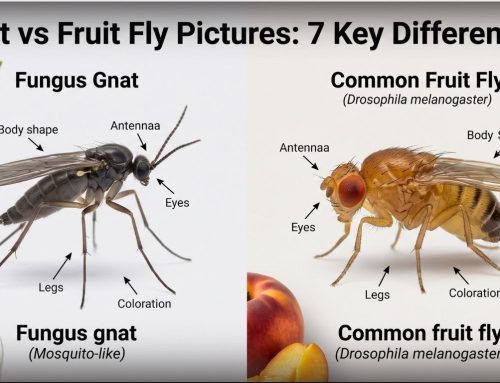
For indoor fly confusion, Green Pest Management CT’s fly versus gnat identification guide explains how small flying insects can be separated by appearance and source.
3. A Beetle That Looks Like a Wasp Is Still a Beetle
Some beetles carry surprisingly convincing wasp-like colors.
Longhorn beetles are particularly well known for producing species with narrow bodies and banded or brightly marked appearances. Their resemblance to wasps may help discourage predators.
The fastest clue is the wings.
Beetles belong to the order Coleoptera. Their front wings are modified into hardened wing covers called elytra. These meet along the back and protect the functional flight wings underneath.
A true wasp does not have hardened beetle wing covers.
How to recognize a wasp-mimicking beetle
Look for a hard-backed appearance and a center line where the two wing covers meet.
Many longhorn beetles also have prominent antennae, sometimes extremely long ones.
Their movements may appear more beetle-like than the quick, agile flight and walking behavior of social wasps.
A beetle that looks like a wasp is not automatically a structural pest, either. Beetles are an enormous insect order, and their biology varies tremendously.
Some larvae develop in dead or stressed wood. Others feed on plants, fungi, stored products, or other materials.
Correct species-level or family-level identification matters before treatment is considered.
4. Flying Ant vs. Wasp Confusion Is Common
A winged ant appearing indoors or around a building is frequently called a “tiny wasp.”
Ant colonies produce winged reproductive individuals, known as alates. Under appropriate conditions, these males and females leave established colonies to mate and potentially establish new colonies.
Their wings and narrow-looking body can make them appear wasp-like at first glance.
Flying ant vs. wasp: the easiest differences
A winged ant normally has distinctly elbowed antennae.
Its waist also has one or more characteristic nodes between the thorax and abdomen. A wasp’s waist has a different shape and generally lacks the ant-like node structure.
Both ants and wasps belong to the order Hymenoptera and share evolutionary relationships, which helps explain why some body characteristics appear similar.
Behavior supplies another clue.
A sudden concentration of winged ants emerging from one structural location is different from repeated worker wasps carrying food to a paper nest or flying into a wall void.
Why winged ants indoors deserve attention
A single outdoor winged ant does not necessarily mean there is a problem inside the house.
Numerous winged ants repeatedly emerging indoors, however, may indicate a colony associated with the structure or nearby environment.
This is where an identification mistake can affect treatment. Wasp aerosol aimed at a few visible ant reproductives does not address the colony responsible for producing them.
Professional inspection should focus on the source.
5. Flying Ants Are Also Commonly Confused With Termite Swarmers
This is technically a second layer of confusion, but it is important for Connecticut homeowners.
A small winged insect may be identified as a wasp when it is an ant, or as an ant when it is actually a termite reproductive.
Winged ants generally have elbowed antennae, a constricted waist, and front wings noticeably larger than the hind wings.
Termite swarmers generally have straighter, bead-like antennae, a less pinched body shape, and two pairs of wings that are comparatively similar in size.
Those distinctions matter because the implications for the property are very different.
If numerous winged insects are emerging from trim, wall gaps, window areas, foundations, or another part of a building, collect a dead specimen safely or take a clear photo rather than guessing.
Professional identification may prevent an entirely wrong control approach.
6. Horse Fly vs. Hornet Is a Misleading but Important Comparison
Horse flies and hornets are fundamentally different insects, but their size, noisy flight, and intimidating appearance can cause confusion.
Horse flies are true flies in the family Tabanidae. Females of many species are blood feeders and can produce painful bites. Hornets are social wasps and defend themselves or their colonies with venomous stings.
Horse fly vs. hornet identification
| Feature | Horse fly | Hornet |
| Insect order | Diptera | Hymenoptera |
| Functional wing pairs | One | Two |
| Eyes | Very large and conspicuous | Smaller relative to head |
| Antennae | Fly-like | More conspicuous wasp antennae |
| Main human injury | Female may bite | Female worker can sting |
| Stinger | None | Present in females |
| Social paper nest | No | Yes for social hornets |
| Flight behavior | Strong, persistent flying | Variable; workers forage and defend nest |
Horse flies can be persistent around people or animals because females seek blood meals. A hornet hovering around a structure may instead be foraging, searching, or traveling to a colony.
A painful horse fly bite and a hornet sting are also different injuries.
Green Pest Management CT’s yellow fly versus deer fly guide provides additional information on biting fly identification.
For suspected hornets, use the guide to what a hornet looks like instead of judging from size alone.
7. Clearwing Moths Can Look Remarkably Wasp-Like
Moths are usually associated with broad, scale-covered wings and nighttime flight.
Clearwing moths challenge that stereotype.
Several clearwing moths have transparent portions of the wings, narrow bodies, and yellow, orange, reddish, or black markings. Some strongly resemble wasps or hornets.
These features likely provide defensive advantages through mimicry.
Wasp vs. clearwing moth
A closer photograph often shows important differences.
Moths belong to the order Lepidoptera and have different antennae, wing structure, mouthparts, body covering, and life cycles from wasps.
Some clearwing moths are also associated with particular host plants because their larvae bore into plant tissue. That means identifying a clearwing correctly can reveal a landscape or plant-health issue rather than a stinging-insect problem.
Again, the management decision depends on knowing which insect you actually have.
A yellow-and-black pattern alone is not enough.
8. Bees Can Be Mistaken for Wasps and the Difference Matters
Bees are not wasp mimics in exactly the same way hoverflies are, because bees and wasps are closely related Hymenoptera. Nevertheless, homeowners commonly confuse them.
This matters for safety, pollinator protection, and pest-management decisions.
Many bees are comparatively hairy because body hairs help collect pollen. Wasps often look smoother, although this is not an absolute rule.
Honey bees, bumblebees, carpenter bees, yellow jackets, paper wasps, and hornets also have very different nesting behaviors.
The bee versus wasp identification guide provides a side-by-side comparison.
Carpenter bee vs. hornet
Large carpenter bees can alarm homeowners because of their size and loud flight.
Male carpenter bees may hover territorially around decks, trim, fascia, or other wood surfaces, but males cannot sting. Females can sting, although they generally do so only when handled or strongly provoked.
Carpenter bees are associated with nesting in wood rather than constructing a social paper hornet nest.
For that specific identification problem, see the hornet versus carpenter bee guide.
Bumblebee vs. hornet
Bumblebees generally appear much hairier and more robust than hornets. Their nesting biology and defensive behavior also differ.
The bumblebee versus hornet identification guide explains the differences homeowners can observe safely.
9. Some Wasps Look So Unusual That People Assume They Must Be Something Else
Wasp confusion works both ways.
Sometimes a harmless fly is mistaken for a wasp. Other times a genuine wasp looks so unlike a familiar yellow jacket that people assume it cannot sting.
Parasitoid wasps are a good example.
Wasps represent an enormous range of species. Some are tiny. Some are slender. Some have extraordinarily long ovipositors. Some are brilliantly colored. Many live solitary lives and have little or no practical sting risk to humans.
A strange-looking insect with a needle-like structure projecting from its abdomen may be a parasitoid wasp using an ovipositor to place eggs in hosts rather than a dangerous social wasp equipped with an oversized defensive stinger.
Green Pest Management CT’s guide explaining what a parasitic wasp is describes this biology in more detail.
For homeowners primarily concerned about human safety, the non-stinging wasp identification guide explains why not every wasp poses the same threat.
10. Behavior and Nest Evidence Often Identify a Wasp Better Than Color
One of the most reliable field lessons is to watch where an insect goes.
Do not follow it closely. Observe from a safe location.
A single yellow-and-black insect feeding at flowers may be a hoverfly, bee, solitary wasp, or social wasp worker. That sighting alone gives limited information.
Twenty similarly sized insects repeatedly entering the same hole are telling you something very different.
Repeated flight traffic is an important clue
Social wasps maintain a colony. Workers leave to forage and return to the same location.
Look for repeated movement around:
- Holes in lawns or landscape beds
- Siding gaps
- Soffits and fascia
- Roof transitions
- Hollow trees
- Stone walls
- Dense shrubs
- Porch ceilings
- Deck framing
- Sheds and outbuildings
A steady stream of insects entering one point deserves caution.
The wasp and hornet behavior hub can help homeowners interpret these patterns.
Why Do So Many Bugs Look Like Wasps?
Bright warning coloration can be valuable in nature.
Predators that have unpleasant experiences with venomous or otherwise well-defended insects may learn to associate specific visual patterns with danger. An unrelated insect can potentially benefit by resembling that warning pattern.
This helps explain why yellow and black recur across insect groups.
But mimicry does not have to be perfect to work.
A beetle does not need to pass a human entomology exam. It simply needs enough resemblance to make a potential predator hesitate.
Humans experience the same hesitation.
That is why a fast-moving yellow-and-black hoverfly can look extremely convincing at six feet even though a close photograph reveals obvious fly characteristics.
Insects That Look Like Wasps: A Practical Identification Guide
The most useful identification method is a sequence rather than one characteristic.
Step 1: Look at the wings
One pair strongly suggests a true fly.
Two pairs suggest Hymenoptera or another four-winged group, although hind wings can be difficult to see.
Hard wing covers indicate a beetle.
Scale-covered wings suggest a moth or butterfly.
Step 2: Check the antennae
Elbowed antennae strongly support ant identification.
Short fly-like antennae combined with very large eyes suggest a fly.
Longer, obvious antennae may support wasp, bee, beetle, or moth identification depending on the other characteristics.
Step 3: Examine the waist
Many wasps have a narrow connection between thorax and abdomen.
Winged ants also have narrow waists but show characteristic nodes.
Many flies lack a genuine wasp-like constriction, although their coloration can create the illusion of one.
Step 4: Observe the eyes
Large eyes are an excellent clue for many flies.
Horse flies are a particularly strong example; their eyes dominate the head.
Step 5: Watch the flight
Hoverflies often hover with impressive stability and dart abruptly.
Ant alates commonly appear during dispersal events.
Social-wasp workers may exhibit purposeful traffic between a food source and nest.
Step 6: Look for nesting evidence
Do not approach the suspected nest.
Instead, determine whether insects repeatedly return to one location.
This may be more valuable than trying to inspect individual body markings.
Common Bugs That Look Like Wasps at a Glance
| What you see | Possible identity | Key clue |
| Yellow-black insect hovering over flowers | Hoverfly | One wing pair, large eyes, hovering |
| Long-bodied yellow-black hard-backed insect | Wasp-mimicking beetle | Elytra/wing covers |
| Small winged insect with pinched waist | Flying ant | Elbowed antennae and waist nodes |
| Large loud fly around people/animals | Horse fly | Huge eyes, one pair of wings |
| Clear-winged yellow-black “wasp” | Clearwing moth | Moth anatomy and wing structure |
| Large insect hovering around wood | Carpenter bee | Robust bee body, wood nesting |
| Fuzzy yellow-black insect | Bumblebee | Hairy body |
| Yellow-black workers entering one soil hole | Yellow jackets possible | Repeated colony traffic |
| Black-white insects around gray paper nest | Bald-faced hornets | Enclosed social nest |
| Thin insects around exposed paper cells | Paper wasps | Open-comb paper nest |
This table is an identification starting point, not a reason to handle an insect.
What Real Wasps Are Commonly Confused With Mimics?
Several genuine wasps frequently appear in mistaken-identity calls.
Yellow jackets
Yellow jackets have compact bodies, contrasting markings, and fast movement. Because many hoverflies mimic similar patterns, homeowners sometimes underestimate or overestimate what they are seeing.
The critical difference emerges when workers repeatedly enter a colony location.
The yellow jacket deep-dive guide explains their nesting and defensive behavior.
Paper wasps
Paper wasps have slimmer bodies with long legs that may hang noticeably during flight.
Their nests consist of exposed cells.
The paper wasp nest identification resource is useful when a comb is visible beneath an eave or overhang.
Bald-faced hornets
Bald-faced hornets are actually yellow jackets despite the common name.
Their black-and-white appearance distinguishes them from traditional yellow-and-black imagery, but homeowners sometimes mistake other black-and-white insects for them.
Their enclosed paper colony nest is a strong clue.
European hornets
European hornets are large true hornets established in the northeastern United States.
Their size can lead to confusion with large bees, flies, and other insects.
The yellow jacket versus European hornet comparison can help separate these groups.
Is It Dangerous to Misidentify a Wasp Mimic?
Sometimes.
There are two directions in which an identification error can cause problems.
The first is treating a harmless or beneficial insect unnecessarily. Spraying hoverflies, parasitoid wasps, solitary pollinators, or other beneficial insects adds pesticide exposure without resolving a pest problem.
The second error can be more immediately hazardous: assuming a genuine social wasp is harmless.
A homeowner who believes yellow jackets entering the lawn are solitary ground nesters may walk up to the opening or mow directly across it.
Likewise, treating repeated activity into siding as “just flies” can delay recognition of a social-wasp colony occupying a structural void.
The safest approach when identification remains uncertain is distance and observation.
Wasp Sting vs. Fly or Horse Fly Bite
The terms bite and sting are often used interchangeably, but the mechanisms differ.
Wasps deliver venom through a stinger. Many can sting repeatedly because they do not normally leave the stinger behind.
Horse flies injure differently. Females of blood-feeding species use cutting mouthparts to obtain blood, resulting in a painful bite rather than a venomous wasp sting.
Hoverflies neither bite like horse flies nor sting like wasps.
What if you do not know what injured you?
Prioritize symptoms over insect identification.
For a simple local insect injury, basic cleaning and monitoring may be appropriate. For a suspected wasp sting, see Green Pest Management CT’s wasp sting treatment and first-aid guide.
Call 911 for signs of anaphylaxis, including significant trouble breathing, tongue or throat swelling, fainting, or rapidly developing severe systemic symptoms.
The American Academy of Allergy, Asthma & Immunology’s information about stinging-insect allergy provides authoritative guidance about venom allergy.
Why Identification Matters for Integrated Pest Management
Integrated Pest Management, or IPM, depends on identifying the organism before selecting a control.
That sounds obvious, but wasp mimicry demonstrates why it matters.
Consider four similar-looking insects:
A hoverfly may need no control.
A winged ant may indicate an ant colony requiring source-based treatment.
A wood-associated beetle may require determining whether it is simply an outdoor visitor or connected to affected wood.
A yellow jacket repeatedly entering a wall cavity presents a stinging-insect problem.
One generic “bug spray” response cannot intelligently address all four.
The EPA’s Integrated Pest Management information describes the broader strategy of combining pest knowledge, monitoring, prevention, and appropriately selected controls.
Professional pest management applies that principle at the property level.
Signs You Are Dealing With a Real Wasp Colony
Instead of focusing only on body color, watch for colony behavior.
Repeated entrance traffic is one of the strongest signs.
A few insects spread across a flowering garden usually do not indicate a social-wasp nest in the garden. Dozens of similarly sized insects repeatedly entering one ground hole are much more significant.
Nest material also provides clues.
Paper wasps create open cells. Bald-faced hornets and some other social wasps produce enclosed paper structures. Yellow jackets can occupy ground cavities or hidden spaces where the nest itself is invisible.
Green Pest Management CT’s guide to different wasp nest types provides visual context.
Why Are Wasp-Like Insects Around My Connecticut Property?
Connecticut’s warm season supports an abundance of insect life.
Landscaped Fairfield County properties provide nectar, pollen, prey insects, water, host plants, wood, soil, and sheltered nesting sites.
Flowering landscapes
Flower beds can attract bees, wasps, butterflies, moths, and hoverflies simultaneously.
Seeing several yellow-and-black insects around flowers is therefore not unusual.
Mature trees and woodland edges
Greenwich, Wilton, New Canaan, and other wooded communities contain mature trees that support beetles, moths, solitary wasps, flies, bees, and social-wasp nesting opportunities.
Decks and structural wood
Carpenter bees and other insects may become noticeable around exposed or weathered wood.
Lawns and soil
Ground-nesting bees and solitary wasps can use appropriate soil. Yellow jackets can also nest underground, which is why identification matters before lawn treatment.
Homes and wall voids
Structural gaps create opportunities for ants, wasps, flies, and other insects.
The specific organism—not simply the fact that it flies—determines what management is appropriate.
Seasonal Wasp Mimic Activity in Connecticut
Season provides valuable context, although it should never be used as the sole identification method.
Spring
As Connecticut warms, insects emerge from overwintering stages or become active.
Carpenter bees may attract attention around wood. Winged reproductive ants may appear under appropriate seasonal conditions. Social-wasp queens begin founding colonies.
At this stage, one large wasp-like insect does not necessarily mean a mature colony exists.
Early and midsummer
Insect diversity expands substantially.
Hoverflies become common around flowers. Solitary wasps hunt and nest. Beetles, moths, bees, flies, ants, paper wasps, hornets, and yellow jackets can all be active.
This is when color-based identification becomes especially unreliable.
Late summer into early fall
Social-wasp colonies can be well developed.
Yellow jackets may become particularly noticeable around outdoor food, garbage, sweet beverages, patios, and cookouts.
Hoverflies and other harmless mimics can be present at the same time, making accurate identification even more valuable.
Late fall and winter
Cold temperatures dramatically reduce outdoor flying-insect activity. Many annual social-wasp colonies die, while newly produced queens of certain species overwinter in protected locations.
Persistent indoor flying insects during cold weather should be evaluated according to their actual source rather than assumed to be outdoor wasps.
Wasp Mimic & Confusion Content for Fairfield County Homeowners
Local property conditions strongly influence which insects homeowners encounter.
Greenwich
Mature trees, extensive landscaping, gardens, stone features, and older or complex home construction can support a broad range of insects. A yellow-and-black insect on a flower may be a beneficial mimic, while repeated traffic into an exterior construction gap is a different matter.
Stamford
A mix of denser neighborhoods, multifamily buildings, commercial areas, residential landscapes, and mature vegetation creates diverse insect encounters. Correctly separating flies, ants, bees, and wasps can prevent treatments aimed at the wrong pest.
Darien and Westport
Decks, pools, gardens, outdoor dining areas, ornamental plantings, sheds, and mature landscapes can bring homeowners into frequent contact with pollinators and social wasps during summer.
Fairfield and Norwalk
A flying insect around siding, a porch, lawn, or flowering landscape might belong to several insect orders. Structural activity deserves particular attention when many insects repeatedly use one entry point.
Wilton and New Canaan
Wooded lots, stone walls, mature trees, naturalized areas, gardens, and exposed soil can support abundant beneficial insect life alongside genuine pest species.
Green Pest Management CT serves these Fairfield County communities with an identification-first approach. The objective is not to label every flying insect a pest—it is to determine what is actually present and whether intervention is justified.
Prevention: How to Reduce Problem Insects Without Killing Every Mimic
Prevention should focus on conditions contributing to actual pest problems rather than creating an insect-free landscape.
That distinction is particularly important with pollinators and beneficial predators.
For social wasps, keeping garbage containers closed and cleaning food spills can reduce foraging opportunities around people. Inspect high-use spaces such as decks, sheds, eaves, play equipment, and patio areas periodically.
For structural insects, maintain screens and repair appropriate exterior gaps. However, do not seal an opening actively used by a yellow jacket or hornet colony without first resolving the colony. Trapping social wasps inside a structural void can create new routes into occupied rooms.
Ground activity should also be identified before intervention. An aggregation of harmless solitary insects requires a different decision from a defensive yellow jacket colony.
For broader prevention advice, Green Pest Management CT’s hornet and wasp control guide covers monitoring and conducive conditions.
DIY Identification: What Homeowners Can Safely Do
DIY identification is useful as long as it does not require approaching a nest.
Start by taking a clear photograph with optical or digital zoom. Ideally, photograph the insect from more than one angle if that can be done safely.
Next, note the location and behavior.
Was it feeding on a flower? Hovering around exposed wood? Emerging from soil? Appearing around garbage? Entering siding? Crawling from an interior wall gap?
Then estimate whether you are seeing one insect or a repeating stream of insects.
Finally, compare broad anatomical traits: wings, eyes, antennae, waist, legs, body texture, and color pattern.
Do not grab an insect, block a suspected nest entrance, dig into a ground hole, open a wall cavity, or spray a colony simply to see how it reacts.
The wasp and hornet safety assessment guide can help determine whether observation is appropriate or the situation deserves professional attention.
DIY Treatment vs. Professional Identification
DIY sanitation and monitoring can resolve some flying-insect concerns without pesticide.
A hoverfly outdoors needs no treatment. One winged ant outdoors may require nothing more than observation. A harmless solitary wasp may be left alone when its nesting site does not create a conflict.
Professional inspection becomes more useful when identification changes what must happen next.
Examples include repeated insects emerging from inside a wall, large numbers of winged ants indoors, a suspected yellow jacket colony in the ground, or wasp-like insects repeatedly entering roofing or siding.
A nest requiring ladder access is another reason to avoid experimentation.
For active social-wasp nests, the DIY versus professional hornet nest removal guide explains why accessibility and colony defense matter.
What Happens During a Professional Inspection?
A useful professional inspection does not begin by spraying every flying insect.
Identification comes first.
A technician considers the insect’s anatomy, movement, number, nesting evidence, emergence point, and property conditions.
For an outdoor mimic, the conclusion may be that no treatment is necessary.
For winged ants, attention may shift toward locating ant activity and identifying conducive conditions.
For a suspected beetle, inspection may focus on the host material and evidence of development.
For social wasps, inspection concentrates on flight paths and colony location.
Treatment is pest-specific
Once the organism and source are identified, an appropriate management strategy can be selected.
That may include sanitation, exclusion, monitoring, habitat modification, mechanical management, or targeted pesticide application where justified.
Any pesticide should be used according to its label. The U.S. Environmental Protection Agency’s guidance on safe pest-control practices provides useful consumer information.
Follow-up prevention
Once active pest pressure is resolved, professionals may identify entry points or conditions that can be corrected.
With structural wasp colonies, sequence matters: blindly sealing an occupied entrance before the colony is addressed can make the situation more complicated.
What Does Professional Identification or Treatment Cost?
There is no responsible single figure that applies to every wasp mimic or flying-insect problem, and this guide intentionally does not provide pricing.
The service required depends heavily on what the insect actually is.
Identifying an outdoor hoverfly is not the same project as evaluating ants emerging inside a building or controlling a yellow jacket colony located in a structural void.
Access, pest type, colony or infestation location, building conditions, treatment method, and follow-up requirements can all affect the scope of work.
The most useful first step is therefore accurate identification. Green Pest Management CT can assess the situation and explain the appropriate service based on what is actually present.
Common Identification Mistakes
Even experienced homeowners can get these insects wrong.
The most common mistake is identifying entirely by color. Yellow and black are used by numerous insects.
Another is assuming that hovering means hornet aggression. Hoverflies are literally named for this flight capability.
Large size also causes confusion. Carpenter bees, horse flies, cicada killers, beetles, and hornets can all be described as “huge flying bugs,” but their biology is very different.
Nest assumptions cause problems too. A hole in the ground can belong to solitary bees, solitary wasps, yellow jackets, ants, or other organisms.
Homeowners also sometimes treat visible insects without investigating their source. Killing three flying ants at a window or two yellow jackets outside does not necessarily resolve the colony responsible for their presence.
Identification is not an academic step—it determines whether the treatment has any chance of solving the problem.
Mistakes to Avoid With a Suspected Wasp
If you cannot identify an insect, avoid creating a higher-risk situation.
Do not strike an aerial paper nest to see what emerges. Do not fill a ground hole without knowing whether an active social colony occupies it. Do not climb a ladder to get a close photograph.
Avoid sealing an active wasp entrance in a wall.
Do not assume a harmless-looking insect cannot sting, either. Many solitary wasps are reluctant to sting but are physically capable of doing so.
Never use gasoline, fire, or improvised pesticide mixtures on a nest.
The objective is safe identification, not provoking the insect into demonstrating what it can do.
Beneficial Mimics and Why They Should Often Be Left Alone
One advantage of understanding bugs that look like wasps is learning how many are useful.
Hoverflies can pollinate flowers, while larvae of some species prey on aphids.
Many solitary wasps prey on insects that damage garden plants.
Parasitoid wasps regulate populations of other arthropods.
Bees provide essential pollination.
Even insects without a direct benefit obvious to homeowners occupy roles within local food webs.
Integrated Pest Management recognizes this. Treatment decisions should balance human safety, property concerns, and ecological impact rather than defaulting to killing every unfamiliar insect.
For examples of low-risk wasps themselves, see Green Pest Management CT’s guide to the least aggressive wasps.
When a Wasp-Like Insect Is Actually a Safety Concern
There are situations where caution is warranted even before exact species identification is complete.
Multiple wasps repeatedly using one entrance suggest a colony.
An occupied nest beside a door, walkway, pool, deck, play structure, mailbox, or landscaping route increases the likelihood of accidental contact.
Ground colonies are particularly easy to disturb with mowers and trimmers.
Structural colonies can also cause problems when homeowners attempt to seal entrances without treatment.
If someone on the property has a known insect-venom allergy, the threshold for accepting an uncertain colony near high-use areas should be lower.
The guide to the most dangerous wasps and warning signs provides more detailed risk information.
What If the Insect Really Is a Hornet or Wasp?
Do not panic, and do not approach the nest.
One wasp passing through the yard does not automatically require pest control.
If you observe repeated activity, use distance to identify where workers are traveling.
The Connecticut wasp versus hornet comparison hub can help distinguish the major groups.
If an active colony is positioned near people or inside a structure, Green Pest Management CT’s professional hornet and wasp control services provide an alternative to risky DIY removal.
Frequently Asked Questions
What insects look like wasps but do not sting?
Hoverflies are among the best examples. Many have yellow-and-black patterns resembling yellow jackets but have no stinger. Some beetles, moths, and other flies also mimic wasps without having a wasp-type sting.
How can I tell a hoverfly from a wasp?
Hoverflies have one functional pair of wings, often have large fly-like eyes and short antennae, and many can hover almost motionless. Wasps have two pairs of wings and generally more obvious antennae. Use several traits rather than color alone.
What beetle looks like a wasp?
Several beetles, including some longhorn beetles, have elongated bodies and yellow, orange, or black patterns that can resemble wasps. Hardened front wing covers, or elytra, identify them as beetles rather than wasps.
How do I tell a flying ant vs. wasp?
Winged ants have distinctly elbowed antennae and a narrow waist containing characteristic nodes. Wasps have differently shaped antennae and waist structures. Both can have two pairs of wings, so wing number alone does not separate them.
What is the difference between a horse fly vs. a hornet?
A horse fly is a true fly with one functional pair of wings and very large eyes. Female horse flies can produce painful bites. A hornet is a social wasp with two pairs of wings; female workers can sting and may defend their colony.
Are hoverflies dangerous?
Hoverflies do not have stingers and do not blood-feed on people. Many are beneficial pollinators, and larvae of some species prey on aphids and other small insects.
Why are there insects that look like wasps?
Many benefit from defensive mimicry. Resembling a stinging or otherwise well-defended insect may discourage predators, even when the mimic itself has no stinger.
What does it mean if many wasp-like insects are entering one hole?
Repeated traffic to one opening can indicate a nest or colony and deserves caution. Depending on the insects, it might involve yellow jackets, ants, solitary ground nesters, bees, or another group. Do not approach or block the entrance until the insects are identified.
Should I spray bugs that look like wasps?
Not before identifying them. Many wasp mimics are harmless or beneficial, and indiscriminate treatment may kill pollinators or natural predators without addressing the real problem. If pesticide treatment is justified, follow the product label.
When should I call a pest professional for a wasp-like insect?
Arrange a professional inspection when large numbers appear indoors, insects repeatedly enter one structural or ground opening, an active nest is near people, species identification remains uncertain, or someone on the property has a serious sting allergy.
Conclusion: Wasp Mimics Show Why Identification Comes First
The number of insects that look like wasps is surprisingly large. Hoverflies can imitate yellow jackets, beetles can carry convincing wasp patterns, clearwing moths can resemble hornets, and flying ants can easily be mistaken for small wasps. Even carpenter bees, horse flies, parasitoid wasps, and other unrelated insects can create confusion during a brief encounter.
The simplest identification lesson is also the most useful: do not identify an insect by yellow-and-black coloration alone.
Look at wing structure, antennae, eyes, body shape, flight behavior, nesting evidence, and most importantly whether numerous insects repeatedly return to one location.
Correct identification also supports better Integrated Pest Management. A hoverfly on a flower deserves a very different response from yellow jackets defending a lawn nest. A winged-ant emergence requires a different investigation from a hornet colony in a wall. A beetle that looks like a wasp should not receive treatment intended for social wasps simply because its coloration is convincing.
For Connecticut homeowners in Greenwich, Stamford, Darien, Westport, Fairfield, Wilton, New Canaan, Norwalk, and surrounding Fairfield County communities, local seasonality and diverse landscapes mean many beneficial insects and true pest species can be active at the same time.
If photographs and safe observation still leave the identity uncertain, Green Pest Management CT can provide a professional flying-insect inspection and identification assessment. Identifying the insect before deciding whether treatment is necessary protects people, avoids unnecessary pesticide use, and addresses the actual source of the problem.