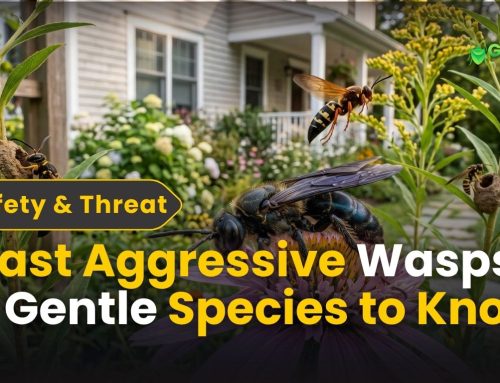
Wasp That Lives in Ground: 7 Key Types You Should Know
If you’ve found a wasp that lives in ground around your Connecticut home, don’t assume it is a “ground hornet.” Several very different wasps use soil or underground cavities. Some are solitary hunters that rarely create a serious problem for homeowners. Others, particularly social yellow jackets, can defend an underground colony with numerous workers when the nest is disturbed.
The quickest identification clue is usually behavior. Many yellow-and-black workers repeatedly entering the same hole suggest a social yellow jacket nest. One large wasp using an individual burrow points more toward a solitary ground wasp. Many separate holes with fuzzy insects may actually belong to ground-nesting bees rather than wasps.
For homeowners in Greenwich, Stamford, Darien, Westport, Fairfield, Wilton, New Canaan, Norwalk, and surrounding Fairfield County, knowing that difference can prevent unnecessary treatment—and reduce the chance of accidentally disturbing a defensive colony.
This guide covers seven types of ground-nesting wasps or commonly confused insects, what their nests look like, their relative danger, Connecticut seasonal patterns, prevention, and when professional pest control makes sense.
Quick Answer: What Kind of Wasp Lives in the Ground?
Several kinds of wasps can nest in the ground. Connecticut homeowners may encounter underground yellow jackets, cicada killers, great golden digger wasps, great black wasps, sand wasps and other solitary digger wasps. People also frequently mistake ground-nesting bees for wasps.
The biggest distinction is social versus solitary nesting.
| What You See | Likely Possibility | Nest Pattern | General Concern |
| Many yellow-and-black wasps using one hole | Yellow jackets | Social colony | Higher near people |
| One very large wasp at a burrow | Cicada killer | Solitary | Usually lower |
| Large black wasp around soil | Great black wasp/other digger wasp | Solitary | Usually lower |
| Large orange-and-black wasp | Great golden digger wasp/another species | Solitary | Usually lower |
| Small wasps around sandy soil | Sand/digger wasps | Often solitary | Usually lower |
| Many fuzzy insects using separate holes | Ground-nesting bees | Usually individual nests | Generally lower |
| Wasps entering foundation or siding | Cavity-nesting social wasps possible | Concealed structural nest | Professional inspection advisable |
These are field clues, not positive species identifications. Color alone is particularly unreliable.
Green Pest Management CT’s ground nesting wasp identification guide provides a complementary step-by-step identification process.
What Is a Ground Wasp?
“Ground wasp” describes nesting behavior rather than one particular species.
Ground-nesting wasps may dig their own burrows or take advantage of existing underground spaces. Solitary species usually construct or occupy individual nests. Social species build colonies in which workers cooperate to raise brood and defend a common nest.
That difference changes how homeowners should respond.
A solitary predatory wasp in a remote landscape bed may provide beneficial insect control and require no intervention. A yellow jacket colony beside a front walkway can present a much more substantial sting risk.
This is why identifying a wasp that lives in ground should come before attempting treatment.
For a broader overview, see Green Pest Management CT’s complete ground-nesting wasp guide.
Type 1: Yellow Jackets
For homeowners, yellow jackets are among the most important underground wasps to recognize.
Certain yellow jacket species commonly establish colonies below ground, often making use of existing cavities such as abandoned animal burrows.
What Yellow Jackets Look Like
Yellow jackets generally have compact, relatively smooth bodies with distinct yellow-and-dark markings. Exact patterns depend on species, so a yellow-and-black body should be treated as a clue rather than proof.
The behavior around the nest is more useful.
Look for numerous workers repeatedly traveling into and out of the same opening.
What an Underground Yellow Jacket Nest Looks Like
Surprisingly, you may not see a nest at all.
The paper nest structure is concealed inside the underground cavity. From above, homeowners often see only an entrance surrounded by grass, soil, roots, leaves, or landscaping.
This is one reason nest pictures can be misleading. The visible hole may look unremarkable even when an active colony lies below.
Are Yellow Jackets Dangerous?
They deserve caution around their nests.
Yellow jackets are social wasps. Multiple workers can respond when activity immediately around a colony is perceived as a threat, and wasps can sting more than once.
Mowing over an underground entrance is a classic accidental disturbance.
For more detailed identification and behavior information, see Green Pest Management CT’s yellow jacket guide.
Type 2: Eastern Cicada Killers
Few Connecticut wasps generate as much unnecessary alarm based purely on size.
Eastern cicada killers (Sphecius speciosus) are large solitary wasps. Females excavate underground burrows and capture cicadas to provision nest cells for their young.
People commonly call them “ground hornets,” but that name can create identification problems.
Cicada Killer Identification
Adults are large and conspicuous. Their dark bodies include yellowish markings on the abdomen, and the wings may appear amber or brownish.
The nesting pattern provides one of the better clues.
Instead of many workers serving one colony, a female cicada killer maintains her burrow. Several females can nest near one another when the soil is attractive, creating an aggregation without becoming a yellow-jacket-style social colony.
What About Aggressive-Looking Males?
Males may patrol nesting areas and approach other insects or people entering their territory.
Despite this conspicuous behavior, male cicada killers cannot sting. Females can sting, but they don’t have a worker colony mounting coordinated nest defense.
Green Pest Management CT’s ground hornet identification and treatment guide provides more context for homeowners using the term “ground hornet.”
Type 3: Great Golden Digger Wasps
The great golden digger wasp (Sphex ichneumoneus) is another large solitary wasp found across much of North America.
Its appearance can be startling if you aren’t expecting a large wasp in the landscape.
How to Recognize It
Great golden digger wasps have distinctive orange and dark coloration, with golden hairs visible on parts of the body. They hunt katydids and related insects, which females use to provision their underground nests.
Their lifestyle is very different from yellow jackets.
They don’t establish large worker colonies below your lawn. Females construct nests for their offspring and hunt prey.
Do They Need Pest Control?
Finding a solitary predatory wasp doesn’t automatically create a pest-control problem.
If the insect occupies an area where it isn’t being disturbed, tolerance is often appropriate. Like many solitary wasps, great golden digger wasps perform useful ecological functions as predators and flower visitors.
Nest position and human exposure still matter, especially around heavily used spaces.
Type 4: Great Black Wasps
Great black wasps (Sphex pensylvanicus) are another large solitary species that Connecticut homeowners may encounter around flowers and suitable nesting areas.
Their mostly black appearance separates them visually from the stereotypical yellow-and-black “ground wasp.”
Why Homeowners Notice Them
Their size makes them conspicuous.
Females hunt katydids and related prey and provision underground nests. Adults also visit flowers.
Seeing one moving around soil does not mean a social colony comparable with yellow jackets is below your lawn.
That is an important field lesson: insect size and actual colony risk aren’t the same thing.
For broader comparisons among Connecticut wasps, use Green Pest Management CT’s wasp and hornet identification encyclopedia.
Type 5: Sand Wasps
Sand wasps and related ground-nesting species can occur where soil conditions suit burrowing.
Rather than maintaining a large communal yellow jacket colony, these wasps typically exhibit solitary nesting behavior, although individual nests can occur close together.
What to Look For
You may notice wasps flying low over bare, loose, or sandy ground and repeatedly returning to individual holes.
Several insects can occur in one area without sharing one social nest.
Again, count entrances as well as insects.
Twenty wasps using twenty individual holes provides a very different identification clue from twenty yellow jackets disappearing through the same opening.
Their Role in the Landscape
Many ground-nesting solitary wasps prey on insects and therefore contribute to natural insect population regulation.
An Integrated Pest Management approach asks whether they are actually creating an unacceptable conflict before recommending control.
Type 6: Other Solitary Digger Wasps
“Digger wasp” covers a wide range of solitary wasps with underground nesting behavior.
Identification to species can be difficult without a clear specimen or good photograph. Fortunately, homeowners often don’t need species-level identification to make an initial risk assessment.
The social-versus-solitary distinction can be more immediately useful.
Signs of Solitary Nesting
Watch for one female working an individual entrance, excavated soil, prey being transported toward a burrow, and multiple distinct nests rather than continuous worker traffic through one communal opening.
None of those clues is absolute on its own.
When the insect can’t be confidently identified, use Green Pest Management CT’s Connecticut wasp and hornet ID guide instead of attempting to catch it.
Type 7: Ground-Nesting Bees—The Common Wasp Look-Alike
Ground-nesting bees aren’t wasps, but they belong in this guide because homeowners constantly confuse the two.
Many native bee species create nests in soil. Depending on the species and conditions, numerous individual burrows may appear close together.
How Ground Bees Differ
Many ground-nesting bees appear hairier than common social wasps such as yellow jackets. Females collect pollen, and their bodies have structures adapted for pollen transport.
Nest arrangement provides another clue.
Numerous insects using separate holes may suggest solitary bees. Numerous smooth-bodied yellow jackets entering the same cavity suggests a social wasp colony.
Why Correct ID Matters
Native bees contribute to pollination and shouldn’t be treated unnecessarily.
Green Pest Management CT’s ground-nesting bees versus wasps guide explains this distinction in greater depth.
For broader visual comparisons, see the bee versus wasp identification guide.
Ground Wasp Identification: 7 Signs to Check
You don’t need to stand over a nest to make useful observations. In fact, staying farther away often lets you see normal behavior without causing defensive activity.
A practical identification checklist is:
- Count entrances: one busy entrance or many separate burrows?
- Count insects: one individual or continuous worker traffic?
- Examine appearance from a safe distance: smooth or hairy, large or small, dark or strongly patterned?
- Watch behavior: individual nest work or workers coming and going from a colony?
- Notice soil conditions: established turf, exposed soil, sandy ground, old animal hole, or structural opening?
- Consider the season: spring bee activity and late-season yellow jacket traffic can look very different.
- Evaluate defensiveness: never provoke the insects to test it.
A photograph taken with zoom can help. Do not crouch directly beside an active nest entrance for a close-up.
If visual identification remains difficult, the site’s ground wasp nest pictures and ID guide provides additional comparisons.
Ground Hornet vs. Yellow Jacket vs. Cicada Killer
The term “ground hornet” is especially problematic because it can describe different insects depending on who is speaking.
| Feature | Underground Yellow Jacket | Cicada Killer | Ground-Nesting Bee |
| True social colony | Yes | No | Common ground species often solitary |
| Workers share nest | Yes | No | Usually no |
| Typical surface clue | Busy shared entrance | Individual burrow | Multiple individual holes possible |
| General appearance | Compact yellow/dark wasp | Very large wasp | Often visibly hairy |
| Colony defense | Can be significant | No social colony defense | Generally limited |
| Main ecological function | Predator/scavenger depending on species | Cicada predator | Pollinator |
For visual assistance, review Green Pest Management CT’s ground nesting hornets pictures guide and wasps, hornets, and yellow jackets comparison.
Why Do Wasps Live in the Ground?
The answer depends on species.
For solitary wasps, soil provides a protected environment in which females can create nest cells and provision offspring. Suitable soil texture, drainage, sunlight, vegetation, and ease of excavation can influence where nests appear.
Social yellow jackets may use existing cavities rather than excavating an entire cavity themselves.
Abandoned rodent burrows and other underground voids can provide protected space.
This does not mean finding ground wasps proves the lawn is dirty or neglected. Even carefully maintained Connecticut properties provide natural habitat.
Why Are They Suddenly Appearing?
Homeowners sometimes report that ground wasps appeared “overnight.”
Often, they simply became noticeable.
A developing yellow jacket colony may produce relatively little visible traffic early in its annual cycle. As worker numbers increase, movement through the entrance becomes much easier to detect.
Solitary species can also have concentrated seasonal emergence and nesting periods, causing noticeable activity for a limited time.
Understanding Connecticut’s seasonal cycle helps put these sightings in context.
Connecticut Ground-Wasp Season
Connecticut’s cold winters produce a distinctly seasonal pattern for outdoor social wasps.
Spring
Overwintered social-wasp queens establish new nests. Early yellow jacket colonies are small and less obvious.
Various solitary bees and wasps may also become active as temperatures rise.
Summer
Social colonies grow.
Worker traffic increases, and lawn care creates opportunities for people to discover previously hidden underground nests.
A mower passing over a concealed entrance can rapidly turn an unnoticed nest into a safety problem.
Late Summer and Early Fall
Yellow jacket activity can become especially conspicuous as established colonies reach a later stage of development.
This period also overlaps with outdoor meals, pool use, gardening, sports, landscaping, and patio activity throughout Fairfield County.
Late Fall and Winter
As Connecticut moves into late fall, the normal annual colony cycle and colder weather bring outdoor yellow jacket colonies to an end. Newly produced queens overwinter separately and may establish new colonies in a later season.
The same annual colony does not simply continue normal activity underground throughout a Connecticut winter.
Learn more in the wasp lifecycle and colony development guide.
Are Wasps That Live in the Ground Dangerous?
Some are; many present relatively little practical danger when left undisturbed.
A social yellow jacket nest deserves considerably more caution than most solitary burrows because numerous workers can participate in colony defense.
Nest location also changes risk dramatically.
An active colony beside a front door creates a different situation from a solitary digger wasp at the edge of a large property.
Pay particular attention to nests near high-use locations such as walkways, patios, pools, children’s play areas, gardens, pet spaces, driveways, and frequently mowed grass.
People with known insect-venom allergies should avoid approaching active nests. Difficulty breathing, throat or tongue swelling, fainting, or other symptoms suggesting anaphylaxis following a sting require emergency medical attention.
The CDC’s guidance on venomous insect exposure provides additional authoritative safety information.
When Should a Ground Wasp Nest Be Treated?
Identification should determine the answer.
A solitary predator occupying an unused part of a property often doesn’t need pest control. Neither do many ground-nesting bees.
An underground social yellow jacket colony next to unavoidable human activity deserves a different assessment.
Treatment is more appropriate to consider when the nest is close to a doorway, children’s area, pool, walkway, patio, pet area, garden path, or routine lawn-maintenance route.
Individual allergy concerns also matter.
Integrated Pest Management (IPM) is useful here because it doesn’t start with “What chemical kills this insect?” It starts with pest identification, biology, risk assessment, and the least disruptive effective management option.
The U.S. Environmental Protection Agency’s Integrated Pest Management resources provide additional background on this approach.
What Not to Do With a Ground Wasp Nest
A hidden nest can encourage risky experiments because only a small entrance is visible.
Don’t pour gasoline, kerosene, bleach, or improvised chemical mixtures down the hole. Avoid attempting to burn the nest. Do not poke tools inside, deliberately mow over it, or repeatedly flood an active colony.
Also avoid plugging a known active social-wasp entrance.
The visible opening is only one part of a concealed nesting system. Blocking it doesn’t demonstrate that the colony is dead and may complicate the situation.
If a pesticide is appropriate, the product must be labeled for its intended pest and application site and used according to the label. Homeowners can consult the EPA’s pesticide safety guidance for responsible-use information.
How Can You Prevent Ground Wasps?
No pest control company can responsibly guarantee that flying wasps will never choose an outdoor property.
Prevention is about lowering risk and reducing favorable conditions where practical.
Maintain healthy turf in frequently used lawn areas where bare soil is undesirable. Address rodent problems appropriately because abandoned burrows can create nesting opportunities. Monitor recurring problem locations during warmer months.
Outdoor sanitation matters for foraging activity. Keep trash containers secured, clean sugary spills, and manage fallen fruit where it causes persistent insect activity.
Check infrequently maintained grass before mowing. Alert landscapers to known nests so workers do not inadvertently drive equipment over them.
For structural gaps, exclusion can be valuable when properly timed. Don’t seal a hole while an active social colony is occupying the void without first addressing the infestation.
DIY vs. Professional Ground-Wasp Control
The word “wasp” alone shouldn’t determine the treatment method.
| Situation | Appropriate Starting Point |
| One solitary wasp in remote soil | Monitor |
| Ground-nesting bees away from activity | Usually tolerate/monitor |
| Many separate individual burrows | Identify before treating |
| Numerous yellow jackets using one hole | Professional assessment |
| Nest next to play area or doorway | Professional inspection |
| Wasps entering siding/foundation | Evaluate structural nesting |
| Known severe sting allergy | Avoid DIY nest exposure |
| Uncertain identification | Professional ID |
The greatest value of a professional inspection is often determining what insect is present and whether control is necessary.
Green Pest Management CT’s professional hornet and wasp services explain options for active social-wasp problems.
What Happens During Professional Treatment?
Professional pest control should start with inspection, not automatic spraying.
Inspection and Identification
The technician evaluates insect appearance, behavior, flight traffic, nest entrance, landscape conditions, and structural factors.
Finding many insects doesn’t automatically mean finding one colony.
Risk Assessment
The technician considers whether people can reasonably avoid the area and whether children, pets, landscaping workers, entrances, or outdoor living spaces increase exposure.
Management Selection
If control is justified, the management method should match the pest and nesting situation.
A ground-nesting bee aggregation should not be managed automatically like a yellow jacket colony.
Treatment
Where pesticide treatment is needed, registered products should be selected and applied according to label requirements and site conditions.
Monitoring
Activity is monitored as appropriate after service. Homeowners should follow the technician’s directions before resuming close lawn work around the site.
Prevention
Once activity has ended, relevant habitat changes, exclusion, sanitation, or other IPM measures can reduce future conflicts.
For suspected yellow jacket or “ground hornet” colonies, Green Pest Management CT provides additional information about ground hornet treatment in Connecticut.
Ground Wasps in Fairfield County, Connecticut
Local landscape design influences how people encounter these insects.
Greenwich, New Canaan, and Wilton often include properties with larger lawns, wooded margins, mature plantings, and stone features. A nest can remain unnoticed until landscaping activity reaches it.
Stamford and Norwalk can have denser residential environments where a colony is difficult to avoid because lawns, driveways, sidewalks, doors, and neighboring properties are close together.
Darien, Westport, and Fairfield properties frequently combine gardens, lawns, pools, patios, children’s areas, and established landscaping. In these settings, where a nest is located can matter as much as the wasp species.
Green Pest Management CT provides professional pest management throughout these communities and surrounding Fairfield County areas.
If you’re seeing repeated activity but can’t identify it, the company’s wasp and hornet behavior and identification hub provides additional guidance.
Frequently Asked Questions
What is the most common wasp that lives in ground?
Several wasps use underground nests, so there isn’t one universal answer. For homeowners, underground yellow jackets are particularly important because they form social colonies. Cicada killers and various digger wasps also nest in soil but are solitary.
What does a ground wasp nest look like?
It depends on the species. An underground yellow jacket colony may be visible only as a small entrance with repeated worker traffic. Solitary wasps often have individual burrows, sometimes with excavated soil nearby.
How do I know whether ground wasps are yellow jackets?
Watch entrance behavior from a safe distance. Numerous compact yellow-and-dark wasps repeatedly using the same underground entrance strongly suggests a social colony and may indicate yellow jackets. Professional identification can confirm uncertain cases.
Are ground hornets and ground wasps the same thing?
“Ground hornet” is an informal term people use for several ground-nesting wasps. It can refer to insects such as cicada killers or even underground yellow jackets, so the term alone isn’t a reliable identification.
How can I tell a ground wasp from a ground bee?
Many ground-nesting bees are visibly hairier and carry pollen, while many common wasps have smoother bodies. Nest behavior also helps: numerous separate holes may indicate solitary bees, whereas many yellow jacket workers sharing one entrance can indicate a social wasp colony.
Why is there a wasp going into a hole in my yard?
It may be a solitary female maintaining a burrow, or the hole may be the entrance to a social colony. Count insects and entrances from a safe distance rather than investigating the hole up close.
Are solitary ground wasps dangerous?
Female solitary wasps can sting, but they generally don’t have a worker colony mounting coordinated defense. Their practical risk is therefore often lower than that of social yellow jackets, especially when nesting away from people.
Should I fill in a ground wasp hole?
Don’t fill an actively used hole until you know what insect occupies it. Plugging an active yellow jacket entrance doesn’t eliminate the concealed colony and may create additional problems.
Do ground wasps return every year in Connecticut?
Annual yellow jacket colonies do not remain active as the same colony through Connecticut winter. However, favorable habitat can attract new queens or solitary nesters in subsequent years, making activity seem recurring.
When should I call Green Pest Management CT?
Consider professional help when many wasps use one entrance, identification is uncertain, a social nest is close to people or pets, insects enter a building, or safely accessing the property would require passing close to an active nest.
Conclusion: Identify the Wasp That Lives in Ground Before Treating It
Finding a wasp that lives in ground doesn’t automatically mean you’ve discovered a dangerous “ground hornet.”
Connecticut supports numerous ground-nesting insects. A cicada killer, great black wasp, great golden digger wasp, other solitary digger wasp, and underground yellow jacket can all interact with soil while behaving very differently. Ground-nesting bees can make identification even more confusing.
The best field clue is often nest traffic: individual insects using separate burrows suggest solitary nesting, while numerous yellow jackets repeatedly entering one opening can indicate a social colony requiring greater caution.
Identification protects people while also preventing unnecessary treatment of beneficial pollinators and predatory wasps.
If an active underground nest is interfering with a walkway, patio, pool, play area, pet space, entrance, or regular lawn care, Green Pest Management CT can provide a professional inspection and recommend an appropriate IPM-based response. Service is available throughout Greenwich, Stamford, Darien, Westport, Fairfield, Wilton, New Canaan, Norwalk, and surrounding Fairfield County communities.