Hornet Nest vs Wasp Nest: Key Differences Explained
That Gray Blob on Your House Hornet or Wasp? The Answer Changes Everything
It starts innocently enough. You’re trimming hedges in your backyard in Stamford, CT, or maybe checking on the gutters of your home in Greenwich, when you spot it a papery, grayish structure attached to your eave. Or maybe it’s hanging from an oak branch in the backyard.
Your brain immediately asks: Is that a hornet nest or a wasp nest? Are they the same thing? And most importantly is my family in danger?
Here’s the truth most people don’t realize: a hornet nest and a wasp nest are not the same thing, and treating them identically is a mistake that sends people to urgent care every summer across Fairfield County, Connecticut.
This guide gives you a complete, clear, side-by-side breakdown of hornets nest vs wasp nest what each looks like, where each is found, how dangerous each is, and exactly what you should do when you find one near your home.
Read this before you do anything else.
The 1 Mistake Homeowners Make When They Find a Nest
Every summer, homeowners across Darien, Wilton, New Canaan, and Westport, CT make the same critical error: they spot a papery nest structure and assume it’s “just wasps.” They grab a can of spray from the garage shelf, walk up to it, and let loose.
What happens next ranges from a mild scare to a full medical emergency.
The reason? They didn’t identify the nest correctly first. A bald-faced hornet nest that looks superficially similar to a paper wasp nest can house 700 aggressive workers ready to defend it in seconds. One wrong approach triggers a coordinated swarm attack.
Identification isn’t optional. It’s survival. Let’s get into the details.
Hornet Nest vs Wasp Nest: The Master Comparison Table
Use this at-a-glance reference every time you’re unsure what you’re dealing with:
| Feature | Hornet Nest | Paper Wasp Nest | Yellow Jacket Nest (Wasp) |
| Structure | Fully enclosed, layered paper | Open-faced, visible cells | Enclosed — underground or wall void |
| Shape | Round to oval | Flat umbrella / inverted fan | Irregular; shaped by cavity |
| Material | Chewed wood pulp (paper) | Chewed wood pulp (paper) | Chewed wood pulp (paper) |
| Color | Gray to tan, swirling layers | Gray to light brown | Gray to tan |
| Size | Golf ball → basketball | Small — rarely fist-sized | Can be enormous underground |
| Location | Trees, eaves, attics, wall voids | Eaves, porch ceilings, overhangs | Underground, wall voids |
| Entrance | Single hole at bottom | Fully open (no enclosure) | Small hole at ground level |
| Colony Size | 400–700+ workers | 20–75 workers | 1,000–5,000+ workers |
| Aggression | Extremely High | Moderate | Extremely High |
| DIY Safe? | Never | Only tiny early nests | Never |
For a deeper visual comparison of every nest type including mud nests, bee hives, and ground nests see our comprehensive wasp nest identification chart guide.
What Does a Hornet Nest Look Like? Every Visual Detail
Shape and Structure
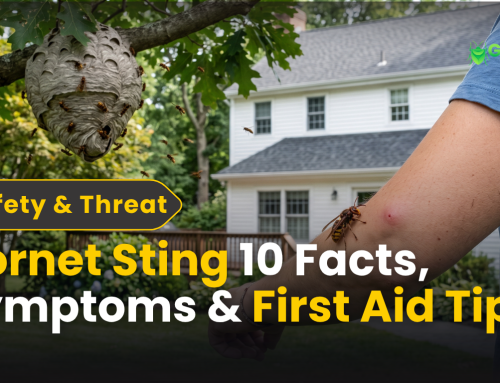
The single most important thing to understand about a hornet nest is this: it is completely enclosed.
Unlike a paper wasp nest where you can see the cells directly, a hornet nest has a thick outer paper shell that completely covers and protects the interior comb structure. Think of it like a paper mâché ball built in layers over weeks and months.
Detailed visual description of a hornet nest:
- Shape: Round to slightly oval — like a football or basketball
- Outer surface: Layered papery sheets with a distinctive swirling, wood-grain pattern created by the construction rings
- Color: Gray to tan, sometimes with subtle brown streaks — the exact color varies depending on what type of wood the hornets harvested for pulp
- Texture: Crisp, slightly rigid, surprisingly sturdy — not fragile
- Entrance: A single hole at the bottom of the nest — well-defined and intentional
- Size progression:
- Early May: Marble to golf ball (queen alone)
- June: Tennis ball to baseball
- July: Softball to grapefruit
- Late August: Football to basketball
- Peak: Up to 14 inches in diameter or larger
Where hornet nests are located:
Hornets prefer elevated, protected locations wherever possible. In Connecticut, you’ll commonly find them:
- Hanging from tree branches — often 10–30 feet up
- Attached to house eaves, soffits, or overhangs
- Inside attics and wall voids — completely hidden
- Inside hollow trees (European hornets prefer this)
- Under deck boards or wooden structures
The most common builder of enclosed aerial nests in Connecticut is the bald-faced hornet (Dolichovespula maculata). For full identification details on this specific species, visit our bald-faced hornet identification and removal guide.
The European hornet (Vespa crabro) — the only true hornet native to North America — also builds enclosed paper nests but tends toward wall voids, tree cavities, and attics rather than open aerial locations. Compare the two species in our yellow jacket vs. European hornet breakdown.
Hornet Nest Behavior Clues
Beyond the visual, hornet nests have distinct behavioral signatures that confirm your identification:
- Active patrolling: Hornets maintain a perimeter guard — you may notice workers hovering near the nest even when no one approaches
- Dive-bombing behavior: If you walk within 10–15 feet of a mature hornet nest, workers may approach or circle you aggressively
- Night activity: European hornets are uniquely active after dark — if you hear loud buzzing near a light source at night, a European hornet nest may be nearby
- Sound: A mature bald-faced hornet nest produces a deep, consistent buzzing hum audible several feet away
Learn more about what triggers hornet territorial behavior in our guide on whether hornets are territorial and what sets them off.
What Does a Wasp Nest Look Like? Visual Details by Type
Paper Wasp Nests (Open-Comb)
When most people picture a wasp nest, they’re imagining a paper wasp structure. These are the smaller, open-faced nests you’ll find tucked under eaves, inside porch ceilings, and around window frames across Westport, CT and New Canaan, CT.
Detailed visual description:
- Shape: Flat, circular or fan-shaped — like an upside-down umbrella
- Structure: Completely open-faced — the hexagonal cells are fully visible with no outer covering
- Attachment: Hangs from a single papery stalk (petiole) attached to a surface
- Color: Gray to light brown
- Size: Rarely larger than a fist — typically 15–30 cells at maturity
- Cells: Downward-facing hexagonal cells; you can see larvae or white-capped pupae inside if you look closely (from a safe distance)
Paper wasp nests are the most commonly encountered nest type in Connecticut because paper wasps build in accessible, human-frequented areas — door frames, porch ceilings, inside grills, under deck boards, inside mailboxes.
Paper wasps are moderately aggressive — they’ll sting if directly threatened or if you disturb the nest, but they won’t launch mass attacks the way hornets do.
For a complete breakdown of paper wasp species in Connecticut, our wasp and hornet ID encyclopedia has every species with identifying details.
Yellow Jacket Nests (Enclosed, Underground or In Walls)
Here’s where things get confusing. Yellow jackets are technically wasps not hornets but their nests look more like hornet nests than paper wasp nests. They build fully enclosed paper nests, just in very different locations.
Underground yellow jacket nest:
- No visible above-ground structure — the nest is entirely underground
- Entrance hole — quarter to golf ball sized, in the lawn or garden soil
- Loose dirt around the entrance
- Constant stream of yellow-black wasps entering and exiting
- Underground chambers can extend 12–24 inches deep and house thousands of workers
Wall void yellow jacket nest:
- Completely hidden inside wall cavity, attic, or crawl space
- Only visible clue: workers entering and exiting through a crack, gap, or vent in the exterior
- Can sometimes be detected by buzzing or rustling sounds inside walls
- May cause workers to appear inside the home through electrical outlets or ceiling light fixtures
According to Wikipedia’s entry on yellow jackets, eastern yellow jackets are one of the most aggressive stinging insects in North America and responsible for the majority of serious sting incidents in the northeastern United States — including Connecticut.
If you hear buzzing inside your walls or see yellow jackets entering a wall crack in your Stamford or Greenwich home do not ignore it. This problem escalates fast. Contact our professional pest control team immediately for a same-day assessment.
For everything on yellow jacket biology and nest behavior, our yellow jacket deep dive resource is the most complete guide available for Connecticut homeowners.
Hornets Nest vs Wasp Nest: The 7 Key Differences in Detail
Now that you understand what each looks like individually, let’s directly compare hornets nest vs wasp nest across the seven most important factors:
Difference 1: Enclosure
Hornet nest: Fully enclosed with a thick outer paper shell. You cannot see interior cells from the outside.
Paper wasp nest: Completely open. The honeycomb cells are fully exposed — there is no outer covering.
Why it matters: The enclosed structure of a hornet nest protects hundreds of workers even when the exterior is disturbed. A paper wasp nest provides no such protection — which partly explains why paper wasps are less immediately reactive than hornets.
Difference 2: Size
Hornet nest: Starts small in spring but grows dramatically. Can reach basketball size or larger by late summer.
Paper wasp nest: Stays small throughout the season — rarely exceeds fist-size even at peak colony development.
Rule of thumb: If the nest is larger than a softball and enclosed — treat it as a hornet nest regardless of what you think the insects are.
Difference 3: Location
Hornet nests favor elevated, sheltered locations — tree branches, high eaves, inside attics.
Paper wasp nests appear in human-traffic areas — door frames, porch ceilings, inside grills, under deck furniture.
Yellow jacket nests (a type of wasp) are underground or inside wall voids — an entirely different scenario requiring an entirely different treatment approach.
Difference 4: Colony Size and Danger
This is the factor that matters most for your safety:
| Species | Colony Size (Peak) | Danger Level |
| Bald-faced hornet | 400–700 workers | Extreme |
| European hornet | 300–500 workers | Extreme |
| Paper wasp | 20–75 workers | Moderate |
| Yellow jacket (ground) | 1,000–5,000+ workers | Extreme |
More workers = more potential stings = greater medical risk. According to the Centers for Disease Control and Prevention (CDC), stinging insects cause approximately 90–100 deaths annually in the United States the majority from anaphylactic reactions.
Difference 5: Aggression Pattern
Hornets maintain active perimeter patrols and will engage perceived threats at distances of 10–15 feet from the nest. They sting multiple times and release alarm pheromones that recruit additional attackers.
Paper wasps are reactive rather than proactive — they’ll sting if you directly touch or disturb the nest but are generally not aggressive at a distance.
Yellow jackets combine the worst of both — they’re highly aggressive like hornets AND can be provoked by ground vibrations even without direct nest contact.
Explore the full aggression comparison in our guide on whether hornets are more aggressive than wasps.
Difference 6: Treatment Approach
This difference is critical. The wrong treatment for the wrong nest type can make things dramatically worse.
Hornet nests (enclosed, aerial):
- Professional aerosol or dust treatment at night
- Stand well back — professional equipment required
- Never attempt without full protective gear
Paper wasp nests (small, early-season):
- Jet-spray aerosol at night can be effective for very small nests
- Larger, active nests = call a professional
Yellow jacket ground nests:
- Professional dust injection into entrance hole
- Never pour anything into the hole
- Night treatment essential
For professional guidance on nest removal approaches, see our hornet nest removal DIY vs. professional comparison and our guide on how to destroy a hornet nest safely.
Difference 7: Seasonal Timing
Both hornet and wasp nests begin in spring and peak in late summer — but the timing of maximum danger differs slightly:
- Paper wasp nests: Active April–September; most defensive in July–August
- Bald-faced hornet nests: Build rapidly June–August; maximum aggression August–October
- Yellow jacket ground nests: Most aggressive and most populated August–September
Understanding seasonal activity helps you time prevention and treatment correctly. See our detailed guide on the best time to treat and kill a hornet nest.
Bee Hive vs Wasp Nest: Don’t Confuse These Two
While we’re covering nest comparisons, we need to address the bee hive vs wasp nest question because misidentifying a honey bee colony leads to serious mistakes.
Key differences:
| Feature | Bee Hive (Honey Bee) | Wasp Nest (Any Type) |
| Material | Golden wax | Gray chewed wood pulp |
| Cell appearance | Deep, uniform hexagons | Shallower hexagons |
| Color | Golden-yellow to amber | Gray to tan |
| Smell | Sweet, honey-waxy | Neutral |
| Insect appearance | Fuzzy, rounded, pollen visible | Smooth, narrow-waisted |
| Aggression | Low to moderate | Moderate to extreme |
The most important rule: Never treat a honey bee colony with wasp spray. Honey bees are federally recognized as critical pollinators and should be removed only by a licensed beekeeper using live-removal methods. Our bee vs. wasp identification guide covers every distinguishing feature.
Ground Wasp Nest Pictures: What to Look For In Your Yard
If you suspect a ground wasp nest in your Connecticut yard, here are the visual clues to look for even without a picture in front of you:
Surface warning signs:
- A hole in the soil — quarter to golf ball diameter
- Disturbed dirt or loose soil mound around the hole entrance
- Rapid, purposeful insect traffic entering and exiting — not random hovering
- Dead or yellowing grass in a small radius above the underground chamber
- Absence of obvious aerial nest combined with heavy wasp activity at ground level
Behavioral signs:
- Wasps appearing to dive into the ground
- Aggressive behavior when you approach a specific lawn area
- Unexpected stinging incident while mowing or doing yard work
Do not attempt to treat a ground nest yourself. Underground yellow jacket colonies can contain thousands of workers in chambers you can’t see. One disturbed entrance hole can trigger a mass response within seconds. Our ground hornets identification and treatment guide explains why professional treatment is essential for these situations.
For Connecticut homeowners specifically, our ground hornet treatment in CT service page provides local expertise and fast response.
Tree Nests and Wall Nests: The Hidden Dangers
Nests Inside Trees
Both bald-faced hornets and European hornets nest inside hollow trees. From the outside, the only indication is a stream of large insects entering a hole in the trunk.
Warning signs:
- Constant large insect traffic at a tree hole
- Low buzzing or humming from inside the trunk
- Dark staining or propolis-like residue around the entrance
Tree nests are difficult to treat because the nest is protected by wood. Professional treatment requires direct injection into the cavity not surface spraying. Our hornet exterminator services include specialized treatment for tree and structural nests.
Nests Inside Walls
Wall nests whether yellow jacket or European hornet are among the most serious structural pest situations you can face as a homeowner.
Warning signs:
- Buzzing or rustling sounds inside walls, especially at night
- Insects entering through exterior cracks, gaps, or vents
- Workers appearing indoors through outlets or ceiling fixtures
- Soft spots or dark staining on drywall
Why wall nests are so dangerous:
- The colony is fully protected and can grow to massive size before detection
- Yellow jackets inside walls sting anyone who disturbs the surrounding structure
- Untreated nests can cause structural damage over time
- Worker die-off in autumn leaves behind wax and organic material that attracts secondary pests — rodents, ants, cockroaches
If you’re in Greenwich, Stamford, or Darien, CT and hearing buzzing inside your walls, reach out to our professional pest control team immediately. This is not a situation that improves with time.
Pro Tips: 5 Things Experts Know That Homeowners Usually Don’t
- The swirling pattern identifies the nest type. Bald-faced hornet nests have a distinctive wood-grain swirling pattern on the outer paper surface from layers built in different directions. Yellow jacket paper nests are more uniform. This pattern is one of the fastest visual identification clues.
- A small nest is not a safe nest. Even a golf ball-sized hornet nest in June contains dozens of workers and an extremely defensive queen. Size does not determine danger level.
- Hornets chew wood from unpainted surfaces. If you notice hornets persistently landing on weathered wood trim, a fence, or old deck boards and chewing, they’re harvesting material for nest construction. This is a sign of active building nearby.
- Night is the right time — for identification AND treatment. During daylight hours, many workers are out foraging. At night, the full colony is home. This makes nighttime the safest time for inspection from a distance — and the most effective time for professional treatment.
- Vibrations trigger ground nests — not just direct contact. Ground yellow jacket nests respond to lawnmower vibrations, weed trimmers, and even heavy foot traffic above their chambers. You don’t need to step on the hole to trigger an attack.
For complete guidance on seasonal nest activity and what to do at each stage, visit our wasp and hornet behavior hub.
Real Connecticut Homeowner Stories
“We had what we thought was a small paper wasp nest on our porch in New Canaan I figured I’d knock it down with a broom handle. Turns out it was an early-stage bald-faced hornet nest about the size of a baseball. I got stung five times before I even realized what was happening. The pest control team came out the next morning and said the colony was already well-established. I wish I’d looked more carefully at what it actually was before doing anything.”
— Homeowner, New Canaan, CT
“There was a nest in the old oak tree in our backyard in Wilton that we noticed in early July. We watched it grow week by week thinking we’d deal with it eventually. By mid-August it was enormous and we had to avoid that whole section of the yard. Green Pest Management handled it in one visit. Lesson learned — early treatment is so much easier.”
— Homeowner, Wilton, CT
Your Action Checklist: What to Do When You Find a Nest
Use this step-by-step checklist when you find any suspected wasp or hornet nest:
- Stay calm and back away — do not swat, spray, or poke
- Observe from a safe distance (at least 20 feet for enclosed nests)
- Note the shape — enclosed (round) or open (flat umbrella)?
- Note the location — aerial, ground, wall, or tree?
- Check the insect size and color — large and black/white = hornet; slender and yellow/black = wasp or yellow jacket
- Listen for sound — deep buzzing from a fixed point indicates a large colony
- Keep family and pets away from the area
- Do not attempt DIY treatment for any enclosed or ground nest
- Call a professional — especially for enclosed nests, ground nests, or wall nests
For complete treatment options and professional service in Connecticut, our hornet control guide with 15 expert tips is your next step.
FAQ: Hornet Nest vs Wasp Nest Expert Answers
Q1: What is the main visual difference between a hornet nest and a wasp nest?
A: The most important difference is enclosure. A hornet nest is completely enclosed in layered gray paper — round or oval shaped, with a single entrance hole at the bottom. You cannot see the interior. A paper wasp nest (the most common wasp nest) is open-faced — the hexagonal cells are fully visible with no outer covering, and it’s shaped like a flat, inverted umbrella. If it’s enclosed and round — treat it as a hornet nest. See our full wasp vs. hornet in CT comparison hub for more detail.
Q2: Is a yellow jacket nest the same as a wasp nest?
A: Yes — yellow jackets are wasps, technically. But their nests look very different from paper wasp nests. Yellow jackets build fully enclosed paper nests almost exclusively underground or inside wall voids. The nest itself is never visible from outside — you only see the entrance hole in the ground or the gap in a wall where workers enter and exit. Yellow jacket nests can be far more dangerous than paper wasp nests due to their massive colony size. Our hornets vs. yellow jackets vs. wasps comparison breaks this down clearly.
Q3: How can I tell if a nest is a bee hive or a wasp nest?
A: Look at the material and the insects. Bee hives are made of golden wax and have a sweet, honey-like smell. Wasp nests are made of gray chewed wood pulp (paper) and have no noticeable smell. The insects tell you even more — bees are fuzzy and rounded with visible pollen on their legs; wasps are smooth and narrow-waisted. Never treat a bee hive with wasp spray. Our bee vs. wasp identification guide covers every detail.
Q4: Are hornets more dangerous than wasps?
A: Generally, yes — particularly bald-faced hornets. Hornet nests contain larger colonies, hornets are more aggressive at greater distances, and they sting multiple times per attack. However, yellow jackets (which are wasps, not hornets) can be equally dangerous due to massive colony sizes in ground nests. The real danger depends on colony size, nest location, and how close you get. Read our detailed how harmful are hornets guide for a full risk assessment.
Q5: Can I remove a hornet nest or wasp nest myself?
A: For hornet nests — never. Enclosed aerial nests, ground nests, and wall nests should always be handled by professionals with proper equipment and protective gear. For very small, early-season paper wasp nests (fewer than 10 cells, no larvae, accessible location, no known sting allergies), careful nighttime treatment with a jet-spray product is sometimes reasonable. When in doubt — call a professional. Our hornet nest removal in CT service provides fast, guaranteed results.
Q6: Do hornet nests and wasp nests get reused the following year?
A: No. Workers and males die each autumn. Only mated queens survive winter — and they never return to the previous year’s nest. They build entirely new nests each spring. However, prime nesting locations attract new queens year after year, so you may see recurring activity near the same area of your home. Removing old nests in winter helps discourage this pattern.
Q7: What’s the best way to prevent wasps and hornets from nesting on my property in Connecticut?
A: The most effective prevention strategies are: early spring inspection (April–May, when new queens are just beginning to build), sealing all exterior gaps and cracks larger than ¼ inch, removing weathered or unpainted wood that hornets harvest for nest material, and scheduling a professional preventive treatment before nesting season begins. For detailed seasonal prevention advice specific to Connecticut, see our how to deter hornets from nesting guide.
Don’t Wait Until Someone Gets Stung Act Now
Here’s the reality for homeowners across Greenwich, Stamford, Darien, New Canaan, Wilton, and Westport, CT: stinging insect nests do not shrink. They do not go away on their own during summer. They do not become less dangerous over time.
Every week you wait, the colony grows. A 50-worker paper wasp nest in June becomes 300 workers by August. A golf ball-sized hornet nest in early July becomes a basketball-sized colony of 600+ defenders by September. A modest ground nest in May becomes an underground city of 4,000 yellow jackets by Labor Day weekend.
The longer you wait, the harder and more dangerous the situation becomes.
Whether you’ve found an enclosed gray ball hanging from your tree, a hole in your lawn with constant insect traffic, buzzing inside your walls, or mud tubes under your eave we can identify it, treat it safely, and make sure it’s completely eliminated.
Our team at Green Pest Management CT serves all of Fairfield County and greater Connecticut with:
- Expert nest identification before any treatment begins
- Full protective equipment and professional-grade products
- Safe, fast treatment for aerial, ground, and structural nests
- Follow-up inspection to confirm complete colony elimination
- Preventive guidance to keep nests from returning
For immediate professional help, see our immediate hornet control in CT service and our hornet nest removal in CT page.