Bumblebee vs Hornet: Complete ID & Danger Guide
Large, Striped, and Flying — But Which One Is It?
You’re deadheading roses in your Wilton garden when something large, fuzzy, and loudly buzzing lifts off from the soil near the foundation. Your heart rate jumps. Your first thought: hornet. But is it?
The bumblebee vs. hornet confusion is genuinely one of the most common identification mistakes Connecticut homeowners make and the consequences of getting it wrong cut both ways. Call a hornet a bumblebee and you’ll underestimate a real danger. Call a bumblebee a hornet and you might unnecessarily destroy one of the most ecologically valuable insects in your garden.
Both insects are large. Both have black and yellow markings. Both can sting. But they’re fundamentally different creatures with completely different behavior, nesting habits, ecological roles, and risk profiles. This guide gives you the tools to tell them apart accurately in the field, in real time and explains exactly what to do once you know what you’re dealing with.
The Quick Answer: Bumblebee vs. Hornet
Bumblebees (Bombus species) are fuzzy, round, slow-moving pollinators that feed on nectar and pollen. They’re gentle by nature, rarely sting, and are critical to the health of Connecticut’s native plant communities and gardens. Hornets specifically bald-faced hornets (Dolichovespula maculata) and European hornets (Vespa crabro) are smooth-bodied, predatory insects that hunt other insects, defend their nests aggressively, and pose a meaningful sting risk when their territory is encroached upon.
The distinction matters enormously for how you respond. Bumblebees deserve to be left alone or, at most, carefully relocated if their nest is in a genuinely problematic location. Hornets near a structure, entryway, or high-traffic area generally warrant professional removal.
For a broader look at how hornets compare to other stinging insects, the hornets vs. bees key differences guide and the wasps vs. hornets key differences guide provide useful comparative context.
Physical Identification: How to Tell Them Apart
Body Surface The Most Reliable Single Indicator
If there’s one observation that resolves the bumblebee vs. hornet question faster than anything else, it’s this: look at the body surface.
Bumblebees are densely furry. Their branched body hairs cover the thorax and abdomen in a thick, velvety coat. This isn’t cosmetic the branched structure of bee hair is specifically adapted for pollen collection, trapping pollen grains as the bee forages from flower to flower. From even a few feet away, a bumblebee looks soft and plump.
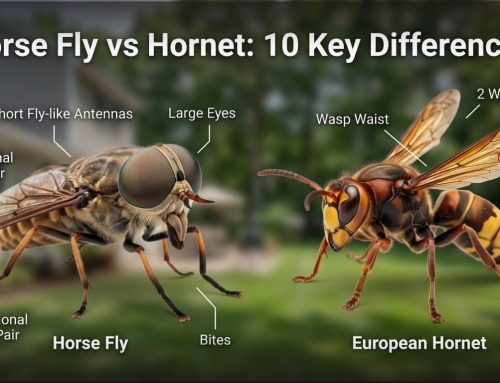
Hornets are smooth and shiny. Hornets and wasps have hard, polished exoskeletons with minimal hair. They look angular, defined, and almost lacquered. Even a large European hornet, which can approach bumblebee size, has a sleekness that’s completely absent in bumblebees.
This single observation — fuzzy versus smooth is the fastest and most reliable bumblebee vs. hornet identifier you have. Practice it once and you’ll use it automatically.
Size and Body Shape
Both bumblebees and hornets can be impressively large, which is part of what creates the confusion. But their proportions are quite different.
Bumblebees are round and compact. Their abdomens are wide and full, giving them a plump, barrel-shaped appearance. Worker bumblebees range from about ½ inch to ¾ inch, while queens can exceed an inch in length. Their legs are often visibly loaded with pollen bright yellow pollen baskets on the hind legs are a definitive bumblebee indicator when present.
Hornets are elongated and have a defined, narrow waist the characteristic pinched connection between thorax and abdomen that’s typical of all wasps. Bald-faced hornets reach about ¾ inch to just over an inch. European hornets are larger still, reaching up to 1.5 inches but their elongated, wasp-like profile is very different from the rounded bumblebee shape even at similar lengths.
Flight pattern also differs noticeably. Bumblebees drift between flowers in a slow, somewhat meandering pattern, hovering briefly to investigate blossoms. Hornets fly with direct, purposeful speed they’re on a mission, not browsing.
Color and Markings
Bumblebees in Connecticut display black and yellow banding with dense hair in both colors. Some species also show orange or white markings. The coloring is warm and muted the yellow looks golden rather than vivid because it’s filtered through layers of hair.
Bald-faced hornets are predominantly black and white not the yellow and black that most people expect. Their white facial markings and white abdominal banding are distinctive and actually make them easier to distinguish from bumblebees than many other hornet species, once you know to look for white rather than yellow. For detailed bald-faced hornet identification, the bald-faced hornet identification and removal guide covers the species thoroughly.
European hornets are brown and yellow a more muted, earthy coloring compared to the vivid yellow-black of yellow jackets. The brown thorax and brown-banded abdomen distinguish them from bumblebees, which don’t have significant brown in their coloring. For additional visual context on what hornets look like across species, the what does a hornet look like guide is a useful reference.
Complete Bumblebee vs. Hornet Comparison Table
| Feature | Bumblebee | Bald-Faced Hornet | European Hornet |
| Body surface | Dense, fuzzy hair | Smooth, shiny | Smooth, shiny |
| Size | ½ – 1+ inch | ¾ – 1 inch | 1 – 1.5 inches |
| Shape | Round, compact | Elongated, defined waist | Large, elongated waist |
| Color | Black & yellow (fuzzy) | Black & white | Brown & yellow |
| Pollen baskets | Yes (visible on legs) | No | No |
| Flight pattern | Slow, drifting | Fast, direct | Fast, direct |
| Nest type | Ground cavity/debris | Enclosed aerial paper nest | Enclosed cavity nest |
| Diet | Nectar, pollen | Insects, sap | Insects, sap, fruit |
| Aggression | Very low | Very high | High |
| Stinger | Smooth, rarely used | Smooth, used readily | Smooth, used readily |
| Nocturnal? | No | No | Yes (attracted to light) |
| Ecological role | Pollinator | Insect predator | Insect predator |
Nesting: Where Each Species Sets Up
Nest location and structure are often the most reliable identification clues when the insect itself is moving too fast to observe clearly.
Bumblebee Nesting Habits
Bumblebees are cavity nesters that prefer pre-existing shelter over constructing elaborate structures. In Connecticut, bumblebees commonly nest in:
- Abandoned rodent burrows in lawns, garden beds, and wooded edges
- Piles of debris leaf litter, compost piles, wood chip mulch
- Hollow logs and stumps in wooded areas
- Dense ground cover like ornamental grasses or thick low shrubs
- Occasionally under decking or foundations in raised structures
The nest itself is a loose cluster of waxy cells irregular and organic-looking, nothing like the structured honeycomb of honeybees or the papery envelope of hornet nests. Colony size is modest, typically ranging from a few dozen to a few hundred workers at peak summer population.
A key behavioral indicator: if you see bumblebees entering and exiting from a small hole in the ground near a garden bed in Darien or Westport, you’re almost certainly looking at a bumblebee nest rather than anything more dangerous. Bumblebees entering a ground hole tend to do so in a slow, drifting manner hovering briefly before descending.
Hornet Nesting Habits
Hornet nests are structurally very different from bumblebee nests and are made of a completely different material.
Bald-faced hornets build the enclosed, football-shaped gray paper nests that are a familiar sight throughout Fairfield County in late summer. These are suspended aerially from tree branches, shrubs, eaves, and fence posts. The outer shell is a layered papery material constructed from chewed wood fiber. Nests can reach basketball size or larger by September. For a detailed structural comparison with wasp nests, the hornet nest vs. wasp nest key differences guide covers the distinguishing characteristics clearly.
European hornets prefer enclosed cavities hollow trees, wall voids, attic spaces, and outbuildings. Their nests are similarly constructed from chewed wood fiber but are hidden inside structures rather than suspended visibly. European hornets are well known for entering homes at night through gaps around utility conduits and window frames, drawn by interior light sources a behavioral pattern quite unlike anything bumblebees do.
If you’re seeing something that looks like a gray paper ball hanging in a shrub in your Wilton or New Canaan yard, it’s a hornet nest. If you’re seeing fuzzy insects coming in and out of a ground hole near a flower bed, it’s almost certainly bumblebees.
Danger Assessment: How Much Risk Does Each Pose?
Bumblebee Danger Level: Low
Bumblebees are among the most tolerant and non-aggressive stinging insects you’ll encounter in Connecticut. Here’s the realistic picture:
Foraging bumblebees away from the nest pose essentially zero sting risk. They’re focused on pollen and nectar collection and have no reason to sting unless directly handled, squeezed, or trapped. You can walk through a garden full of actively foraging bumblebees without incident.
Near the nest, bumblebees will defend if directly disturbed, but their defensive perimeter is small and their response is measured. Unlike hornets, bumblebees don’t maintain an aggressive territorial perimeter that extends far from the nest entrance. Accidentally disturbing a bumblebee nest by stepping near it or vibrating the ground with a lawn mower may produce some buzzing and circling, but a sustained pursuit is extremely unlikely.
Stinging mechanics: Bumblebees have smooth stingers and can technically sting multiple times. But they almost never do. Stings typically only occur when a bumblebee is directly handled or deliberately provoked. The venom of a bumblebee sting is similar to a honeybee sting painful but not severe for most people.
Hornet Danger Level: High
The contrast with hornets is stark.
Bald-faced hornets are among the most aggressive stinging insects in Connecticut. They defend a territorial perimeter extending well beyond the physical nest sometimes 10 feet or more. They release alarm pheromones when threatened that recruit other colony members rapidly. Unlike bumblebees, they don’t wait to be directly handled before stinging simply approaching the nest perimeter too closely can trigger a defensive response.
Colony size amplifies the risk. A mature bald-faced hornet nest in September may contain several hundred workers. A single disturbed nest can produce dozens of simultaneous stings within seconds.
European hornets are somewhat less immediately reactive than bald-faced hornets but are still vigorous defenders. Their size means each sting delivers more venom than a typical wasp or even bald-faced hornet sting. Their nocturnal behavior adds an additional risk dimension encounters with European hornets flying indoors toward light sources can startle homeowners into making sudden movements that provoke stinging.
For anyone with a known hymenoptera venom allergy a condition that can develop at any point in life, even after years of non-reactive stings any stinging insect encounter carries serious risk. But for the general population, the hornet risk profile is meaningfully higher than that of bumblebees.
The how harmful hornets are guide provides a more detailed assessment of hornet sting risk, and the are hornets territorial and what triggers them guide explains exactly what behaviors provoke a defensive response.
The Bumblebee’s Ecological Role: Why This Identification Matters
The stakes of misidentifying a bumblebee as a hornet go beyond the immediate encounter. Bumblebees are critical pollinators and several bumblebee species are experiencing significant population declines across North America.
According to research from the Xerces Society for Invertebrate Conservation, several bumblebee species in the eastern United States have seen dramatic population declines over the past several decades due to habitat loss, pesticide exposure, disease, and climate change. In Connecticut, native bumblebee populations are an important part of the ecological fabric supporting native plant reproduction, agricultural productivity, and garden health across Fairfield County.
Unnecessarily destroying a bumblebee colony with insecticide doesn’t just eliminate that colony. It removes a locally adapted population of pollinators that can’t simply be replaced. This is why correct identification matters even before safety considerations enter the picture.
What to Do: Bumblebee vs. Hornet Response Guide
If You Have Bumblebees
Foraging bumblebees in the garden: Leave them alone. They’re doing you a service.
A bumblebee nest in a low-traffic area of the yard: The most ecologically sound response is to leave it undisturbed until the colony ends naturally in fall. Bumblebee colonies are annual all workers die when temperatures drop, leaving only newly mated queens to overwinter in the soil. By November, the nest will be abandoned on its own.
A bumblebee nest directly in a problem location inside a children’s play structure, directly under a frequently used entryway, or in an area where the ground is regularly disturbed warrants careful relocation. A pest management professional can assess whether relocation is feasible and advise on the safest approach.
Do not spray insecticide on a bumblebee nest as a first response. Beyond the ecological impact, it’s often unnecessary given the low risk profile of bumblebees and their seasonal lifecycle.
If You Have Hornets
Any hornet nest near a structure, entryway, or high-traffic area: Contact a professional. The emergency hornet removal guide covers what to do while waiting for professional help, including keeping people and pets clear of the area and avoiding any activities that vibrate or disturb surfaces near the nest.
A hornet nest in a remote tree location with minimal human traffic: Risk-assess based on the specific situation. A nest 25 feet up in an oak tree at the far edge of a large property poses different practical risk than a nest at head height near a back door. A professional assessment helps you make that determination accurately.
European hornets inside your home: Seal the light sources or gaps they’re entering through and contact a professional to treat the colony in its nesting cavity. Attempting to treat a wall void or attic nest without professional equipment significantly increases risk.
Green Pest Management CT provides professional hornet exterminator services throughout Greenwich, Stamford, Darien, Westport, Fairfield, Wilton, New Canaan, Norwalk, and surrounding Fairfield County communities. Their approach follows Integrated Pest Management (IPM) principles using targeted treatment methods that eliminate genuine threats while protecting beneficial insects like bumblebees where possible, consistent with EPA guidelines for pest management.
Common Mistakes Homeowners Make
The team at Green Pest Management CT encounters the same identification errors repeatedly across Fairfield County properties. Here’s what to avoid:
Mistake 1: Treating a bumblebee nest like a hornet nest.
Bumblebees in a garden or under a compost pile are not a threat in most circumstances. Immediately reaching for insecticide is an overreaction that destroys a beneficial colony and solves a problem that usually didn’t need solving.
Mistake 2: Treating a hornet nest like a bumblebee nest.
The opposite mistake is far more dangerous. Approaching a bald-faced hornet nest with the assumption that the large, striped insects nearby are calm bumblebees can result in a genuinely serious stinging incident.
Mistake 3: Disturbing the nest before confirming what it is.
The safest approach when you’re uncertain is to observe from a distance without disturbing anything. Note the insect’s body surface (fuzzy vs. smooth), flight pattern (drifting vs. direct), and nest structure (if visible) before making any decisions.
Mistake 4: DIY treatment of a confirmed hornet nest.
Commercial wasp sprays are not adequate protection for hornet nest treatment without full protective equipment and a clear plan. Professional treatment is consistently safer and more effective. The hornet nest removal DIY vs. professional comparison outlines exactly why this matters.
Mistake 5: Waiting too long with confirmed hornets.
A bald-faced hornet nest in June contains far fewer workers than the same nest in September. Early identification and professional treatment is significantly less complicated and less expensive than end-of-season emergency removal.
Seasonal Context: Bumblebees and Hornets in Connecticut
Connecticut’s climate creates distinct seasonal windows for both bumblebee and hornet activity. Understanding the annual cycle helps you anticipate encounters and respond appropriately.
Early Spring (March–April):
Bumblebee queens emerge from overwintering sites in soil and begin searching for nesting locations. You may see large, solitary bumblebee queens moving slowly near ground level these are founding queens, not aggressive insects, despite their impressive size.
Hornet queens also emerge from overwintering sites and begin establishing founding colonies alone. Early-season hornet nests are tiny just a few cells and minimally defended.
Late Spring–Early Summer (May–June):
Bumblebee colonies grow steadily. Workers begin foraging actively in gardens and flowering plants. Honeysuckle, clover, native wildflowers, and vegetable garden blossoms attract heavy bumblebee activity across Fairfield County properties.
Hornet colonies expand. Workers take over from the queen for expansion duties. Nests become more established and more defended.
Peak Summer (July–August):
Both species reach significant population levels. Bumblebee foraging activity is at its height. Hornet nests grow rapidly bald-faced hornet colonies that started with a single queen in April may contain several hundred workers by August.
This is the most critical identification period for Fairfield County homeowners. Backyard activity, outdoor dining, garden work, and children playing outdoors all increase encounter frequency with both species.
Late Summer–Fall (August–October):
Bumblebee colonies begin producing new queens and males in preparation for the colony’s end. The founding queen’s egg production declines. The colony will begin to wind down through September and October.
Hornet colonies reach maximum size and maximum aggression. This is the peak risk period across Greenwich, Stamford, Darien, Westport, Wilton, New Canaan, Norwalk, and Fairfield. Late-season hornet workers are more defensive and less predictable than earlier in the year.
Winter (November–March):
All bumblebee workers die. New queens overwinter in small soil cavities. Hornet colonies collapse entirely workers and old queens die. Only newly mated hornet queens survive by overwintering in sheltered sites. Abandoned hornet nests remain visible but are completely inactive.
The wasp lifespan and lifecycle guide provides additional detail on how these annual cycles play out across stinging insect species.
Local Perspective: Fairfield County Bumblebee and Hornet Patterns
The ecological diversity of Fairfield County’s communities creates variable conditions for both bumblebee and hornet populations:
Greenwich and Darien — with their large properties, mature native plantings, and significant horticultural investment tend to support robust bumblebee populations in garden areas while also experiencing European hornet pressure in hollow trees and older home structures. Homeowners in these communities often have the most complex identification situations because both species are genuinely present at meaningful densities.
Westport and Fairfield — coastal communities with native meadow gardens, rain gardens, and shoreline vegetation are among the strongest bumblebee habitats in Fairfield County. Multiple native Bombus species forage actively in these environments from spring through fall. Bald-faced hornet activity is also consistent in the wooded buffers and ornamental shrub plantings common in these communities.
Wilton and New Canaan — heavily wooded, with forest edges and significant undeveloped land adjacent to residential properties experience higher concentrations of bald-faced hornet nesting in shrubs and understory trees. The forest edge character of these communities is ideal hornet nesting habitat.
Stamford and Norwalk — more urbanized areas see bumblebee activity concentrated around parks, community gardens, and residential plantings. Hornet activity tends to be more localized, with nests appearing in structural gaps, eaves, and ornamental landscaping.
The wasp and hornet ID encyclopedia for Connecticut and the CT wasp and hornet ID guide both provide species-level identification resources specific to Connecticut’s stinging insect landscape.
Frequently Asked Questions
How do I tell a bumblebee from a hornet quickly?
Look at the body surface. Bumblebees are densely fuzzy — their body hair is thick and visible even from several feet away. Hornets are smooth and shiny with no significant body hair. This single observation resolves most bumblebee vs. hornet confusion quickly and reliably. Flight pattern helps confirm: bumblebees drift slowly between flowers, while hornets fly with fast, direct purpose.
Are bumblebees dangerous?
Bumblebees pose very low risk under normal circumstances. A foraging bumblebee away from its nest almost never stings. Near the nest, they’ll defend if directly disturbed, but their defensive perimeter is small and their response is moderate compared to hornets. Stings typically only occur when a bumblebee is directly handled or accidentally trapped.
Can bumblebees sting more than once?
Technically yes — bumblebees have smooth stingers that don’t detach, so they can sting multiple times. However, they almost never do. Bumblebee stings are rare events that typically only happen under direct provocation. This is very different from hornets, which sting readily and repeatedly in defense of their colony.
What does a bumblebee nest look like?
Bumblebee nests are irregular clusters of waxy cells, typically hidden inside a ground cavity, hollow log, or pile of debris. They don’t have the structured comb of honeybees or the papery envelope of hornet nests. You’ll often identify a bumblebee nest by seeing fuzzy insects entering and exiting a small ground hole or cavity rather than by seeing the nest structure itself.
What should I do if I find a bumblebee nest in my garden?
In most cases, leave it alone. Bumblebee colonies are annual — they’ll end naturally in fall and the nest will be abandoned. If the nest is directly in a problem location (under a children’s play area, in a high-traffic entryway), contact a pest management professional to discuss careful relocation options. Avoid using insecticide on bumblebee nests unless absolutely necessary.
How do I know if the large insect in my yard is a hornet and not a bumblebee?
Check body surface (smooth vs. fuzzy), flight pattern (fast and direct vs. slow and drifting), and if possible, where it’s headed. Hornets fly purposefully between a food source and their nest. Bumblebees drift between flowers. If you see a large smooth-bodied insect repeatedly entering and exiting a single point on a structure, shrub, or the ground in a fast, direct pattern — that’s hornet behavior, not bumblebee.
Should I remove a bumblebee nest on my property?
Usually not. Most bumblebee nests in garden settings pose minimal risk and provide significant ecological benefit. Unless the nest is directly in a location that creates unavoidable human contact, leaving it alone until the colony ends naturally in fall is the best approach for both safety and ecological reasons.
Are European hornets active at night?
Yes — European hornets are notably nocturnal compared to most other stinging insects. They’re strongly attracted to light and will fly toward lit windows, porch lights, and indoor fixtures after dark. This nocturnal behavior is one of the most distinctive identification clues for European hornets and is completely unlike bumblebee behavior.
What attracts hornets to my property?
Available nesting sites (tree cavities, wall voids, hollow logs, shrubs), insect prey populations, and in the case of European hornets, light sources at night. Reducing available cavity nesting sites by sealing structural gaps in early spring, and maintaining good exterior lighting management, reduces hornet pressure on Connecticut properties.
When should I call a professional for a hornet nest?
For any hornet nest in or near a structure, entryway, play area, pool, or outdoor dining space. Also for any nest where a household member has a known venom allergy, any nest inside a wall void or attic, and any situation where DIY treatment has already been attempted without success. When in doubt, a professional inspection is the lower-risk choice.
Conclusion: Know What You’re Looking At Before You React
The bumblebee vs. hornet distinction is one of the most practically important identification calls a Fairfield County homeowner can make and with the right knowledge, it’s also one of the most reliably solvable.
Fuzzy and round, drifting slowly from flower to flower? Bumblebee. Treat it as the ecological asset it is. Smooth and elongated, flying fast and directly toward a single point on your property? Hornet. Assess the risk, keep people clear, and contact a professional if the nest is in a location that poses meaningful danger.
The seven comparison points in this guide body surface, size, shape, color, nesting, diet, and aggression give you the framework to make that identification correctly, even when the insect is moving fast and your instinct is to back away. Use them together, and you’ll get the right answer the vast majority of the time.
For Connecticut homeowners across Greenwich, Stamford, Darien, Westport, Fairfield, Wilton, New Canaan, and Norwalk, both bumblebees and hornets are reliable summer residents. The property decisions you make about each will be better safer, more ecologically sound, and more effective when they start with accurate identification.
If you’ve found something on your property and aren’t confident about what it is, or if you’ve confirmed hornets and need professional removal, Green Pest Management CT is available to help with expert identification and targeted treatment throughout Fairfield County. Their team brings both the ecological awareness to protect beneficial pollinators and the professional capability to safely address genuine hornet threats.
Explore the complete pest identification and comparison content hub for additional comparison guides covering wasps vs. hornets, fruit flies vs. drain flies, and other common Connecticut pest identification questions.
For additional resources, explore the hornet control guide with 15 expert tips, the wasp hornet behavior hub, and the professional service lead hub for Connecticut-specific pest management support