Bugs That Look Like Wasps: 15 Amazing Lookalikes Explained
Many bugs that look like wasps are not wasps at all—and several cannot sting. Hoverflies can imitate yellow jackets, longhorn beetles may have convincing black-and-yellow markings, clearwing moths can resemble hornets, and flying ants are frequently mistaken for small wasps. Carpenter bees, robber flies, and other insects add to the confusion.
For Connecticut homeowners, the fastest identification method is to look beyond color. True flies have one functional pair of wings. Beetles have hardened front wing covers. Flying ants have elbowed antennae and a nodal waist. Wasps generally have two pairs of membranous wings, noticeable antennae, and a characteristic waist.
Correct identification is more than curiosity. A beneficial hoverfly on a flower usually needs no treatment, while dozens of yellow jackets repeatedly entering one ground hole can indicate a defensive colony. Treating the wrong insect wastes effort and can unnecessarily harm pollinators and other beneficial species.
This guide covers 15 common or noteworthy lookalikes and explains how homeowners in Greenwich, Stamford, Darien, Westport, Fairfield, Wilton, New Canaan, Norwalk, and surrounding Fairfield County can tell them apart safely.
Why Do So Many Bugs Look Like Wasps?
The resemblance often has an evolutionary advantage.
Many predators learn to associate contrasting patterns—particularly combinations of yellow, orange, black, reddish, or white—with animals that may sting or otherwise defend themselves.
A relatively harmless insect can potentially benefit by resembling a dangerous one. This is known as Batesian mimicry.
To be effective, the disguise does not have to fool an entomologist looking at a high-resolution photograph. It only needs to make a predator hesitate long enough to give the insect an advantage.
Humans get fooled by the same pattern.
That is why an insect that looks exactly like a yellow jacket while hovering above flowers can turn out to be a completely harmless fly when viewed closely.
For an expanded discussion of this phenomenon, Green Pest Management CT’s wasp mimic and identification hub covers the major lookalike groups.
Quick Identification: Wasp or Lookalike?
Start with anatomy rather than body color.
| Feature | Wasp | True fly | Beetle | Flying ant | Clearwing moth |
| Wing pairs | 2 | 1 functional pair | Hardened forewings plus flight wings | 2 | 2 |
| Antennae | Usually noticeable | Often relatively short | Variable | Elbowed | Variable, moth-like |
| Eyes | Moderate | Often very large | Variable | Moderate | Variable |
| Waist | Often strongly narrowed | Usually not truly wasp-like | No typical wasp waist | Narrow with node(s) | No typical wasp waist |
| Stinger | Females of many species | No | No wasp stinger | Species-dependent defenses | No |
| Best clue | Wings + waist + behavior | Large eyes + one wing pair | Hard wing covers | Elbowed antennae | Lepidopteran wing/body structure |
Use several clues together. Fast-moving insects can make individual characteristics difficult to see.
A zoomed photograph is safer than capturing an unknown insect by hand.
15 Bugs That Look Like Wasps
1. Hoverflies
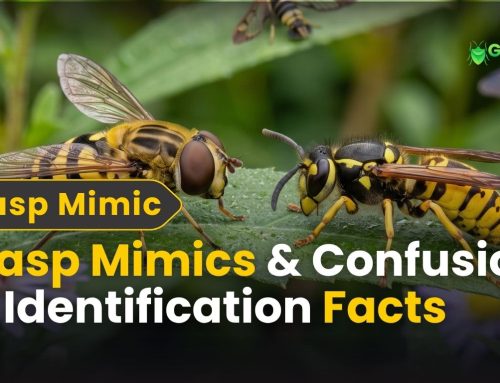
Hoverflies are among the most convincing wasp mimics Connecticut homeowners encounter.
Many species in the family Syrphidae have yellow-and-black or orange-and-black markings that resemble yellow jackets, paper wasps, or bees.
They cannot sting.
They also do not bite people like horse flies.
How to identify a hoverfly
Flight behavior provides the first clue. Many hoverflies can remain nearly motionless in midair before suddenly darting sideways.
Look at the eyes and wings next.
As true flies, hoverflies have one functional pair of wings. Many also possess large fly-like compound eyes and relatively short antennae.
Wasps have two pairs of membranous wings.
Hoverflies can be beneficial as well. Adults of many species visit flowers, while larvae of some species consume aphids and other small insects.
A hoverfly feeding among garden flowers is usually something to leave alone, not a target for wasp pesticide.
2. Wasp-Mimicking Longhorn Beetles
A beetle that looks like a wasp can be surprisingly convincing.
Longhorn beetles are especially noteworthy because some species combine elongated bodies, prominent antennae, and yellow, black, orange, or reddish patterns.
Fortunately, there is one strong identification clue: elytra.
Beetles have hardened front wings called elytra. When closed, they typically form a protective shell over the functional flight wings and meet along a seam running down the back.
Wasps do not have hardened wing covers.
The dedicated wasp-like beetle identification guide explains these structural differences in greater detail.
One outdoor longhorn beetle does not automatically indicate a structural infestation. Species identification and evidence of where larvae developed matter before any treatment decision.
3. Locust Borers
The locust borer is a type of longhorn beetle whose dark body and bold yellow markings create a very wasp-like appearance.
Adults may be found around flowers.
If you see one briefly, the coloration can suggest a yellow jacket. A closer photograph reveals a beetle’s hardened elytra.
Their larval biology is associated with black locust trees rather than underground yellow jacket colonies.
This is a useful illustration of why location alone can mislead. Both beetles and wasps visit flowers, so feeding on blossoms does not prove an insect belongs to either group.
Anatomy provides the stronger evidence.
4. Thick-Headed Flies
Some thick-headed flies, family Conopidae, look remarkably like wasps.
Their body shape may be narrow or elongated, while contrasting abdominal coloration strengthens the disguise.
Despite appearances, they are true flies.
That means one functional wing pair rather than two.
Look for fly-like eyes, antennae, and wing structure in a clear photograph.
These insects do not establish yellow jacket-style social colonies around your home. Their biology is fundamentally different, so treating them as nesting wasps would accomplish little.
5. Soldier Flies
Several soldier flies have dark or contrasting bodies that can be mistaken for narrow-bodied wasps.
Again, wing number separates the groups.
A soldier fly has one functional pair of wings. A wasp has two.
The more important pest-management lesson is that identifying something simply as a “fly” is still not always enough. Different fly species develop in completely different materials.
An outdoor harmless fly and an indoor fly breeding in organic material call for different responses.
Green Pest Management CT’s fly versus gnat guide explains the importance of identifying indoor flying insects by source.
6. Robber Flies
Robber flies are predatory true flies that capture other insects.
Some are large, fast, and powerful fliers. Certain species resemble bees or wasps closely enough to be mistaken for hornets.
Robber flies do not build social paper nests.
They are predators rather than social stinging insects.
They should still not be handled, but an individual robber fly hunting other insects around the landscape usually does not require the response appropriate for a hornet colony.
Check for one pair of wings and characteristic fly anatomy if a large “hornet” seems unusually fly-like.
7. Bee Flies
Bee flies add another layer to the confusion.
Many have fuzzy bodies and hover around flowers. At a glance, they may resemble bees, small wasps, or even unusual flies with a threatening-looking projection at the front of the head.
That projection can be a feeding structure rather than a stinger.
Bee flies are true flies and have one functional pair of wings.
They illustrate an important identification principle: a long or pointed body part does not automatically mean an insect is equipped to sting you.
8. Horse Flies
Large horse flies are sometimes called hornets because of their size, strong flight, and painful encounters with people.
Horse flies and hornets, however, injure people in completely different ways.
Female blood-feeding horse flies use specialized cutting mouthparts to obtain blood. They bite.
Hornets use venomous stingers.
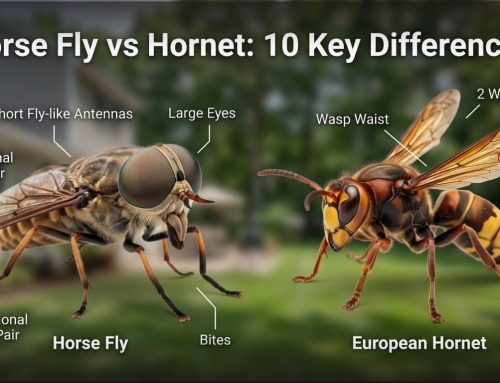
Horse fly vs hornet
Horse flies have one functional pair of wings and extremely prominent compound eyes. Hornets have two pairs of wings, more conspicuous antennae, and a narrowed wasp waist.
Horse flies also do not build a social paper nest.
For a complete comparison, use Green Pest Management CT’s horse fly versus hornet guide.
9. Flying Ants
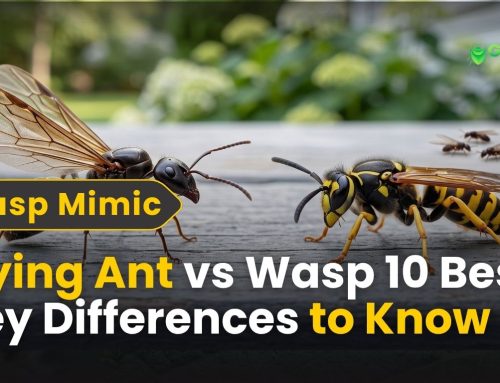
Flying ant vs wasp is one of the most useful structural identification comparisons for homeowners.
Flying ants are reproductive males or females produced by established ant colonies. They are commonly called alates.
Both ants and wasps belong to Hymenoptera, so broad similarities are not surprising.
How to identify a flying ant
Look for distinctly elbowed antennae.
The waist also provides an excellent clue. Ants possess one or two characteristic nodes between the main thoracic region and abdomen.
Flying ants usually have front wings larger than their rear wings.
A sudden emergence of winged ants inside a house can indicate ant colony activity and deserves a different inspection from a social-wasp nest.
The flying ant versus wasp identification guide covers these differences in detail.
10. Termite Swarmers
Termite swarmers are not particularly convincing wasp mimics when examined closely, but in real homes they commonly enter the same identification conversation.
A homeowner may see small winged insects at a window and wonder whether they are ants, termites, or tiny wasps.
Termite swarmers have relatively straight or bead-like antennae, broad waists, and two pairs of wings that are similar in length.
Flying ants have elbowed antennae, pinched waists, and front wings generally larger than the rear pair.
This distinction is important because an indoor termite emergence has very different implications from finding a solitary wasp at a window.
Professional identification is appropriate when termite swarmers cannot be confidently ruled out.
11. Clearwing Moths
Some clearwing moths perform an impressive wasp imitation.
Instead of the broad, heavily scaled wings people typically picture when they hear “moth,” clearwing species can have large transparent sections.
Combine those wings with a narrow body and yellow, black, orange, or reddish markings, and the insect can look remarkably wasp-like.
Clearwing moths are Lepidoptera, not Hymenoptera.
The larvae of some species develop within plant stems, trunks, or other host material. Accurate identification can therefore point toward a landscape issue rather than a stinging-insect problem.
12. Carpenter Bees
Large carpenter bees are routinely mistaken for hornets.
Their loud flight and habit of hovering around decks, fascia boards, railings, pergolas, sheds, or other wood can make homeowners particularly nervous.
Male carpenter bees may appear territorial and approach people passing through an area.
Males cannot sting.
Females can sting but generally avoid doing so unless handled or seriously provoked.
Carpenter bees have robust bee-like bodies and nest in tunnels excavated in suitable wood rather than building social paper nests.
Green Pest Management CT’s hornet versus carpenter bee guide explains how to identify them safely.
13. Bumblebees
Bumblebees may be confused with large yellow-and-black wasps, especially when someone only sees the insect in flight.
A close view usually resolves the question.
Bumblebees generally appear robust and noticeably hairy. That hair helps collect pollen.
Yellow jackets and hornets typically appear smoother.
Bumblebee females can sting, so these are not harmless mimics, but their nesting behavior and ecological role differ considerably from social wasps.
For identification help, see the bumblebee versus hornet guide.
14. Cicada Killers
Cicada killers are actual wasps, but they belong on a lookalike list because homeowners commonly mistake them for hornets or oversized yellow jackets.
These substantial solitary wasps dig burrows in soil and provision their offspring with cicadas.
Their behavior differs from social yellow jackets.
Male cicada killers may patrol nesting areas and look confrontational but cannot sting. Females can sting, although they generally avoid doing so unless handled or strongly provoked.
Multiple individual burrows can occur in favorable soil, which sometimes makes a solitary species look like a social colony.
Green Pest Management CT’s ground-nesting wasp identification guide explains how these patterns differ.
15. Parasitoid Wasps
Sometimes a bug looks too strange to be a wasp—but actually is one.
Parasitoid wasps include enormous diversity. Some are tiny. Others are extremely slender or possess long ovipositors that homeowners mistake for giant stingers.
An ovipositor is fundamentally an egg-laying structure. In many parasitoids, it is used to reach a host located within plant tissue, wood, or another concealed site.
Many parasitoid wasps pose essentially no practical sting threat to people and can be beneficial because they help regulate populations of other insects.
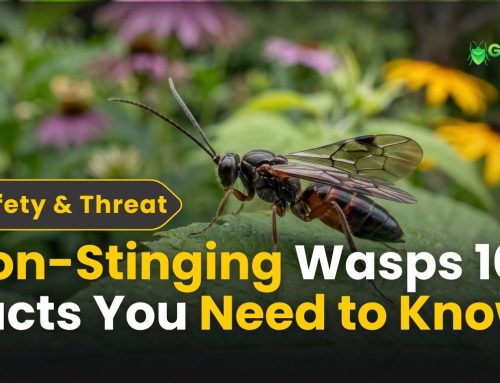
The parasitoid wasp information hub provides more detail, while the non-stinging wasp guide explains human sting risks.
Bugs That Look Like Wasps: 5 Fast Identification Checks
If you have a good photograph, use a simple sequence:
- Check the wings. One functional pair suggests a fly; hardened wing covers mean beetle; two membranous pairs can indicate wasp, bee, or ant.
- Look at the antennae. Strongly elbowed antennae suggest an ant.
- Inspect the eyes. Extremely large eyes are a strong fly clue.
- Examine the waist. Ant nodes differ from a wasp waist; flies and beetles generally lack the same constriction.
- Watch behavior. Repeated traffic into one opening can be more informative than body color.
Avoid relying solely on yellow-and-black striping.
Numerous unrelated insects share those colors.
Is It a Harmless Mimic or a Real Wasp Colony?
This is the most important practical question for a homeowner.
An individual insect feeding on a flower is often difficult to interpret because flies, bees, beetles, solitary wasps, and social-wasp workers can all visit flowers.
Repeated directional traffic provides stronger evidence.
Many similarly sized wasps flying into and out of one ground hole, wall opening, hollow tree, soffit, shrub, or other fixed location suggests a colony.
Common Connecticut nesting locations include ground cavities, structural voids, eaves, decks, sheds, tree cavities, stone walls, and dense vegetation.
Do not approach the entrance for a better look.
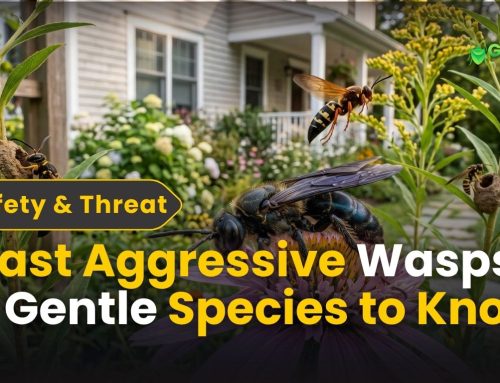
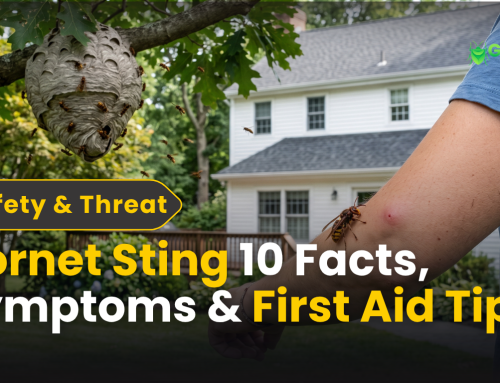
The wasp and hornet Safety & Threat Assessment provides a practical way to evaluate colony risk.
Risks of Misidentifying Wasp Lookalikes
The first risk is unnecessary pesticide use.
Hoverflies and many other wasp-like insects contribute to pollination or natural pest suppression. Spraying them simply because they share warning colors with yellow jackets provides no meaningful pest-management benefit.
The opposite mistake can present a more immediate safety issue.
Assuming an active yellow jacket colony is a harmless group of flies or solitary ground insects can lead someone to mow, trim, or walk directly through the nest-defense zone.
Yellow jackets and other social wasps can sting repeatedly.
This is why Integrated Pest Management, or IPM, begins with correct pest identification.
The EPA’s Integrated Pest Management guidance describes an approach based on pest biology, monitoring, prevention, and targeted control rather than unnecessary pesticide application.
What Causes Wasp-Like Bugs Around Connecticut Homes?
Fairfield County properties provide food and habitat for an enormous variety of insects.
Flowering plants attract hoverflies, bees, wasps, moths, and flower-visiting beetles.
Mature trees provide habitat for beetles, clearwing moths, bees, and social wasps.
Bare or suitable soil supports some solitary ground nesters.
Exterior wood can attract carpenter bees.
Moist environments can support various fly species.
Outdoor food, garbage, sugary drinks, and fallen fruit can bring yellow jackets into closer contact with people.
The presence of wasp-like bugs therefore does not automatically indicate an infestation.
The species, number of insects, behavior, and source determine whether management is needed.
Seasonal Activity in Connecticut
Spring
As temperatures warm, social-wasp queens begin establishing colonies. Carpenter bees may become conspicuous around wood, while winged ants and other insects can emerge under suitable conditions.
Summer
This is prime insect-identification season.
Fairfield County gardens may simultaneously contain hoverflies, bees, beetles, moths, solitary wasps, yellow jackets, and hornets.
Color alone becomes particularly unreliable.
Late summer and early fall
Established social-wasp colonies contain larger worker populations.
Yellow jackets may also become conspicuous around garbage, outdoor dining areas, sweet beverages, and cookouts.
This is an important period to distinguish harmless flower visitors from a colony close to people.
Late fall and winter
Cold weather significantly reduces most outdoor flying-insect activity.
When numerous insects continue appearing indoors during cold periods, finding the source becomes particularly important.
Local Wasp Lookalikes in Fairfield County
In Greenwich, Wilton, and New Canaan, wooded landscapes, mature trees, gardens, and larger lots support diverse insect communities.
Darien, Westport, and Fairfield properties frequently contain decks, pools, ornamental flowers, sheds, and outdoor dining areas where beneficial insects and social wasps overlap.
Stamford and Norwalk combine denser residential development with mature landscapes and structural nesting opportunities.
Across all these communities, the same professional principle applies: identify first.
A hoverfly in a Westport garden, a winged-ant emergence in Stamford, a longhorn beetle near firewood in Wilton, and a yellow jacket colony beside a Greenwich walkway are four entirely different pest-management situations.
Preventing Problem Flying Insects Without Harming Beneficial Species
Prevention works best when aimed at an identified problem.
For social wasps, keep garbage containers closed and clean outdoor food and drink spills. Periodically inspect high-use outdoor areas for nest activity.
Repair appropriate exterior gaps when no active colony is present.
Never blindly seal an opening actively used by social wasps. Trapping a yellow jacket or hornet colony inside a structural void may cause workers to search for alternate routes, potentially toward occupied rooms.
Maintain window and door screens to reduce accidental indoor entry by flying insects.
When activity involves wood, moisture, or indoor organic matter, address the condition associated with the identified insect rather than applying a generic wasp treatment.
For homeowner pesticide use, follow label directions. The EPA provides consumer guidance for safe pest control.
DIY Identification vs. Professional Inspection
DIY identification is reasonable when you can photograph the insect without approaching a nest.
Take clear top and side images if possible. Note the location, approximate size, number of insects, and flight pattern.
Record whether insects repeatedly return to one opening.
Professional inspection makes sense when many flying insects emerge indoors, the species could be termites or structural ants, repeated activity points toward a wall or ground colony, or the nest is too close to people for safe identification.
Properties where someone has a serious insect-venom allergy also warrant greater caution around unknown social-wasp activity.
Green Pest Management CT’s flying-insect control guide explains how professional identification determines the management approach.
Professional Treatment Process
A professional inspection should begin with evidence, not spraying.
The technician identifies the insect as closely as practical, looks for nesting or breeding evidence, evaluates flight patterns, and determines whether the activity originates on the property.
If the insect is a harmless hoverfly outdoors, no treatment may be needed.
If winged ants are emerging inside, inspection shifts toward locating ant activity and conducive conditions.
If a genuine social-wasp colony is present, the technician evaluates species, nest location, human exposure, and treatment access.
Targeted treatment is then chosen based on the actual pest.
For confirmed social-wasp colonies in high-risk locations, Green Pest Management CT provides professional wasp and hornet control services.
What About the Cost of Treatment?
There is no useful universal figure because the first question is what insect is present.
A harmless outdoor mimic may need no pest-control treatment. An ant emergence, fly breeding problem, wood-associated beetle, or social-wasp colony requires a different inspection and management strategy.
The scope also depends on accessibility, source location, structural conditions, and treatment requirements.
For that reason, identification should come before any service recommendation.
Common Mistakes to Avoid
Do not identify flying insects from color alone. Avoid spraying pollinators or beneficial mimics merely because they resemble yellow jackets.
Do not handle an unfamiliar insect to determine whether it stings.
Never stand over a ground hole, climb a ladder toward an occupied nest, or block an active social-wasp entrance.
Do not assume an indoor winged-insect swarm is “just wasps.” Flying ants and termite swarmers need to be considered.
And do not assume that every intimidating insect requires treatment. Many solitary and mimicking species have little interest in people.
Frequently Asked Questions
What bugs look like wasps but do not sting?
Hoverflies, many wasp-mimicking beetles, clearwing moths, and other true flies can look wasp-like without possessing a wasp stinger.
What fly looks most like a wasp?
Hoverflies are among the best-known wasp mimics. Many species have yellow-and-black markings similar to yellow jackets but have one functional pair of wings and no stinger.
What beetle looks like a wasp?
Several longhorn beetles, including the locust borer and various flower longhorns, have wasp-like colors and body shapes. Their hardened front wing covers identify them as beetles.
How can I tell a flying ant vs wasp?
Flying ants have elbowed antennae and one or two nodes at the waist. Wasps have differently shaped antennae and lack the characteristic ant waist nodes.
How can I tell a horse fly vs hornet?
Horse flies have one functional wing pair, extremely large eyes, and no narrow wasp waist. Hornets have two wing pairs and a defined waist. Female horse flies bite; female hornet workers sting.
Are carpenter bees dangerous like hornets?
Carpenter bee males cannot sting. Females can sting but usually avoid doing so unless handled or strongly provoked. Their behavior and nesting in wood differ from social hornet colonies.
Why are there so many insects that look like wasps?
Mimicry can discourage predators. An insect that resembles a stinging wasp may be avoided even when it cannot sting itself.
Does repeated activity at one hole mean I have wasps?
It can. Numerous similarly sized insects repeatedly using one opening can indicate a colony, but ants, bees, and solitary nesters are also possibilities. Keep your distance until identification is confirmed.
Should I spray a bug just because it looks like a yellow jacket?
No. Identify the insect first. Many harmless and beneficial organisms resemble yellow jackets, and unnecessary pesticide application can kill pollinators and natural predators.
When should I contact professional pest control?
Arrange an inspection when numerous insects repeatedly enter one structural or ground opening, flying insects emerge indoors, an active nest is close to people, species identification remains uncertain, or someone on the property has a serious sting allergy.
Conclusion: Bugs That Look Like Wasps Aren’t Always Dangerous
Bugs that look like wasps include hoverflies, longhorn beetles, locust borers, thick-headed flies, soldier flies, robber flies, bee flies, horse flies, flying ants, termite swarmers, clearwing moths, carpenter bees, bumblebees, and other insects.
Many cannot sting. Several are beneficial. Others bite rather than sting, and some are genuine wasps whose behavior is very different from defensive social species.
The key is to use anatomy and behavior together. Check the wings, antennae, eyes, waist, body covering, and flight pattern. Then determine whether you are seeing one passing insect or repeated traffic into a fixed nesting location.
For homeowners in Greenwich, Stamford, Darien, Westport, Fairfield, Wilton, New Canaan, Norwalk, and surrounding Fairfield County, Green Pest Management CT can provide a professional flying-insect identification and pest-control inspection when an unknown wasp-like insect is repeatedly appearing or suspected colony activity creates a safety concern.