Beetle That Looks Like a Wasp: 10 Amazing Lookalikes Explained
A beetle that looks like a wasp is often using color, body shape, or movement that resembles a stinging insect, but the easiest identification clue is usually its wings. Beetles have hardened front wings called elytra that form protective covers over their functional hind wings. Wasps do not. A true wasp has membranous wings and, in many species, a distinctly narrow waist.
For Connecticut homeowners, this distinction matters. A yellow-and-black longhorn beetle crossing a flower bed usually presents a completely different concern from yellow jackets repeatedly entering a ground hole or hornets defending a social nest. Treating every wasp-like insect can kill harmless or beneficial species without solving an actual pest problem.
This guide explains 10 beetles and other insects commonly confused with wasps, how wasp mimicry works, what signs to check, and when homeowners in Greenwich, Stamford, Darien, Westport, Fairfield, Wilton, New Canaan, Norwalk, and surrounding Fairfield County should consider a professional inspection.
How Do You Tell a Beetle From a Wasp?
Look at the insect’s back.
Most adult beetles have a hard shell-like pair of front wings called elytra. When closed, the two elytra usually meet along a straight seam down the back.
Wasps instead have two pairs of membranous wings. The front and rear wings connect during flight, making the four individual wings difficult to distinguish when the insect is moving.
Other differences can help:
| Feature | Wasp-like beetle | Wasp |
| Front wings | Hardened elytra | Membranous |
| Center back | Often obvious seam | No beetle-like wing-cover seam |
| Waist | Usually not a true wasp waist | Often strongly constricted |
| Antennae | Highly variable; sometimes very long | Usually prominent but different by group |
| Stinger | No wasp stinger | Females of many species can sting |
| Social paper nest | No | Some species build social nests |
| Larval form | Beetle grub/larva | Wasp larva |
| Insect order | Coleoptera | Hymenoptera |
Do not catch the insect in your hand to check these details. A zoomed photograph is safer, especially if there is any chance you are looking at a genuine wasp.
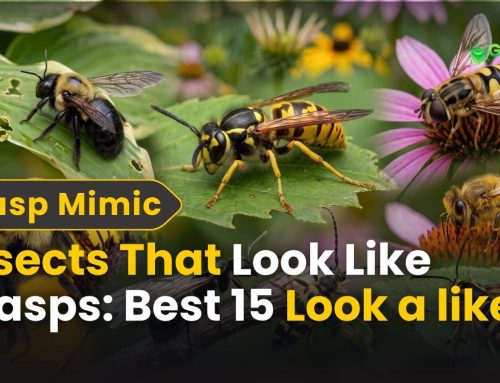
For a broader comparison, Green Pest Management CT’s guide to insects that look like wasps covers flies, ants, bees, moths, beetles, and other lookalikes.
Why Would a Beetle Look Like a Wasp?
The resemblance often has an evolutionary explanation.
Predators can learn that certain visual patterns are associated with animals capable of defending themselves. Yellow-and-black coloration, narrow-looking bodies, or wasp-like movement may therefore provide protection to an otherwise more vulnerable insect.
One relevant concept is Batesian mimicry, where a relatively harmless organism resembles a better-defended species.
For example, a beetle without a stinger may receive some protection if a bird hesitates because it resembles a wasp.
The imitation does not need to fool an entomologist at close range. It only needs to be convincing enough, at the right distance and moment, to discourage a predator.
That same effect works on people. A rapidly moving yellow-and-black beetle may look like a wasp until you see the hard wing covers.
10 Beetles and Insects Commonly Confused With Wasps
Not all 10 insects below are beetles. That distinction is intentional: when homeowners search for a “beetle that looks like a wasp,” the photographed insect frequently turns out to be a fly, bee, moth, ant, solitary wasp, or another wasp mimic.
1. Wasp-Mimicking Longhorn Beetles
Longhorn beetles, family Cerambycidae, include some of the most convincing beetle wasp mimics.
These beetles often have long, prominent antennae, and certain species combine elongated bodies with yellow, orange, reddish, or pale bands against darker backgrounds.
From a few feet away, that can produce a remarkably wasp-like silhouette.
How to recognize a longhorn beetle
Look for the hardened wing covers.
The elytra typically meet along the middle of the insect’s back. Long antennae may also extend to the length of the body or beyond, although antenna length varies considerably among species.
Longhorn beetles do not possess a wasp stinger.
However, “longhorn beetle” is an enormous category with varied biology. Their larvae often develop in plant material or wood, and the significance depends on the particular species and host material involved.
Finding one adult outside does not automatically mean your home contains a wood-destroying infestation.
That is where identification beyond “yellow and black beetle” becomes useful.
2. Locust Borer
The locust borer is a longhorn beetle and a particularly good example of wasp-like coloration.
Its bold yellow markings on a dark body can create an appearance homeowners readily associate with yellow jackets.
Adults may be observed on flowers, particularly during their active season. Their larval biology is associated with black locust trees, not a paper wasp colony.
The distinction is easy once you see the wing covers.
A locust borer has beetle elytra. A yellow jacket has membranous wings and a true wasp body structure.
An insect feeding on flowers is also behaving differently from a stream of social-wasp workers repeatedly entering a fixed nest opening.
This is why pest professionals consider host association and behavior alongside color.
3. Flower Longhorn Beetles
Various flower longhorn beetles are slim, active beetles commonly found around flowers.
Some species have contrasting patterns and narrow, tapered bodies that increase their resemblance to wasps.
Their behavior strengthens the illusion because adults can move actively around blossoms where people also expect to see bees and wasps.
Look for beetle anatomy rather than flower choice.
The hardened elytra and longhorn characteristics separate them from a paper wasp or yellow jacket.
For Connecticut homeowners, one flower-visiting longhorn beetle is usually an identification issue rather than evidence of a stinging-insect colony.
4. Banded Longhorn Beetles
Several longhorn beetles display banding that can resemble the alternating abdominal markings of wasps.
Again, the important clue is that the banding occurs on a beetle body covered by elytra rather than a flexible wasp abdomen behind membranous wings.
These insects may be associated with dead, dying, or decomposing woody material depending on the species.
That does not mean a beetle observed on your porch is necessarily damaging structural lumber.
An accurate identification should answer two separate questions: What is the insect, and where is its immature stage developing?
A professional inspection can be useful if adults repeatedly emerge indoors or if there is associated evidence of wood damage.
5. Wedge-Shaped Beetles
Some beetles in the family Ripiphoridae have unusual body forms and coloration that can cause confusion with wasps, bees, or other Hymenoptera.
Their appearance demonstrates how diverse beetles can be.
Not every beetle has the broad, obvious shell shape of a lady beetle or ground beetle. Some have tapered bodies and unusual proportions that make the family resemblance far less obvious to a homeowner.
When body shape creates uncertainty, return to structural features such as the wing covers.
That is usually more reliable than trying to decide whether an unfamiliar insect “acts like a wasp.”
6. Hoverflies
If the insect does not have beetle wing covers, one of the next groups to consider is hoverflies.
Hoverflies belong to the fly family Syrphidae and include some of the most effective wasp mimics in Connecticut landscapes.
Yellow-and-black species can closely resemble yellow jackets.
They have no stinger.
Adults of many species visit flowers and contribute to pollination. Larvae of some hoverflies prey on aphids, providing natural pest suppression.
Hoverfly vs. wasp
Hoverflies have one functional pair of wings because they are true flies. Wasps have two pairs.
Many hoverflies also possess very large fly-like eyes and relatively short antennae.
Flight pattern is another clue. They may remain almost stationary in the air before darting in another direction.
The complete wasp mimic guide provides a more detailed hoverfly comparison.
7. Clearwing Moths
Clearwing moths challenge the familiar image of a broad-winged, fuzzy nighttime moth.
Some species possess transparent areas in their wings and narrow bodies marked with combinations of black, yellow, orange, or red.
That can produce strong wasp mimicry.
They are still members of Lepidoptera, not beetles or wasps.
A clear photograph may show moth-like antennae, wing scales on portions of the wings, and anatomical details inconsistent with a wasp.
Some clearwing moth larvae develop within specific host plants. Identifying the species may therefore point toward a plant-health problem rather than a stinging-insect nest.
8. Winged Ants
A small dark “wasp” around a window may actually be a reproductive ant.
Flying ants, or alates, are produced by established ant colonies for mating and dispersal.
Because ants and wasps are both Hymenoptera, their broad resemblance is unsurprising. Fortunately, there are useful visual differences.
Flying ant vs. wasp
Winged ants possess distinctly elbowed antennae and a narrow waist containing one or more characteristic nodes.
Wasps have different antennae and a differently constructed waist.
Ant reproductive wings also show characteristic proportions, with the front pair generally larger than the rear pair.
If numerous winged ants are emerging inside a Connecticut home rather than simply appearing outdoors, identify the source rather than treating them as wasps.
A cluster at windows can represent insects attracted to light after emerging from somewhere within the structure.
9. Carpenter Bees
A carpenter bee is neither beetle nor wasp, yet homeowners regularly identify the large insect as one or the other.
Carpenter bees become especially noticeable around decks, fascia, railings, and exposed wood.
Male carpenter bees may hover near nesting locations and approach people. Their behavior can seem confrontational.
Males cannot sting.
Females can sting but generally avoid doing so unless handled or strongly provoked.
Carpenter bees have robust bee-like bodies rather than beetle wing covers, and their nesting behavior involves tunnels in suitable wood rather than paper nests.
Green Pest Management CT’s hornet versus carpenter bee identification guide provides additional identification points.
10. Cicada Killers and Other Solitary Wasps
Sometimes the insect homeowners think is a mimicking beetle is actually a genuine wasp—just not the kind they expected.
Cicada killers are large solitary wasps that nest in soil and provision their offspring with cicadas.
Their substantial body size and markings can cause them to be mistaken for hornets.
Unlike yellow jackets, they do not have hundreds of workers defending one social colony.
Male cicada killers may fly conspicuously around nesting areas but cannot sting. Females can sting, although they generally do not seek confrontations with people.
The ground-nesting wasp guide explains how solitary ground nesters differ from social yellow jacket colonies.
This is an important reminder: lack of aggression is not proof that an insect is a beetle.
Beetle That Looks Like a Wasp vs. Yellow Jacket
Yellow jackets are among the insects homeowners most want to rule out because they form social colonies and can sting repeatedly.
They have a smooth, fairly compact appearance with distinct yellow-and-dark markings. Adults have membranous wings rather than hardened elytra.
Behavior can be especially revealing.
A beetle generally will not be one of dozens of identical individuals repeatedly flying into the same underground opening to service a social colony.
Yellow jackets can.
If many yellow-and-black insects continuously enter and exit one hole in the soil, wall, stone feature, or building gap, stay away from it.
The yellow jacket identification and behavior guide covers the warning signs in greater depth.
Beetle That Looks Like a Wasp vs. Hornet
“Hornet” is frequently used for almost any large insect that looks intimidating.
True hornets are social wasps. In Connecticut and the northeastern United States, European hornets are an important example.
Bald-faced hornets are commonly called hornets but are actually a type of yellow jacket.
Neither group has beetle elytra.
A hornet’s wings are transparent or translucent and membranous. Its abdomen is flexible and connected to the thorax with a wasp-type waist.
If the insect has a rigid pair of shell-like front wings meeting down its back, you are looking at a beetle rather than a hornet.
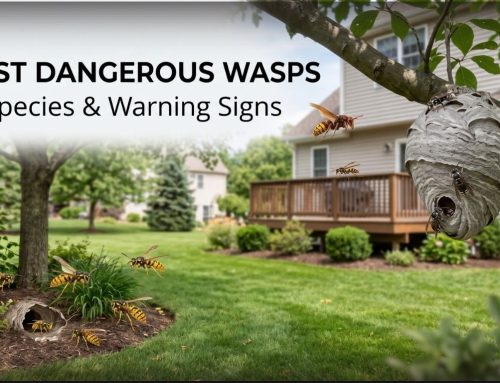
For genuine hornet identification, use the Connecticut wasp and hornet encyclopedia.
Beetle vs. Hoverfly vs. Wasp: Fast Identification
When you only have a photograph, start with the wings.
A beetle has hardened elytra.
A hoverfly has one obvious functional wing pair.
A wasp has two pairs of membranous wings.
Next, examine the eyes. Hoverflies frequently have very large eyes covering much of the head.
Then check the waist. Many social wasps show a clear constriction between thorax and abdomen.
Finally, consider behavior. Flower visitation alone proves little because beetles, hoverflies, bees, and wasps may all feed at flowers. Repeated traffic into a social nest location provides much stronger evidence of wasps.
Horse Fly vs. Hornet: Don’t Confuse Biting With Stinging
A large buzzing insect can also turn out to be a horse fly.
Horse flies are true flies with one functional pair of wings and very large compound eyes. Females of blood-feeding species use cutting mouthparts to bite people or animals.
Hornets sting using a venom-delivering stinger.
A horse fly will not create a social paper hornet nest.
If the insect persistently approaches people or livestock and has enormous fly-like eyes, horse fly identification becomes more plausible than beetle or hornet.
The yellow fly versus deer fly identification guide provides additional information about biting flies.
Signs You’re Looking at a Beetle Instead of a Wasp
A clear photograph makes identification easier. Look for several clues together rather than relying on one.
Signs supporting beetle identification include:
- Hard wing covers rather than exposed membranous wings
- A straight seam where the elytra meet along the back
- No obvious social paper nest activity
- Beetle-like body construction rather than a flexible wasp abdomen
- Antennae characteristic of longhorns or another beetle group
- Activity associated with flowers, trees, logs, or other host material
- No repeated worker traffic to a social colony
One adult insect is rarely enough to demonstrate an infestation.
If beetles repeatedly emerge inside or appear alongside holes, frass, damaged wood, stored-product damage, or affected plants, the associated evidence becomes more important.
Why Are Wasp-Like Beetles Around My Home?
The answer depends on the species.
Adult flower-visiting beetles may simply be feeding on nectar or pollen. Wood-associated beetles may be connected to trees, branches, firewood, logs, dead wood, or plant material around the landscape.
Outdoor lighting can attract various flying beetles toward homes at night.
Sometimes an adult wanders indoors accidentally.
The presence of one insect does not establish where its larvae developed.
That is why pest professionals avoid making treatment decisions from a single adult without looking at the surrounding evidence.
Risks and Problems: Do Wasp-Like Beetles Sting?
Beetles do not possess a wasp-style venomous stinger.
That does not mean every beetle should be handled. Beetles have mouthparts, and some can pinch or produce defensive chemicals.
But a longhorn beetle’s yellow-and-black coloration does not give it the repeated stinging capability of a yellow jacket.
The greater homeowner risk is often misidentification.
Someone may spray beneficial beetles unnecessarily. The opposite mistake is potentially more serious: assuming genuine social wasps are harmless beetles and approaching their nest.
If you cannot see the insect clearly, treat repeated colony-like traffic cautiously until identification is confirmed.
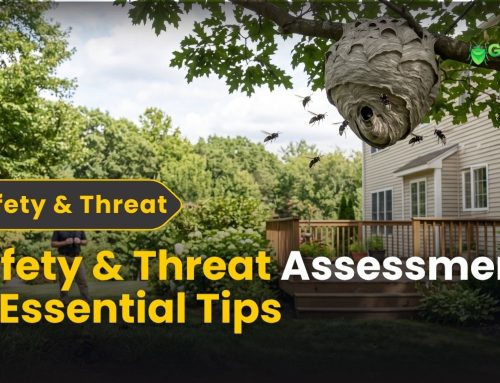
Green Pest Management CT’s wasp and hornet safety assessment provides a practical risk framework.
Connecticut Seasonal Information
Connecticut’s seasons affect when different beetles and wasp mimics become noticeable.
Spring warming increases insect activity throughout Fairfield County. Social-wasp queens establish colonies while beetles, flies, bees, ants, and moths begin appearing according to their individual life cycles.
Summer produces the greatest diversity of visible activity. Flowering landscapes can host beetles, hoverflies, bees, and wasps simultaneously.
Late summer and early fall deserve extra attention because social-wasp colonies are mature. A yellow-and-black insect at flowers may still be harmless, but repeated traffic to a nest entrance should be treated more cautiously.
Cold winter weather dramatically reduces outdoor insect flight. Beetles appearing indoors during cold weather can have different explanations, making source identification particularly important.
Local Identification in Fairfield County
Greenwich, Stamford, Darien, Westport, Fairfield, Wilton, New Canaan, and Norwalk contain varied environments that support both beneficial insects and genuine pests.
Wooded landscapes in Greenwich, Wilton, and New Canaan provide mature trees, dead wood, flowers, and natural habitat for numerous beetles and solitary insects.
Landscaped properties in Darien, Westport, and Fairfield can attract flower-visiting beetles, hoverflies, bees, and wasps to the same plantings.
In Stamford and Norwalk, homes may combine mature landscaping with denser structural environments, making it especially important to distinguish a harmless outdoor visitor from insects repeatedly emerging from or entering a building.
Green Pest Management CT uses identification, source evidence, and property conditions rather than color alone when assessing wasp-like insects.
Prevention Tips for Wasp-Like Beetles
There is no reason to eliminate every outdoor beetle that happens to resemble a wasp.
Integrated Pest Management, or IPM, focuses on prevention and intervention only when the organism creates a genuine problem.
Useful homeowner practices include:
- Keep firewood stored appropriately and inspect it before bringing it inside.
- Maintain screens around windows and doors.
- Repair gaps that allow incidental insects indoors when no active stinging-insect colony is using the opening.
- Remove or manage dead woody material when appropriate for landscape health.
- Inspect plants showing unexplained decline or borer symptoms.
- Avoid indiscriminate spraying of insects visiting flowers.
- Photograph unfamiliar insects before choosing a pesticide.
The EPA’s Integrated Pest Management guidance provides useful background on identification-based pest management.
DIY Identification vs Professional Pest Control
DIY identification is reasonable when the insect can be photographed without approaching a nest.
Take a clear top-down photo if possible. A view of the insect’s back can reveal elytra immediately.
A side view can help show the waist, antennae, and body structure.
Then record where the insect was found: flowers, firewood, siding, a tree, an interior window, or a specific structural opening.
Professional inspection becomes more appropriate when many insects repeatedly appear indoors, beetle activity accompanies suspicious wood damage, or you cannot determine whether the insects are beetles or defensive wasps.
Do not experiment with an active ground or wall opening to see what comes out.
For broad flying-insect identification, Green Pest Management CT’s professional flying insect service guide explains why different pests require different solutions.
What Professional Identification and Treatment Involve
A professional inspection first determines whether treatment is needed at all.
A technician may inspect body characteristics, photographs or specimens, emergence locations, wood conditions, plant material, flight patterns, and other evidence.
If the insect is merely an outdoor flower-visiting beetle, pest-control treatment may not be warranted.
If a wood-associated beetle is emerging from material inside the home, the source needs to be identified before a management strategy is selected.
If the insects turn out to be yellow jackets or hornets instead, the focus changes to locating and controlling the colony safely.
That identification-first approach is a core element of Integrated Pest Management.
When pesticides are appropriate, they should be selected for the target organism and used according to the label. The EPA’s pesticide safety guidance for homeowners explains why label-directed use matters.
Common Mistakes to Avoid
The most frequent mistake is assuming yellow and black means yellow jacket.
Another is assuming every long-antenna insect is a wasp. Longhorn beetles demonstrate why that does not work.
Do not spray unknown flower visitors indiscriminately, handle unfamiliar insects, tear into wood to search for larvae, or approach suspected social-wasp nests for a close photograph.
Avoid sealing structural openings when genuine wasps are actively using them.
And do not assume a beetle found indoors necessarily developed in the house. Source evidence matters.
Correct identification prevents unnecessary treatments and keeps genuine stinging-insect situations from being underestimated.
Frequently Asked Questions
What kind of beetle looks like a wasp?
Several longhorn beetles have wasp-like shapes and yellow, orange, red, or black markings. Locust borers and various flower longhorn beetles are good examples of beetles that can resemble wasps.
How do I know whether it’s a beetle or wasp?
Check the front wings. Beetles have hardened wing covers called elytra, usually meeting along a straight seam on the back. Wasps have membranous wings and do not have beetle-like wing covers.
Can a beetle that looks like a wasp sting?
No. Beetles do not possess the venomous stinger found in female stinging wasps. Some beetles can pinch or use other defenses, so unfamiliar insects still should not be handled.
Why do some beetles imitate wasps?
Wasp mimicry may help protect beetles from predators. Resembling a potentially stinging insect can cause predators to hesitate or avoid an otherwise vulnerable beetle.
Is a yellow-and-black beetle a yellow jacket?
No. Yellow-and-black coloration alone does not make an insect a yellow jacket. Check wing structure, waist shape, antennae, and behavior before identifying it.
How do I tell a hoverfly from a wasp-like beetle?
A hoverfly has one functional pair of membranous wings and often very large eyes. A beetle has hardened front wings, or elytra. Neither should be confused with the two pairs of membranous wings of a wasp.
What is the difference between a flying ant vs. wasp?
Winged ants have distinctly elbowed antennae and a waist with characteristic nodes. Wasps have a differently constructed waist and generally do not have strongly elbowed ant antennae.
What is the difference between a horse fly vs. hornet?
Horse flies are true flies with one functional wing pair and very large eyes; females of blood-feeding species bite. Hornets are social wasps whose female workers can sting.
Should I kill a wasp-like beetle?
Not automatically. Many outdoor beetles are harmless in the context in which they are found, and some are ecologically useful. Determine the species and whether it is actually causing a problem before considering control.
When should I call pest control about a wasp-like beetle?
Consider a professional inspection when many insects repeatedly emerge indoors, there is associated wood or plant damage, identification remains uncertain, or activity may actually involve an active yellow jacket or hornet colony.
Conclusion: A Beetle That Looks Like a Wasp Isn’t Necessarily a Threat
A beetle that looks like a wasp may have evolved an impressive disguise, but beetle anatomy reveals the difference. Hardened front wing covers, a central elytral seam, and the absence of a wasp-style stinger are among the strongest clues.
Longhorn beetles including locust borers and various flower-visiting species—are common examples of beetles with wasp-like appearances. Hoverflies, clearwing moths, carpenter bees, flying ants, and even solitary wasps can add another layer of confusion.
For Connecticut homeowners, the most important habit is to identify before treating. One brightly patterned beetle on a flower has very different implications from dozens of yellow jackets repeatedly entering a lawn hole or wall gap.
Green Pest Management CT serves Greenwich, Stamford, Darien, Westport, Fairfield, Wilton, New Canaan, Norwalk, and surrounding Fairfield County. If an unknown insect is repeatedly appearing indoors, associated with possible property damage, or may actually be a defensive wasp, homeowners can schedule a professional pest identification and inspection to determine what is present and whether pest management is necessary.