White Vinegar Fruit Fly Trap: 7 Easy DIY Steps That Work
A white vinegar fruit fly trap can catch fruit flies, but plain white vinegar usually isn’t as attractive to them as apple cider vinegar. If white vinegar is what you have at home, you can make it more useful as a DIY trap by pairing it with a fermentation-related attractant and a small amount of dish soap. More importantly, you need to remove whatever is allowing the flies to breed.
For Connecticut homeowners, that last step makes the biggest difference. Traps can catch the adults circling your kitchen today, but they cannot remove eggs and larvae developing in overripe fruit, sticky recycling containers, spilled beverages, or other moist organic material.
This guide explains how to build a white vinegar trap in seven practical steps, where to place it, why apple cider vinegar often performs better, how to distinguish fruit flies from similar pests, and when recurring fly activity in a Greenwich, Stamford, Darien, Westport, Fairfield, Wilton, New Canaan, or Norwalk home warrants professional pest control.
What Is a White Vinegar Fruit Fly Trap?
A white vinegar fruit fly trap is a homemade trapping device that uses vinegar-based liquid as part of the bait and usually incorporates dish soap or a funnel-style container to prevent attracted fruit flies from escaping easily.
There is an important distinction homeowners should know before making one.
Fruit flies are attracted to volatile compounds associated with fermenting fruits and other organic material. Apple cider vinegar has an odor profile associated with fermentation, which is why ACV traps have become so popular. Plain distilled white vinegar has a sharper acetic acid odor but is not necessarily as attractive on its own.
That doesn’t make white vinegar useless. It means expectations should be realistic.
Quick answer: Does white vinegar attract fruit flies?
White vinegar may attract some fruit flies, but apple cider vinegar is usually the more practical vinegar bait. If you only have white vinegar, it can be incorporated into a trap with an appropriate fruit or fermentation-related attractant. Whichever bait you use, trapping adults will not eliminate an infestation unless the original breeding source is found and removed.
For a direct comparison with the more familiar method, Green Pest Management CT’s guide to apple cider vinegar fruit fly traps explains why ACV is commonly used.
Identify Fruit Flies Before Setting the Trap
A good trap starts with correct identification.
In field pest control, one of the fastest ways to waste time is treating an insect based only on where it was seen. “Tiny fly in the kitchen” isn’t a species identification.
Fruit flies, drain flies, fungus gnats, and other small flies can occur indoors, but their breeding sources aren’t the same.
What do fruit flies look like?
Common fruit flies found around homes are tiny insects, often tan to brownish, and some frequently encountered species have noticeable reddish eyes.
Behavior provides useful clues.
Fruit flies tend to congregate around fermenting fruit and vegetables, beverage residue, garbage, recycling, and similar organic material. They may hover around a fruit bowl or suddenly rise from an overlooked food source when it’s disturbed.
Fruit flies vs. drain flies
Drain flies generally have a fuzzy or moth-like appearance. Their activity is commonly associated with moist organic buildup in drains and related environments.
If tiny insects consistently rest around a sink or shower area, compare them using Green Pest Management CT’s fruit fly vs. drain fly guide.
Repeatedly setting countertop vinegar traps will not solve a drain-associated breeding condition.
Fruit flies vs. fungus gnats
Fungus gnats are often dark, delicate-looking flies associated with moist potting media. If your insects spend most of their time around houseplants rather than produce, take a closer look.
Our fly vs. gnat identification guide provides additional identification clues.
Correct identification is part of Integrated Pest Management (IPM): understand the pest before selecting the control.
Why Fruit Flies Appear So Quickly
A fruit-fly problem can seem to appear out of nowhere.
Usually, something changed before the flies became obvious.
Produce may have become overripe. An onion or potato could be deteriorating in a cabinet. Beverage residue may have collected in recycling. Organic liquid might have spilled beneath an appliance.
Warm temperatures also support faster insect development.
This helps explain why fruit fly problems become particularly noticeable during Connecticut’s warm summer and early fall months, when kitchens often contain plenty of fresh produce.
Fruit flies don’t require a visibly filthy home. They require suitable organic material.
Green Pest Management CT’s guide explaining where fruit flies come from is useful when the obvious fruit bowl isn’t responsible.
Signs You Have an Active Fruit Fly Problem
A single fly near an open door isn’t necessarily evidence of an infestation. Repeated patterns are more informative.
Watch for adults appearing every day, several flies congregating around produce or recycling, catches continuing in traps after you’ve cleaned the counters, or new adults appearing soon after existing ones are removed.
Pay particular attention to location.
If 15 flies gather around one recycling container and almost none appear elsewhere, the insects are giving you information.
If the kitchen looks clean but flies remain concentrated around one cabinet, investigate what’s inside and underneath it.
If activity centers around plumbing, reconsider whether the insect is a fruit fly.
The question isn’t simply, “How can I kill these flies?”
It is, “Why are these flies concentrated here?”
That question usually leads to better control.
How to Make a White Vinegar Fruit Fly Trap in 7 Easy Steps
A basic trap can be made using a small jar or cup, plain white vinegar, a suitable fruit-fly attractant, dishwashing liquid, and an optional paper or plastic funnel.
Keep homemade traps away from uncovered food and out of the reach of children and pets.
Step 1: Choose a Small Container
Use a clean glass, jar, or disposable cup.
A transparent container is useful because you can monitor captures without taking the trap apart. The opening should be large enough to release attractive odors but small enough that a funnel or cover can be added if desired.
Do not repurpose a container that previously held pesticides, solvents, or other hazardous chemicals.
Clean food containers are preferable.
Step 2: Add a Small Amount of White Vinegar
Pour plain distilled white vinegar into the bottom of the container.
You don’t need to fill it.
Remember that white vinegar itself may not compete effectively with a stronger fermenting source elsewhere in the kitchen. If the flies are gathering around forgotten bananas while your vinegar sits across the room, the trap is unlikely to win that competition.
This is one reason placement and source removal matter as much as bait selection.
Step 3: Add a Fermentation-Related Attractant
Because plain white vinegar may be less attractive than ACV, a small amount of ripe fruit or another appropriate fermentation-related food bait can improve attraction.
Keep this simple.
Adding large quantities of fruit can turn your “trap” into another container of fermenting organic material that requires management.
The objective is to create enough odor to draw nearby adults—not establish a new breeding source.
If you’d rather avoid food bait altogether, switching to an apple vinegar fly trap may make more sense.
Step 4: Add a Small Drop of Dish Soap
Add a small drop of liquid dish soap to the vinegar mixture.
Dish soap is frequently described online as though it attracts flies. That isn’t its main role in this type of trap.
Soap reduces surface tension. When a fruit fly contacts the liquid, it has more difficulty remaining on the surface and escaping.
More is not necessarily better. An excessive amount of soap can overwhelm the bait odor without addressing the underlying problem.
This principle applies to most dish soap traps: attract first, trap second.
Step 5: Add a Funnel or Perforated Cover
You can leave a liquid trap open, but a funnel can improve containment.
Roll paper into a cone with a small opening at the bottom and place it above the bait without letting it touch the liquid. Alternatively, an appropriate perforated cover can create entry points.
Adults follow the odor into the container and may have difficulty relocating the smaller exit.
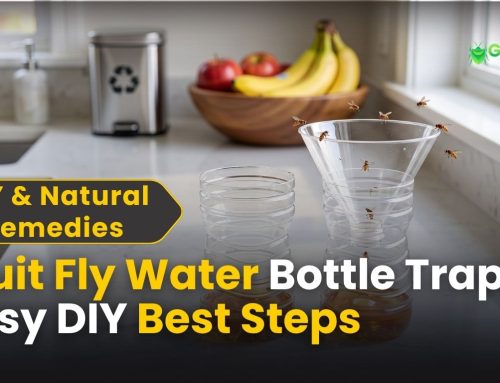
Another variation uses a bottle rather than a jar. Our fruit fly water bottle trap guide explains how to turn the upper portion of a plastic bottle into an inverted funnel.
Step 6: Place the Trap Near Fruit Fly Activity
Location makes a significant difference.
Place the trap reasonably close to the area where fruit flies are repeatedly observed, but don’t put it directly on a food-preparation surface or beside uncovered food.
Potential locations include near a recycling area, close to where spoiled produce was removed, or near another suspected source.
Don’t scatter traps randomly around the house.
Use them strategically.
In pest management, a trap has two jobs: control and monitoring. If one trap consistently catches flies while another does not, that distribution can help focus your inspection.
Step 7: Monitor Results and Find the Breeding Source
This is the step that determines whether your DIY effort actually works.
Check the trap regularly and monitor the room’s overall fly activity.
If the trap captures adults and sightings steadily decline after sanitation, keep monitoring until activity stops.
If catches remain high day after day, don’t simply keep replacing vinegar.
Search again for the source.
Green Pest Management CT’s fruit fly authority hub covers the entire control process, including identification, breeding areas, trapping, and prevention.
White Vinegar vs. Apple Cider Vinegar: Which Is Better?
For a fruit-fly attractant trap, apple cider vinegar is generally the better starting point.
The difference relates to odor.
Fruit flies use chemical cues associated with fermenting organic material to locate food and developmental resources. Apple cider vinegar provides fermentation-associated odors that make it useful for baiting.
Plain white vinegar is largely a dilute solution of acetic acid in water and doesn’t offer the same complex odor profile.
A practical comparison looks like this:
| DIY Method | Main Function | Best Use | Limitation |
| White vinegar fruit fly trap | Attract/capture adults | When white vinegar is available | Plain white vinegar can be less attractive |
| ACV trap | Attract/capture adults | Confirmed fruit flies | Does not eliminate breeding sources |
| Dish soap trap | Improves liquid trapping | Combined with suitable bait | Soap itself isn’t the key attractant |
| Water bottle trap | Funnel-based capture | Monitoring adult fruit flies | Requires source removal too |
| Essential oils | Potential repellency | Supplemental deterrence | Not an infestation solution |
| DIY zappers | Capture selected insects | Species-dependent situations | Variable response by pest |
The key takeaway is that no bait compensates for an active breeding source.
How to Find the Fruit Fly Breeding Source
Start where adult activity is greatest.
Search methodically rather than repeatedly cleaning areas that are already clean.
Inspect ripe and overripe produce. Look underneath fruit bowls and inside bags. Check potatoes, onions, tomatoes, bananas, peaches, and other produce stored outside the refrigerator.
Then move to recycling.
Bottles and cans that once contained wine, beer, soda, juice, or other sweet beverages can retain enough residue to attract flies. Rinse them before indoor storage and clean the recycling container itself when necessary.
Inspect trash cans beneath the liner. Check for leakage and residue around the rim, base, and surrounding floor.
Look beneath appliances and cabinets for spilled organic liquids.
If activity appears connected to the sink, investigate appropriately. Green Pest Management CT’s guide to finding fruit flies around drains can help distinguish a plumbing-area source from a countertop infestation.
Source removal is usually more important than changing trap recipes.
Do Essential Oils Repel Fruit Flies?
Some plant-derived volatile compounds can have repellent effects on insects under particular conditions, which has led to widespread use of peppermint, clove, citronella, lemongrass, and other essential oils in homemade natural repellents.
Their practical performance varies by species, formulation, concentration, placement, and environmental conditions.
There’s another issue when you’re using a vinegar trap.
A natural fly repellent and an attractant trap have opposing jobs.
You don’t want to surround an apple cider vinegar or white vinegar trap with a strong scent intended to make flies avoid the area.
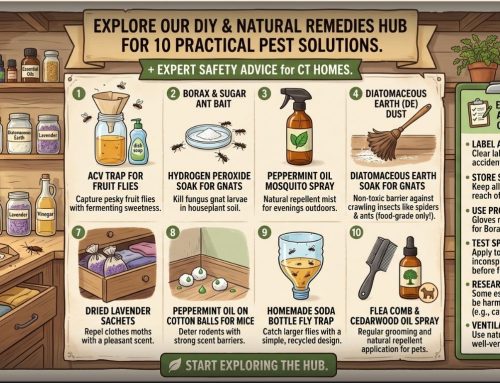
For a more complete discussion, see our natural fly repellent guide and DIY natural pest remedies.
Also remember that “natural” doesn’t automatically mean harmless. Concentrated essential oils can irritate people and may pose risks to pets depending on the oil and exposure. Use them cautiously and don’t improvise concentrated applications around food.
What About DIY Zappers?
DIY zappers and light traps can capture some flying insects, but fruit-fly control shouldn’t begin by assuming all flying pests are equally attracted to light.
Fruit flies have a strong relationship with fermentation odors.
That makes odor-based monitoring and breeding-source inspection particularly useful.
Commercial light traps can have a place in an integrated fly-management program, especially in some commercial environments, but trap selection and placement need to match pest behavior.
If you’re comparing alternatives to homemade traps, Green Pest Management CT’s guide to indoor fruit fly control products discusses additional options.
Risks and Problems Associated With Fruit Flies
Fruit flies are usually treated as a nuisance in residential homes, but recurring activity should still be addressed.
Their presence typically tells you suitable organic material is available somewhere. Adults can move between undesirable organic matter and food-related surfaces, making sanitation particularly important in kitchens.
In restaurants and commercial food facilities, persistent fly activity demands even closer attention because food handling, sanitation, waste management, and monitoring standards are critical. Our guide to fruit fly control in restaurants addresses these environments in greater detail.
The objective is not to panic over an occasional fly. It is to prevent a breeding population from becoming established.
Safety: Never Mix Vinegar With Household Chemicals
White vinegar is common in homes, which sometimes encourages people to combine it with other cleaning products.
Do not experiment with chemical mixtures.
In particular, acids such as vinegar should never be mixed with chlorine bleach because hazardous chlorine gas can be released. Keep DIY pest-control recipes separate from household chemical experiments.
Follow product labels for cleaners and pesticide products.
The EPA’s guidance for controlling household pests safely emphasizes prevention and correct product use. The EPA also provides useful information about Integrated Pest Management, which prioritizes understanding and managing the causes of pest activity.
Preventing Fruit Flies After Trapping
Once the infestation decreases, change the conditions that allowed it to begin.
Store produce appropriately and inspect ripe items regularly. Remove damaged food instead of allowing it to ferment on a counter.
Rinse recycling that contains sugary or fermented drink residue. Clean garbage and recycling receptacles as necessary rather than relying solely on liners.
Wipe spills promptly and investigate liquid that may have run under cabinets or appliances.
Screens can help prevent some outdoor insects from entering, but exclusion isn’t enough if fruit flies are already developing indoors.
Continue monitoring for several days after the obvious problem appears resolved. A fresh trap can serve as an early warning system, but it should not become a permanent substitute for sanitation.
Fruit Flies in Connecticut: Seasonal Information
Connecticut’s seasonal climate influences fruit-fly activity.
Warm conditions during summer and early fall are favorable for insect development. At the same time, homes contain more ripe fruit, garden produce, beverages, and food associated with outdoor entertaining.
That combination makes kitchens especially vulnerable when produce becomes overripe or recycling isn’t rinsed promptly.
The problem isn’t restricted to summer, however.
A heated home can provide suitable temperatures at other times of year if fermenting material remains available indoors.
This is why sudden winter fruit flies should prompt an indoor source inspection rather than the assumption that cold weather will automatically eliminate them.
Fairfield County Homeowner Concerns
Fruit-fly biology is the same across Fairfield County, but homes and lifestyles create different source conditions.
In Greenwich and New Canaan, larger homes may have multiple food-storage, bar, pantry, or recycling areas that need inspection. Stamford and Norwalk properties can range from apartments to single-family homes and commercial environments. Darien and Westport households may see activity after summer entertaining or around kitchen and outdoor beverage areas. Fairfield and Wilton homes with gardens or stored produce may introduce ripe fruits and vegetables directly from outdoors.
In practice, a successful inspection follows the evidence rather than assuming the source is always beside the kitchen sink.
Look where the flies are active and ask what organic material is available there.
Common White Vinegar Fruit Fly Trap Mistakes
Several mistakes explain most disappointing DIY results:
- Using white vinegar and expecting it to outperform apple cider vinegar automatically.
- Treating fungus gnats or drain flies as fruit flies.
- Adding too much dish soap.
- Positioning a trap far away from fly activity.
- Using a natural fly repellent directly beside an attractant trap.
- Cleaning visible counters while overlooking produce storage and recycling.
- Leaving fermenting bait unattended for too long.
- Assuming catches mean the breeding source is gone.
- Pouring random homemade mixtures into plumbing.
- Mixing vinegar with household cleaning chemicals.
- Depending on DIY zappers without identifying the species.
- Ignoring flies that continue appearing after several rounds of trapping.
The best response to a failed trap isn’t always a different trap. Sometimes it is a better inspection.
DIY vs. Professional Fruit Fly Control
DIY control is appropriate for many small fruit-fly problems.
If you discover forgotten produce, remove it, clean the surrounding area, rinse recycling, and put out an appropriate monitoring trap. The adult population should decline as the existing flies are captured or disappear and no new ones develop from the removed source.
Professional pest control becomes more useful when that pattern doesn’t occur.
If fruit flies keep returning despite thorough sanitation, activity is widespread, the insect cannot be identified confidently, or the apparent source is inaccessible, consider a professional inspection.
Green Pest Management CT explains the decision further in its guide on when to call a fly exterminator.
What Happens During a Professional Inspection?
Professional fly treatment should begin with identification and inspection, not indiscriminate spraying.
A technician may examine specimens, map where adult activity occurs, review food and produce storage, inspect waste and recycling areas, investigate relevant plumbing or moisture conditions, and consider exterior entry pathways.
From there, an Integrated Pest Management plan can focus on the cause.
Recommendations may include sanitation correction, breeding-source removal, monitoring, exclusion, and appropriate targeted treatment where needed.
Green Pest Management CT provides professional flying insect control services for recurring problems in Connecticut.
Homeowners in Greenwich, Stamford, Darien, Westport, Fairfield, Wilton, New Canaan, Norwalk, and surrounding Fairfield County communities can schedule a professional inspection when DIY trapping isn’t resolving the source.
Frequently Asked Questions
Does a white vinegar fruit fly trap really work?
It can catch some fruit flies, particularly when combined with an appropriate fermentation-related attractant. Plain white vinegar is generally less attractive than apple cider vinegar, so results can vary.
Is white vinegar or apple cider vinegar better for fruit flies?
Apple cider vinegar is usually the better DIY attractant because its fermentation-associated odor is attractive to fruit flies. White vinegar can still be used when ACV isn’t available.
What do I add to white vinegar to catch fruit flies?
A small amount of suitable fermentation-related bait can improve attraction, while a drop of dishwashing liquid can reduce the liquid’s surface tension and help retain flies that contact it.
Does dish soap attract fruit flies?
Not primarily. In dish soap traps, vinegar or another bait generally provides the attractive odor. The soap helps prevent insects that contact the liquid from escaping easily.
Why isn’t my vinegar trap catching fruit flies?
The flies may be attracted to a stronger competing food source, the trap may be poorly placed, or the insects may not be fruit flies. Recheck both the source and species identification.
Why are fruit flies still appearing after I catch them?
A breeding source is probably still present. Traps target adults but don’t automatically eliminate eggs and larvae developing in spoiled produce, recycling residue, or other organic material.
Can I pour white vinegar down the drain to kill fruit flies?
Don’t assume vinegar poured into a drain will eliminate a fly problem. First determine whether the insects are fruit flies or drain flies and identify the material supporting them. Never combine vinegar with bleach or other incompatible cleaners.
Can essential oils replace a fruit fly trap?
No. Essential oils may have varying repellent effects, but they do not replace breeding-source elimination. They can also work against an attractant trap if positioned directly beside it.
When should I call a professional for fruit flies?
Consider professional pest control when flies persist despite thorough sanitation and trapping, the species is uncertain, several areas are affected, or the source cannot be accessed or identified.
Does Green Pest Management CT handle persistent fly problems?
Green Pest Management CT provides professional pest inspection and flying-insect control for homeowners in Greenwich, Stamford, Darien, Westport, Fairfield, Wilton, New Canaan, Norwalk, and surrounding Fairfield County areas.
Conclusion: A White Vinegar Trap Is a Tool, Not the Entire Solution
A white vinegar fruit fly trap can be useful when you need a simple DIY method using common household materials. Combining white vinegar with an appropriate attractant and a small amount of dish soap can help capture adult fruit flies.
If you have apple cider vinegar available, however, an ACV trap is generally a better first choice because of its fermentation-associated odor.
Neither trap fixes the most important part of a fruit-fly infestation: the source.
Inspect produce, recycling, garbage containers, food spills, storage areas, and suspicious plumbing locations. Remove fermenting organic material, keep affected areas clean, and use traps to confirm that activity is declining.
That source-first strategy follows the principles of Integrated Pest Management and provides a more dependable result than continually changing homemade recipes.
If a white vinegar fruit fly trap, sanitation, and source removal aren’t stopping the flies, homeowners throughout Greenwich, Stamford, Darien, Westport, Fairfield, Wilton, New Canaan, Norwalk, and surrounding Fairfield County can contact Green Pest Management CT to schedule a professional inspection and determine where the problem is originating.