Do Parasitic Wasps Sting? 7 Surprising Facts You Should Know
You spotted a small, slender wasp hovering around your garden plants or crawling along a tree branch in your Westport or Darien backyard. It does not look like a yellow jacket. It is not acting aggressively. But naturally, your first question is: do parasitic wasps sting?
Here is the straightforward answer: most parasitic wasps cannot sting humans in any meaningful way, and those that technically can sting almost never do. They are solitary insects focused entirely on finding insect hosts — not people, not pets, and not food at your outdoor table.
That said, there are genuine exceptions worth knowing about. And just as importantly, the biggest risk in this situation is often not the parasitic wasp itself — it is misidentifying a social stinging wasp as a harmless beneficial one.
This guide covers seven key facts about parasitic wasp sting risk, what these wasps actually are, how to identify them, and when a wasp situation in your Connecticut yard requires professional attention.
Quick Answer: Do Parasitic Wasps Sting Humans?
For the majority of parasitic wasp species, the answer is no — they do not pose a meaningful sting risk to humans.
Here is why:
- Many parasitic wasp species are too small to penetrate human skin
- In many females, the ovipositor (egg-laying tube) is not designed as a defensive weapon
- Parasitic wasps are behaviorally focused on insect hosts, not people
- They are solitary insects with no colony to defend
- Males of all wasp species, parasitic or otherwise, cannot sting at all
The sting structure in wasps is a modified ovipositor. In parasitic wasps, this structure is usually adapted specifically for laying eggs — drilling into plant tissue, depositing eggs inside an aphid, or placing eggs on a caterpillar. Delivering venom to a person is simply not what it is built for in most parasitic species.
For a broader overview of parasitic and parasitoid wasp types found in Connecticut, visit our complete Parasitic & Parasitoid Wasp Hub.
Fact 1: The Ovipositor Is Not the Same as a Stinger
One of the most common concerns we hear from homeowners — particularly in Greenwich and New Canaan, where wooded properties bring a lot of unusual insect activity — involves seeing a large wasp with what looks like a terrifying tail.
That “tail” is almost always an ovipositor: a precision egg-laying organ, not a stinger.
In social wasps like yellow jackets and hornets, the stinger evolved from the ovipositor but serves a purely defensive function. The ovipositor was repurposed over millions of years of evolution into a venom-injecting weapon.
In most parasitic wasps, the ovipositor retained its original job. It is used to:
- Drill into wood to reach beetle larvae
- Pierce the skin of a caterpillar to deposit eggs
- Probe an aphid to place an egg inside it
- Detect vibrations of wood-boring insects through solid tree bark
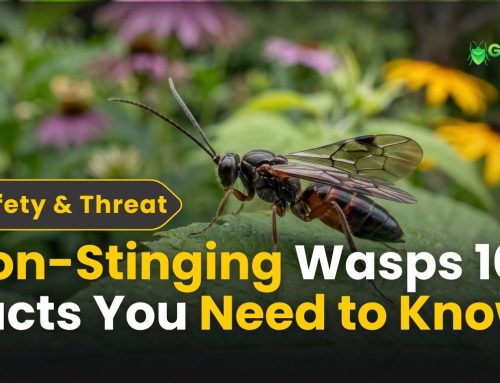
A female ichneumon wasp with a three-inch ovipositor trailing behind her looks alarming. In reality, she is a sophisticated insect detection system searching for wood-boring larvae beneath tree bark — not a threat to the person standing nearby.
If you are curious about how different wasp anatomy compares, our guide to wasp body parts and simple anatomy explains the differences clearly.
Fact 2: Size Is the Most Practical Limiting Factor
The vast majority of parasitic wasp species are extremely small — many ranging from less than one millimeter to around five millimeters in length. A wasp that small simply cannot physically interact with human skin in a way that causes pain or injury.
To give this some perspective:
| Parasitic Wasp Group | Typical Size Range | Practical Sting Risk |
| Trichogramma wasps | 0.3 – 1mm | None |
| Chalcid wasps | 0.5 – 3mm | None |
| Braconid wasps | 1 – 15mm | Negligible |
| Platygastrid wasps | 0.5 – 2mm | None |
| Ichneumon wasps | 3 – 40mm+ | None to very low |
| Spider wasps | 10 – 50mm | Low to moderate if provoked |
The only parasitic or parasitoid wasp group that creates any realistic sting concern for Connecticut homeowners is the spider wasp family — and even these insects are not aggressive by nature.
Fact 3: Spider Wasps Are the Real Exception to Know About
If you are looking for the honest answer about which parasitic-type wasps can actually sting people, spider wasps (family Pompilidae) are the group that deserves the most attention.
Spider wasps are solitary wasps that hunt spiders as hosts for their larvae. You may see them running quickly across garden paths, patio stones, or bare soil in Fairfield County during summer months — often dragging a paralyzed spider toward a burrow.
Here is what makes spider wasps different from other parasitoid species:
- They are larger, often 10–40mm in length
- They do possess a functional venom-injecting stinger
- The venom is primarily used to paralyze spiders
- They are not aggressive toward people, but they can sting defensively
- If handled, stepped on barefoot, or accidentally trapped against skin, a sting can occur
The sting from a spider wasp is real and can be genuinely painful. However, unprovoked attacks on people are essentially unheard of. If you see one moving through your yard, give it space and it will move on. It has no interest in you.
If you have been stung by any wasp and are unsure how to manage the immediate response, our wasp and hornet sting treatment guide covers the right steps to take.
Fact 4: Male Parasitic Wasps Cannot Sting — Ever
This fact applies across all wasp species, not just parasitic ones: male wasps of every species lack a stinger entirely.
The stinger in wasps is a modified ovipositor — a female reproductive structure. Males do not have an ovipositor at all, which means they have no stinging apparatus. A male parasitic wasp is completely harmless from a sting perspective, full stop.
In practical terms, this means that a large portion of any parasitic wasp population you encounter poses zero sting risk because those individuals are male. The only ones even theoretically capable of stinging are females, and in most parasitic wasp species, that theoretical capability rarely translates into any real-world risk to people.
Fact 5: No Colony Means No Defensive Stinging Behavior
Social wasp colonies — yellow jackets, paper wasps, bald-faced hornets, and European hornets — will defend their nests with collective aggression. Disturb a yellow jacket nest in the ground or a hornet nest in a tree on your Wilton or Stamford property, and the colony can mobilize dozens to hundreds of workers in a defensive response.
Parasitic wasps do not behave this way because:
- They are solitary insects
- There is no queen to protect
- There is no colony structure or worker caste
- There is no shared nest with food resources to defend
- Each individual operates completely independently
When a parasitic wasp female is done laying eggs, she moves on. There is no swarm response, no colony alarm, no mass mobilization. You could walk directly past one without any interaction at all.
This behavioral difference is why a solitary wasp on a garden plant rarely requires any intervention, while a visible paper nest near your front door in Greenwich or a ground-nesting yellow jacket colony near your Darien pool area needs professional assessment.
For help understanding the difference in wasp behaviors across species, the wasp and hornet behavior identification hub covers the key distinctions.
Fact 6: Misidentification Is the Real Risk Not the Sting
In field experience, one of the most common situations we encounter is a homeowner who has either:
- Dismissed a genuine stinging wasp colony as harmless because the individual insects “looked small”
- Tried to treat or eliminate a beneficial parasitic wasp because it looked unfamiliar
Both errors carry consequences.
Misidentifying a yellow jacket nest as harmless and approaching it without preparation can result in multiple painful stings — yellow jackets can and do sting multiple times without losing their stinger, unlike bees. If anyone in the household has a venom allergy, this becomes a medical emergency risk.
On the other side, unnecessarily treating beneficial parasitoid wasps with broad-spectrum insecticides removes natural pest control from your garden and may make aphid, caterpillar, and other pest problems significantly worse.
This is why identification comes before treatment — always.
How to Tell a Beneficial Parasitic Wasp from a Stinging Social Wasp
Use this quick checklist to help assess what you are looking at:
Signs it may be a beneficial parasitic wasp:
- Solitary individual, not part of steady insect traffic
- Slow, deliberate searching behavior on plants, bark, or soil
- Small size, often under 15mm
- No visible paper nest nearby
- No aggressive behavior when people walk past
- Searching around aphids, caterpillars, galls, or plant damage
- Long ovipositor trailing behind body (ichneumon wasps)
Signs it may be a social stinging wasp:
- Multiple wasps flying repeatedly to and from one location
- Visible paper or comb-style nest nearby
- Interest in food, sugary drinks, meat, or garbage
- Defensive buzzing or posturing when approached
- Steady entry and exit through a hole in the ground, wall, or wood structure
- Yellow-and-black striping with robust body shape
When in doubt, do not disturb the insect or nest. Take a photo from a safe distance and consult a professional. Green Pest Management CT serves all of Fairfield County — including Greenwich, Stamford, Darien, Westport, Fairfield, Wilton, New Canaan, and Norwalk — and can help you identify the species accurately before any action is taken.
Fact 7: Even Capable Species Rarely Choose to Sting People
Let us say you are dealing with one of the larger parasitic wasp species that technically does have a functional stinger — a larger ichneumon, a spider wasp, or a related hunting wasp. Even in these cases, stinging a person is a last resort, not a default behavior.
These are solitary insects whose entire behavioral program revolves around:
- Detecting appropriate host insects
- Assessing host quality
- Depositing eggs
- Finding nectar or honeydew for personal nutrition
People are not part of that program at all. A spider wasp walking across your garden path in Norwalk or Westport is not sizing you up as a threat. It is searching for a wolf spider. You are background noise to it.
The situations that lead to stings from larger solitary wasps are almost always contact situations:
- Picking one up without realizing what it is
- Barefoot contact on a wasp resting on the ground
- Trapping one against the skin by sitting or leaning on it
- Reaching into a burrow entrance without looking
- Wearing brightly colored clothing and standing near flowers the wasp is visiting for nectar
None of these involve unprovoked attack. They all involve accidental close contact.
What Does a Parasitic Wasp Look Like? Identification Tips for Connecticut Homeowners
Because the sting question is closely tied to correct identification, here is a practical visual guide for the parasitic wasp types Connecticut homeowners are most likely to encounter.
Ichneumon Wasps
- Size: 5mm to 40mm+ (some of the largest parasitoid wasps)
- Color: Black, brown, or banded with yellow or reddish tones
- Key feature: Long antennae; some females have a dramatic long ovipositor
- Behavior: Slow, deliberate movement along bark, wood, or foliage
- Sting risk: Essentially none for most species
Braconid Wasps
- Size: 1–15mm
- Color: Black, dark brown, or reddish
- Key feature: Compact body; parasitized caterpillars often show white cocoon clusters
- Behavior: Searching behavior on plants; may hover near aphid colonies
- Sting risk: Negligible
Chalcid Wasps
- Size: 0.5–3mm
- Color: Metallic green, blue, gold, or bronze iridescence
- Key feature: Bright metallic sheen under sunlight; geniculate (bent) antennae
- Behavior: Tiny, easily missed; often present on plants with scale insects or whiteflies
- Sting risk: None
Spider Wasps
- Size: 10–50mm
- Color: Black or dark blue body, often with orange or reddish legs
- Key feature: Rapid, jerky running movement; wings held flat; often seen dragging spiders
- Behavior: Active ground-level hunting in garden beds, lawn edges, bare soil areas
- Sting risk: Can sting if handled or trapped; not aggressive toward people
For a more complete visual reference to Connecticut wasp species, our wasp and hornet ID encyclopedia for Connecticut is a useful resource.
Are Parasitic Wasps Dangerous to Humans? Honest Risk Assessment
Let us address this directly, since it is what most people really want to know.
For the overwhelming majority of parasitic wasp species found in Connecticut: no, they are not dangerous to humans.
The practical danger profile looks like this:
- Small parasitoid species (Trichogramma, Chalcids, Braconids, Platygastrids): No sting capability for humans. Zero health risk from stinging.
- Ichneumon wasps: No meaningful sting risk. The ovipositor is not venom-injecting in most species. Even the largest ichneumons are docile.
- Spider wasps and larger hunting wasps: Capable of stinging if provoked or mishandled. Not aggressive. Venom causes local pain. Serious reactions rare except in individuals with known insect venom allergies.
When Parasitic Wasp Stings Become a Medical Concern
If someone in your household has a known allergy to insect venom, the calculus changes. Even a sting from a relatively mild species can trigger anaphylaxis in sensitized individuals.
Signs of a severe allergic reaction after any insect sting include:
- Difficulty breathing or shortness of breath
- Swelling of the throat, tongue, or lips
- Widespread hives beyond the sting site
- Rapid or weak pulse
- Dizziness or loss of consciousness
- Nausea and vomiting
Any of these symptoms require emergency medical attention immediately. Contact emergency services rather than waiting to see if symptoms resolve.
The American Academy of Allergy, Asthma & Immunology recommends that individuals with confirmed venom allergies carry an epinephrine auto-injector at all times during outdoor activity.
Seasonal Sting Risk in Fairfield County, Connecticut
Understanding when various wasp species are most active can help Connecticut homeowners take appropriate precautions at the right time of year.
Spring (April–May)
Parasitic wasps begin emerging as temperatures rise. Most activity at this stage is searching behavior — not threatening. The more notable concern in spring is social wasp queens beginning to establish new nests. Early detection of paper wasp nest-building activity on eaves or shutters is valuable at this stage.
Summer (June–August)
Peak activity for most wasp species across Fairfield County. Spider wasps are most visible during this period, actively hunting. Ichneumons and braconids are busy on flowering plants and trees. Yellow jacket colonies are also growing during this period, which is when ground nest traffic becomes noticeable. Distinguishing between beneficial parasitoid wasps and defensive social wasps is particularly important in summer.
Early Fall (September–October)
Late summer through early fall is when yellow jacket colonies are at maximum size and workers become more aggressive, particularly around outdoor food and garbage. This is sometimes when homeowners in Stamford, Norwalk, and Westport notice an uptick in wasp-related problems. Parasitoid wasps are completing their final seasonal cycles during this period.
Winter (November–March)
Adult parasitoid wasps are generally not present in winter. Any wasp activity in or around your Connecticut home during winter months is more likely to involve a social wasp colony that has established inside a wall void or attic space and is surviving with residual warmth from the structure.
When to Leave Wasps Alone vs. When to Call a Professional
Leave It Alone If:
- A single small wasp is searching garden plants or foliage
- You see white cocoons on a caterpillar (braconid parasitism)
- A large wasp with a long ovipositor is probing tree bark
- A spider wasp is moving through the yard hunting spiders
- There is no nest, no aggressive behavior, and no repeated traffic
Contact a Professional If:
- You see a paper nest near doors, windows, decks, or play areas
- Wasps are entering and exiting a wall void, soffit, or attic
- You notice ground-nest traffic near lawn areas used by children or pets
- Stings have occurred or wasp aggression has been noted
- A family member has a known insect venom allergy
- You cannot safely identify the species from a distance
Green Pest Management CT provides professional wasp identification and pest management services throughout Greenwich, Stamford, Darien, Westport, Fairfield, Wilton, New Canaan, and Norwalk. If you are uncertain about a wasp situation on your property, professional assessment is always the safest starting point.
Explore our trusted professional pest management services or contact us directly to schedule an inspection.
Frequently Asked Questions
Do parasitic wasps sting humans?
Most parasitic wasps do not sting humans. The majority are too small to penetrate human skin, or their egg-laying structure is not adapted for venom injection. Spider wasps are the main exception — they can sting defensively but are not aggressive by nature.
Can parasitic wasps hurt you?
For most species, no. They pose no meaningful physical risk to people. The rare exception involves spider wasps or larger hunting wasps, which can sting if accidentally handled or trapped against the skin.
Are parasitic wasps dangerous?
No, most parasitic wasps are not dangerous to humans. They are solitary, non-territorial, and focused on insect hosts. The danger in most cases comes from confusing a parasitic wasp with a social stinging wasp such as a yellow jacket or hornet.
What happens if a parasitic wasp stings you?
For the small number of species capable of stinging, the result is typically localized pain and minor swelling, similar to other insect stings. Most symptoms resolve within a few hours. If you experience difficulty breathing, widespread swelling, or other signs of a severe allergic reaction, seek emergency medical care immediately.
Can a parasitic wasp kill you?
No, parasitic wasps are not capable of causing fatalities in healthy individuals. As with all insect stings, the only life-threatening risk is severe anaphylaxis in individuals with a known venom allergy. Those individuals should carry an epinephrine auto-injector when spending time outdoors.
Do all female parasitic wasps have stingers?
Not all female parasitic wasps have a stinger capable of injecting venom into humans. In many species, the ovipositor is adapted specifically for egg-laying and cannot deliver venom defensively. In some larger species, the ovipositor does function as a stinger but is rarely used against people.
Can male parasitic wasps sting?
No. Male wasps of any species cannot sting. The stinger in wasps is a modified ovipositor, which is a female-only reproductive structure. Males have no stinging apparatus whatsoever.
How do I know if a wasp near my home is a parasitic wasp or a dangerous one?
Key signs of a beneficial parasitic wasp include solitary behavior, small size, no paper nest, slow searching movement over plants or bark, and no interest in human food or activity. Key signs of a potentially problematic social wasp include nest traffic, defensive behavior near a nest, interest in food or garbage, and yellow-black coloring with a robust body. When uncertain, professional identification is the safest option.
Should I spray parasitic wasps in my garden?
Generally, no. Parasitic wasps help control aphids, caterpillars, and other garden pests. Removing them with broad-spectrum insecticides can make pest problems worse. Only treat identified pest species using targeted methods.
When should I contact Green Pest Management CT about wasps?
Contact us if you discover a nest near a high-traffic area, see wasps entering your home’s structure, experience or witness stings, have a family member with a venom allergy, or cannot safely identify the insect species from a distance.
Conclusion: Most Parasitic Wasps Are Not the Threat You May Think
The question — do parasitic wasps sting — has a reassuring answer for most Connecticut homeowners: not really, and not in any way that should cause concern under normal circumstances.
These are solitary, behaviorally focused insects that evolved to interact with other insects, not people. The vast majority are too small to sting humans, use their egg-laying structure for reproduction rather than defense, and have no colony-driven aggression to speak of.
The important thing to take from this guide is not just that parasitic wasps are low-risk — it is that accurate identification matters. Seeing an unfamiliar wasp near your Fairfield or Greenwich home is not automatically a reason to treat. It may well be a beneficial insect helping manage garden pests naturally.
But when you do have a genuine stinging wasp concern — a paper nest near an entryway, yellow jackets in the ground, or a hornet colony in the wall — that is when professional help makes a real difference.
Green Pest Management CT serves homeowners throughout Fairfield County with professional, IPM-based pest identification and management. If you have a wasp situation you want assessed safely and accurately, contact our team to arrange an inspection. We identify first, recommend second, and only treat what actually needs treatment.