Ants in the house? Get Rid of Them Fast (Proven Fixes)
You walk into your kitchen, flip on the light, and there they are — a long, winding line of ants marching across your countertop like they own the place. Sound familiar? If you’re dealing with Ants in House, you are definitely not alone, and more importantly, you don’t have to just live with them.
Whether it’s a trail of tiny sugar ants heading for the fruit bowl, carpenter ants boring into your windowsills, or a mysterious colony appearing in your bathroom overnight — ants in the house are a problem that gets worse fast if ignored. The good news? There are proven, practical fixes that actually work in 2026, whether you want to handle it yourself or call in a professional.
This guide covers everything: why ants invade homes, which rooms they target most, the fastest fixes for each situation, when DIY isn’t enough, and how homeowners across Greenwich CT, Stamford CT, Darien CT, New Canaan CT, Wilton CT, and Westport CT can protect their homes year-round. Let’s get into it.
Why Do Ants Come Inside Your House in the First Place?
Before you can fix the problem, it helps to understand what’s driving it. Ants don’t wander into your home by accident. They are remarkably intelligent, highly organized insects that send scouts out specifically to find food, water, and shelter. When a scout finds something promising inside your home, it lays a chemical trail called a pheromone back to the colony — basically a GPS signal that says “follow me, there’s food here.”
That’s why you rarely see just one ant. You see a trail.
The four main reasons ants enter homes:
- Food sources — Any crumb, spill, open container, or piece of fruit sitting on the counter is a five-star buffet for an ant colony.
- Moisture and water — Leaky pipes, damp wood, or standing water attract ants just as powerfully as food, especially carpenter ants and moisture ants.
- Warmth and shelter — As temperatures drop in fall and winter, ants seek out the warm interior of your walls, foundation, and flooring.
- Easy entry points — Cracks in your foundation, gaps around window frames, spaces under doors, and utility line openings all serve as ant highways.
According to the United States Environmental Protection Agency, ants are one of the most common household pest complaints in the country, affecting millions of homes every year. In Connecticut specifically, the warm and humid summers combined with cold winters create ideal conditions for ants to seek shelter indoors, which is why ants in the house are such a persistent issue in towns like Stamford, Darien, and Westport.
The Most Common Types of Ants Found in Homes (2026)
Not all ants are the same. Identifying the species you’re dealing with is actually the most critical first step, because different ants require different treatments. Using the wrong approach wastes time and money.
1. Odorous House Ants (Sugar Ants)
These are the tiny, dark brown ants you most often find trailing across your kitchen counter or near the bathroom sink. They’re called “odorous” because they release a smell similar to rotten coconut when crushed. They’re attracted to anything sweet — syrups, fruit, spilled juice, even your pet’s water bowl. Learn more about how to get rid of sugar ants specifically, as they require a targeted baiting approach.
2. Carpenter Ants
Larger, usually black or bi-colored (black and red), carpenter ants are a serious structural concern. Unlike termites, they don’t eat wood — they excavate it to build their nests, leaving behind fine sawdust-like material called frass. Finding carpenter ants in your home, especially near damp wood, is a red flag that needs immediate attention.
3. Pavement Ants
Small, brownish-black ants are often found near concrete slabs, driveways, basements, and garage floors. They nest under pavement and enter homes through cracks in the foundation. Very common in Connecticut homes with older foundations.
4. Pharaoh Ants
Tiny, pale yellow ants that are notoriously difficult to eliminate. They are a common problem in kitchens, bathrooms, and hospitals because they’re attracted to grease, sweet foods, and moisture. Improper treatment — like using repellent sprays — actually causes them to “bud,” splitting the colony into multiple new colonies and making the infestation far worse.
5. Argentine Ants
Highly invasive, light brown ants that form massive super-colonies. Originally from South America, they’ve established themselves throughout the eastern United States. They’re relentless foragers and incredibly hard to control without professional intervention.
6. Fire Ants
More common in southern states but increasingly reported in Connecticut in recent years, fire ants are aggressive and deliver a painful, burning sting. If you find a mound indoors or near your foundation, treat this as an urgent situation.
Quick Identification Table:
| Ant Type | Size | Color | Key Sign | Risk Level |
| Odorous House Ant | 1/16″–1/8″ | Dark brown/black | Sweet smell when crushed | Low-Medium |
| Carpenter Ant | 1/4″–1/2″ | Black or black/red | Sawdust (frass) near wood | High |
| Pavement Ant | 1/16″–1/8″ | Dark brown | Near concrete/foundations | Medium |
| Pharaoh Ant | 1/16″ | Pale yellow | Multiplies if sprayed incorrectly | High |
| Argentine Ant | 1/16″–1/8″ | Light brown | Super-colony formation | High |
| Fire Ant | 1/8″–1/4″ | Red-brown | Painful sting, mounds | Very High |
Ants in Kitchen: Why Your Kitchen Is Ground Zero
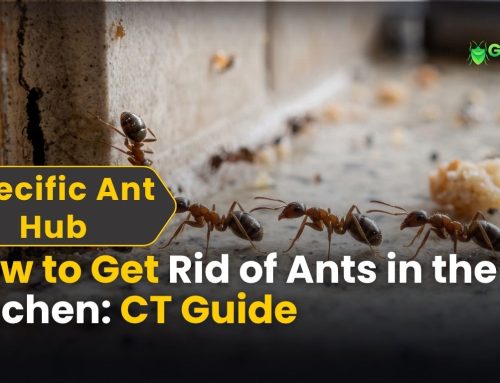
If there’s one room that acts as the primary entry point and feeding zone for ants in the house, it’s the kitchen. And it makes complete sense when you think about it — your kitchen has everything an ant colony could dream of: food, water, warmth, and shelter behind and under appliances.
What’s Attracting Ants to Your Kitchen?
- Open or improperly sealed food containers — Cereal boxes, sugar bags, honey jars with sticky residue on the outside.
- Pet food bowls left out overnight — One of the most overlooked ant attractants in any home.
- Grease buildup near the stove — Particularly attractive to pharaoh ants and grease ants.
- Fruit sitting on the counter — Ripening fruit is one of the top draws for odorous house ants.
- Gaps under the sink — The plumbing under your kitchen sink creates a warm, moist tunnel that connects directly to the exterior.
- Garbage cans without lids — Even a small amount of food residue in a liner attracts scouts immediately.
Fast Fixes for Ants in the Kitchen
Step 1: Find and destroy the trail. Wipe down all surfaces with a 1:1 solution of white vinegar and water. This destroys the pheromone trail and temporarily disrupts communication between ants. It doesn’t kill them, but it breaks their navigation system.
Step 2: Locate the entry point. Follow the trail backward. Where are they coming in? Common spots include gaps around window frames, under the baseboard near the sink, or through a small crack where the countertop meets the wall.
Step 3: Use gel bait, not spray. This is a critical mistake most homeowners make — they reach for a can of ant spray. Spray kills the ants you can see, but it repels the ants you can’t see, pushing the colony deeper into your walls. Gel bait works completely differently. Forager ants eat the bait and carry it back to the colony, ultimately killing the queen. Place small drops of gel bait near (not on) the trail so the ants can find it without being disrupted. For a deeper dive into baiting strategies, check out these best ways to get rid of ants that actually work.
Step 4: Seal entry points. Use caulk to seal any gaps you found in Step 2. Don’t skip this — without sealing entry points, new scouts will just re-establish trails.
Step 5: Eliminate food and moisture sources. Transfer dry goods to airtight glass or hard plastic containers. Fix any dripping faucet or pipe. Clean under the refrigerator and stove where crumbs accumulate unnoticed.
Pro Tip: Place bait stations behind the refrigerator and under the stove, where ants forage heavily but humans rarely disturb them. Patience is key — bait can take 3–10 days to fully work because the ants need time to carry it back to the colony.
Ants in Bathroom: A Moisture Problem, Not Just a Cleanliness Problem
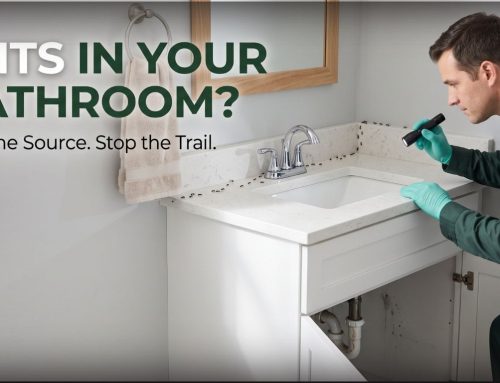
Finding ants in your bathroom is often a surprise to homeowners because bathrooms don’t seem like food sources. But ants don’t just come for food. Moisture is equally as attractive, and your bathroom has moisture in abundance from the shower, from condensation on pipes, from a slow leak under the sink you haven’t noticed yet.
Why Ants Target Bathrooms
- Leaking or sweating pipes under the vanity
- Damp wooden structures around the shower or tub
- Hair and soap residue in drains (organic matter = food for some species)
- Toothpaste, shampoo, and lotion were left with open tops
- Warm, humid air that makes the space ideal for nesting
Carpenter ants, in particular, are heavily drawn to damp wood. If you’re seeing large black ants in your bathroom — especially near the shower wall, under the vanity, or along the baseboard near the toilet there may be a moisture-damaged wood problem that goes well beyond the ant issue itself.
How to Get Rid of Ants in the Bathroom
- Fix the moisture source first. Check under the sink for any slow drips. Look for soft, discolored wood near the shower. Run your hand along pipes and feel for dampness. Without addressing moisture, ant treatments in bathrooms will only be temporary.
- Inspect the drain. Some ant species, particularly pharaoh ants and moisture ants, will forage in and around drains. Pour a small amount of boiling water down the drain to dislodge any organic buildup they may be feeding on.
- Use non-repellent bait. Same principle as the kitchen — avoid sprays. Use gel bait placed near the trail, under the sink vanity, or along the baseboard.
- Caulk around the tub and shower. Old, cracked caulk is a primary entry route. Re-caulk all joints between the tub and the wall, and around the toilet base if there are gaps.
- Ventilate properly. Run the exhaust fan during and after showering. If your bathroom doesn’t have an exhaust fan, consider opening the window briefly to reduce humidity. High ambient moisture is an open invitation.
Room-by-Room Ant Problem Guide
Ants in the house don’t limit themselves to the kitchen and bathroom. Here’s a quick-reference guide for every room they commonly invade:
Ants in the Bedroom
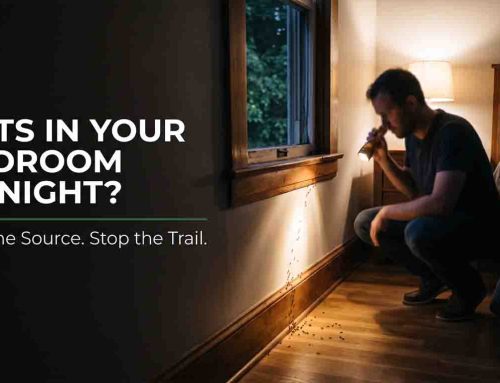
Unusual but not rare, especially if you eat in bed or have young children who bring snacks to their rooms. Also, if there’s a tree branch touching your home near a bedroom window, ants use these as bridges. Trim branches and remove any food sources from the room.
Ants in the Living Room
Often tied to pet food bowls, houseplants (aphids on plant roots attract certain ant species), or a forgotten snack behind furniture. Check under couch cushions and behind the TV stand. If you have potted plants, inspect the soil — some ants nest directly in indoor plant pots.
Ants in the Basement
Basements are a prime nesting ground because they combine moisture, darkness, and proximity to the foundation. Carpenter ants, pavement ants, and moisture ants all commonly nest in basements, especially in Connecticut homes with older foundations. Check for damp insulation, water seepage, and cracks in the concrete floor or walls.
Ants in the Garage
Garages are often overlooked but serve as a major entry route. Pet food stored in the garage, birdseed, trash cans, and compost bins all attract ants. Since garages connect directly to the house interior, an ant colony in the garage will almost always eventually find its way inside.
Ants in Walls
This is where things get serious. If you can hear a faint rustling inside your walls, or if you’re seeing frass (sawdust-like material) at the base of walls, you may have a carpenter ant colony actively excavating inside your home. This is not a DIY situation — professional ant extermination is necessary to locate and treat a colony inside wall voids.
DIY Ant Control Methods That Actually Work in 2026
Let’s be clear about something upfront: DIY ant control absolutely works for small, surface-level infestations. If you’re seeing occasional ant trails and you caught the problem early, you can very likely handle it yourself. The key is using the right methods in the right order.
The DIY Ant Control Toolkit
- Ant Gel Bait (Most Effective DIY Method)
Products containing active ingredients like indoxacarb, fipronil, or borax work as slow-acting baits. The ant eats the bait, survives long enough to carry it back to the colony, and then dies along with the other ants that consumed it. This is called the “transfer effect,” and it’s what makes bait so much more effective than contact sprays.
Popular options include Advion Ant Gel, Terro Liquid Ant Bait (borax-based), and Syngenta Optigard.
- Diatomaceous Earth (DE)
Diatomaceous earth is a naturally occurring, food-grade powder made from fossilized algae. It works mechanically — the tiny particles damage the ant’s exoskeleton, causing it to dehydrate and die. It’s completely non-toxic to humans and pets, making it a great option for kitchen baseboards, behind appliances, and along windowsills. Apply a thin, barely visible layer — too thick and ants walk around it.
- Boric Acid Solutions
Boric acid is one of the oldest and most effective ant control ingredients. Mixed with a sweet attractant (like sugar water or honey), it creates a homemade bait that ants consume and carry back to the colony. Use a ratio of about 1 teaspoon of boric acid per cup of sugar water. Be patient — this takes several days to work. For a complete breakdown of DIY ant control methods, including boric acid recipes and bait station placement maps, that resource covers everything in detail.
- Caulk and Exclusion (Prevention)
Sealing entry points is arguably the single most impactful thing you can do. Use a quality silicone caulk around window frames, door frames, where pipes enter walls, foundation cracks, and any gap larger than 1/16 inch (ants can squeeze through incredibly small spaces).
- Essential Oil Deterrents
Peppermint oil, clove oil, and tea tree oil act as natural ant deterrents by masking pheromone trails. While they don’t kill ants, they’re useful for creating a barrier around specific entry points or in areas where you don’t want to use chemical baits (near food prep surfaces, for example). Mix 10–15 drops with water in a spray bottle and apply to entry points.
- White Vinegar
As mentioned earlier, vinegar disrupts pheromone trails. It’s a great cleaning solution to use after an ant trail has been eliminated to prevent re-foraging on the same path. It doesn’t repel ants long-term, but it’s an excellent reset tool.
DIY Checklist: What to Do When You First Spot Ants
- Identify the ant species, if possible
- Follow the trail to locate entry points
- Wipe down surfaces with a vinegar solution to disrupt trails
- Place gel bait near (not on) the trail
- Seal visible entry points with caulk
- Remove all food sources (seal containers, clean up spills)
- Fix any moisture issues (leaky pipes, damp wood)
- Apply diatomaceous earth along baseboards and entry points
- Monitor bait stations daily without disturbing them
- Reassess after 7–10 days — if any activity persists, escalate to professional treatment
When DIY Isn’t Enough: Signs You Need a Professional
DIY methods work well for common house ants caught early. But there are clear signals that tell you it’s time to bring in a licensed pest control professional. Ignoring these signs typically leads to a much larger, more expensive problem down the road.
Call a professional when:
- You’ve tried bait and other treatments for 2+ weeks with no reduction in ant activity
- You’re finding large black ants (carpenter ants) near damp or soft wood
- You can hear rustling sounds inside your walls
- You’re finding frass (fine sawdust) at the base of walls or around wooden structures
- You’ve discovered what appears to be an active colony inside the wall, floor, or ceiling
- The ant infestation is in a commercial property or multi-unit building
- You’re seeing ant activity in multiple rooms simultaneously, suggesting a large internal colony
- You’ve identified or suspect pharaoh ants (repellent sprays make them much worse)
- The problem recurs every season despite your DIY efforts
Connecticut homeowners in Greenwich, New Canaan, and Wilton frequently deal with recurring carpenter ant infestations tied to older home construction and the heavy tree canopy throughout Fairfield County. These are not situations where over-the-counter products provide reliable, lasting results. A professional ant exterminator in CT has access to commercial-grade products, thermal cameras to detect activity inside walls, and the expertise to treat the colony rather than just the symptoms.
The Professional Ant Extermination Process: What Actually Happens
Many homeowners are curious and sometimes hesitant about what professional pest control actually involves. Here’s a transparent look at what a professional ant treatment looks like in 2026.
Step 1: Inspection and Identification
A licensed technician begins with a thorough inspection of the interior and exterior. This includes checking entry points, moisture sources, wood condition, and foraging trails. Identifying the exact ant species is essential because treatment protocols differ significantly between, say, carpenter ants and pharaoh ants.
Step 2: Colony Location
For infestations that have moved beyond surface trails, the technician locates the colony. This may involve tapping walls to listen for hollow sounds, using moisture meters to identify damp wood, or, in advanced cases, using thermal imaging to detect heat signatures from an active colony inside a wall void.
Step 3: Targeted Treatment Application
Depending on the species and severity, treatment may include:
- Non-repellent residual insecticides applied to exterior perimeters and entry points
- Gel bait is placed in targeted locations where ants are most active
- Dust treatments are injected into wall voids or wood galleries (especially for carpenter ants)
- Liquid bait systems for heavy infestations or multiple species
- Granular bait is applied to the exterior, yard, and areas where outdoor colonies are feeding
The entire process typically takes 1–2 hours for a standard residential treatment, though complex infestations, particularly carpenter ant colonies inside walls, may require follow-up visits. For a detailed walkthrough, the professional ant extermination process in CT covers exactly what to expect from start to finish.
Step 4: Prevention and Exclusion Recommendations
A good pest control company doesn’t just treat the current problem — they help you prevent the next one. After treatment, your technician should walk you through specific prevention recommendations tailored to your home’s construction, landscaping, and the species involved.
Step 5: Follow-Up and Monitoring
For serious infestations, a follow-up visit is standard practice, typically 2–4 weeks after initial treatment. This confirms colony elimination and allows any surviving foragers to be treated before a new colony can establish.
Natural and Eco-Friendly Ant Control Options
For homeowners who prefer to minimize chemical use, particularly families with young children or pets, there are genuinely effective, eco-friendly approaches. Connecticut’s growing awareness of environmental health has driven significant demand for green pest control solutions, and the science behind them has improved considerably.
Effective Natural Methods
Diatomaceous Earth As described above, food-grade DE is one of the best natural options available. It’s EPA-approved, non-toxic, and highly effective against most crawling insects when applied correctly.
Boric Acid Bait Boric acid is a naturally occurring mineral salt that is classified as a minimum-risk pesticide by the EPA. At low concentrations (less than 1%), it’s effective against ants while posing minimal risk to humans and pets.
Botanical Insecticides Products containing plant-derived active ingredients like spinosad, pyrethrin (from chrysanthemum flowers), or neem oil can be effective against ants while breaking down quickly in the environment.
Physical Exclusion Caulking, weatherstripping, door sweeps, and mesh screens over vents are entirely non-chemical and arguably the most environmentally sound long-term strategy.
Beneficial Nematodes For outdoor ant colonies, beneficial nematodes are microscopic soil organisms that naturally parasitize and kill insects, including ants. Applied to lawn and garden areas, they can help reduce outdoor colony populations without any synthetic chemicals.
What Doesn’t Work (Common Myths Debunked)
- Cinnamon Mildly repellent but not effective as a treatment. Ants simply navigate around it.
- Baby powder/talc: Negligible effect. Not a practical solution.
- Chalk lines: An internet myth. Ants cross chalk freely.
- Coffee grounds: No reliable evidence of effectiveness as a deterrent or killer.
- Cucumber peels: A common folk remedy with no scientific support.
- Boiling water on indoor nests: Dangerous to floors, subfloor, and wiring if the nest is inside a wall. Only suitable for outdoor mounds.
Seasonal Ant Activity in Connecticut: When to Expect Problems
Understanding when ants are most active in Connecticut helps you stay one step ahead rather than constantly reacting.
Spring (March–May): Peak Invasion Season
Spring is when ant colonies become most active. As temperatures rise, queens begin laying new eggs and colonies expand rapidly. Scout ants emerge first, looking for new food and water sources, which is why spring is when most homeowners in Stamford, Darien, and Westport first notice ants in the house. This is the best time to set up preventive bait stations before trails are fully established.
Summer (June–August): High Activity, Multiple Species
Summer brings peak foraging activity across all ant species. Carpenter ants are especially active in June and July. Pavement ants swarm to establish new colonies. Odorous house ants push deeper into homes during heat waves, seeking moisture. If you haven’t been treated in the spring, summer activity will be noticeably worse.
Fall (September–November): Seeking Winter Shelter
As temperatures drop, ants that haven’t established indoor nests will seek warm shelter. This is often when homeowners discover carpenter ants or pavement ants inside wall voids — they moved in during fall and became visible only when they started foraging for food during warmer spells. Pre-winter exterior treatment is one of the most effective investments a CT homeowner can make.
Winter (December–February): Hidden But Not Gone
Ants don’t disappear in winter; they slow down dramatically. Most colonies in Connecticut enter a state of reduced activity, surviving on stored food within the nest. However, ants that have established indoor nests (especially in heated wall voids or under heated slabs) may remain active year-round. Seeing ants in December or January is actually a strong indicator of an indoor nest, not just foragers coming in from outside.
DIY vs. Professional Ant Control: Which Is Right for You?
This is one of the most common questions homeowners ask, and the answer genuinely depends on your specific situation. There’s no universal right answer — both approaches have legitimate use cases.
DIY Makes Sense When:
- The infestation is small and localized (one trail in one room)
- You’ve identified it as a common house ant (odorous house ant, pavement ant)
- You’re dealing with a first-time occurrence, not a recurring problem
- You’re comfortable with the patience required for bait-based treatments
- You’re primarily dealing with exterior ants that haven’t yet established an indoor colony
Professional Treatment Makes Sense When:
- The infestation is widespread, affecting multiple rooms
- You’ve tried DIY methods without success
- You suspect or have confirmed carpenter ants or pharaoh ants
- The infestation is recurring season after season
- You have structural concerns (soft wood, visible frass, sounds in walls)
- You simply want guaranteed results without the trial and error
For a thorough comparison of both approaches, including a cost-benefit breakdown and scenarios where each is most appropriate, the DIY vs. professional pest control CT guide is an excellent resource for Connecticut homeowners trying to make an informed decision.
Ant Prevention: The 12-Point Homeowner Checklist
The best ant treatment is one you never need. Here’s a comprehensive prevention checklist tailored for Connecticut homeowners covering both interior habits and exterior maintenance.
Interior Prevention
- Store all dry goods in airtight containers. Plastic bags are not sufficient; ants can chew through them.
- Clean up spills immediately. Even a few drops of juice are enough to attract scouts within hours.
- Never leave pet food out overnight. Use sealed containers or place food bowls on a slightly soapy water moat (a shallow plate of soapy water under the bowl).
- Take out trash daily, especially food waste. Use trash cans with tight-fitting lids.
- Fix all leaky pipes and faucets. Moisture control is critical for carpenter ant prevention.
- Seal cracks and gaps: around windows, doors, baseboards, and where pipes enter walls.
- Reduce indoor clutter.: Cardboard boxes, newspapers, and stored fabric create nesting opportunities.
- Inspect houseplants: Check soil for nesting ants, especially if plants are near windows or doors.
Exterior Prevention
- Keep mulch at least 12 inches from your foundation — Moist mulch is a top nesting environment.
- Trim tree branches away from the roofline — Carpenter ants use branches as bridges to enter near the roof.
- Store firewood at least 20 feet from your home — Firewood piles are a prime carpenter ant habitat.
- Fix exterior wood damage promptly — Rotted fascia boards, deteriorating window frames, and damaged deck wood are carpenter ant magnets.
- Seal foundation cracks — Use masonry caulk for concrete and block foundation cracks.
- Direct gutters and downspouts away from the foundation — Water pooling near the foundation creates the moisture ants seek.
- Remove stumps and dead wood — Decomposing wood within 20 feet of your home is a high-risk nesting zone.
- Apply a perimeter treatment in spring — A granular or liquid non-repellent insecticide applied around the foundation in early spring dramatically reduces seasonal ant activity.
Specific Situations: Real Scenarios and Real Solutions
Scenario 1: I Just Moved Into a New Home in Darien and Found Ants Immediately
This is incredibly common. New construction disturbs soil and exposes existing ant colonies. Older homes often have established colonies in the walls that the previous owners either managed or ignored. The first thing to do is identify the species. If they’re small, dark, and follow a clear trail, start with bait. If they’re large and black and you find them near wood, call a professional immediately. Don’t wait to see if the problem resolves itself.
Scenario 2: I Treated With Spray, and now I Have Ants in Two Rooms Instead of one.
This is a textbook case of repellent spray causing colony fragmentation — particularly common with pharaoh ants. Stop using the spray immediately. Give the colony 48–72 hours to settle. Then introduce a slow-acting gel bait near the areas where you’re seeing activity. Be very patient. Do not move or disturb the bait stations.
Scenario 3: We Have Ants Every Spring, No Matter What We Do
Recurring seasonal ant problems almost always indicate either an outdoor colony that successfully re-establishes itself each year (possibly from a nest in your yard or under a driveway), or an existing indoor colony that hasn’t been fully eliminated. Annual preventive perimeter treatments applied in March or early April, combined with exclusion work, typically break this cycle. If it persists, a professional assessment is warranted.
Scenario 4: We Found Ants in Our Westport Kitchen the Morning After a Big Rainstorm
Very common. Heavy rain floods ant nests in the soil, forcing colonies to relocate — often directly into the nearest structure. This is actually one of the most predictable ant events in Connecticut. If heavy rain is forecast, applying a perimeter barrier treatment the day before dramatically reduces this “rain flush” phenomenon.
Connecticut-Specific Ant Problems: What Fairfield County Homeowners Need to Know
Living in Greenwich, Stamford, Darien, New Canaan, Wilton, or Westport comes with specific ant challenges that aren’t always reflected in general pest control guides written for other parts of the country.
The Tree Canopy Factor
Fairfield County is one of the most heavily wooded suburban regions in Connecticut. This is beautiful, and it’s also a direct driver of carpenter ant problems. Large, mature trees near homes mean larger ant populations living in dead branches and wood, and greater opportunity for those ants to bridge to rooflines and soffits.
Older Housing Stock
Many homes in Greenwich, Darien, and New Canaan were built in the mid-20th century and feature construction styles (post-and-beam, older wood framing, crawl spaces) that are more vulnerable to carpenter ant damage. Regular professional inspections are genuinely worthwhile in these homes.
High Water Tables
Parts of southwestern Connecticut, particularly areas close to the Long Island Sound shoreline and the many rivers and streams through Fairfield County, have higher water tables and more moisture in the soil. This elevates the risk of moisture-related ant problems — especially in basements and crawl spaces.
The Growing Season
Connecticut’s growing season means lawns, gardens, and landscaping are active from April through November. Mulched garden beds, composting, and ornamental plantings close to the home create an ongoing habitat for a wide variety of ant species throughout the season.
For homeowners in any of these towns, having a relationship with a knowledgeable local pest control provider isn’t a luxury — it’s practical home maintenance. A trusted ant exterminator in Connecticut who understands the specific conditions of Fairfield County is far better positioned to deliver lasting results than a national franchise with generic protocols.
How to Choose the Right Ant Exterminator in CT
Not all pest control companies are equal. Here’s what to look for when hiring a professional for ants in your house in Connecticut.
Checklist for Hiring a CT Ant Exterminator
Licensing and Certification: Connecticut requires all pest control operators to be licensed by the Connecticut Department of Energy and Environmental Protection (DEEP). Always verify that your pest control provider holds a valid state license before any treatment.
Species-Specific Expertise Ask directly: “Can you tell me which species of ants I’m dealing with and explain how your treatment targets that species?” A knowledgeable technician should be able to answer this without hesitation.
Inspection Before Treatment: A legitimate pest control provider will always inspect before proposing a treatment plan. Be wary of any company that quotes you a price or schedules treatment without first seeing the property.
Integrated Pest Management (IPM) Approach: Look for companies that practice Integrated Pest Management — a science-based approach that prioritizes prevention, identification, and targeted treatment over blanket chemical application. IPM reduces unnecessary pesticide exposure while delivering more effective, lasting results.
Transparency About Products: Ask what products will be used, what the active ingredients are, and what precautions you should take with children and pets. A reputable company will answer these questions openly.
Written Guarantee: Reputable pest control companies stand behind their work. Ask specifically about their re-treatment policy if ants return after the initial treatment.
Local Knowledge: This matters more than most people realize. A company that has been serving Stamford, Greenwich, Wilton, and the rest of Fairfield County for years understands the specific ant species, seasonal patterns, and housing types in your area in a way that a national franchise simply doesn’t.
Green and Eco-Conscious Pest Control in Connecticut
There’s a growing and very legitimate movement toward environmentally responsible pest control in Connecticut, and it’s worth addressing directly. Many homeowners — particularly in communities like Westport and New Canaan with active conservation cultures — are understandably concerned about pesticide use near children, pets, gardens, and waterways.
The good news is that eco-friendly ant control has come a long way. Modern integrated pest management approaches can achieve excellent results with far less environmental impact than traditional blanket spray treatments. The principles are:
- Minimize chemical use through targeted application rather than broadcast spraying
- Use the least-toxic effective product — borax, diatomaceous earth, and plant-derived insecticides first
- Focus on exclusion and prevention to reduce the need for ongoing chemical treatment
- Work with the biology of the pest — bait-based systems are inherently more targeted and use far less active ingredient than contact sprays
If environmental responsibility is a priority for you, make it a key criterion when contacting a pest control provider. Ask explicitly about their IPM protocols and what percentage of their treatments rely on mechanical exclusion versus chemical application.
Long-Term Ant Control: Building a Year-Round Defense
Dealing with ants in the house shouldn’t be a crisis-to-crisis experience. With the right approach, it becomes a manageable part of routine home maintenance. Here’s how to think about long-term ant control.
The Annual Ant Defense Calendar for CT Homeowners
February/March: Inspect the exterior foundation and caulk any new cracks that opened during the freeze-thaw cycle. Check wood structures (deck, fascia, window frames) for moisture damage.
April: Apply a perimeter granular or liquid non-repellent treatment before the ant season begins. This is the most high-leverage timing for preventive treatment in Connecticut.
May–June: Monitor interior for foraging trails. Set preventive bait stations in the kitchen and basement. Check under sinks for moisture.
July–August: Peak vigilance period. Address any outdoor colonies near the foundation before they move indoors. Keep landscaping trimmed back from the house.
September: Apply a pre-winter perimeter treatment. Seal any entry points identified over the summer. Inspect the attic and basement for signs of carpenter ant nesting.
October–November: Remove leaf litter and debris near the foundation. Bring firewood storage at least 20 feet from the home.
December–February: If you see ants indoors during cold weather, assume an indoor nest. Contact a professional. This is not typical foraging behavior.
FAQ: Ants in House: Your Questions Answered
Q1: Why do I suddenly have so many ants in my house when I’ve never had a problem before?
Several factors can trigger a sudden infestation. A new queen may have established a colony near your home. A rainstorm may have flooded an existing outdoor nest, forcing relocation indoors. Seasonal temperature changes may have pushed a previously small colony to expand into your living space. Or, and this is common, a foraging trail may have been present for a while but went unnoticed. Once a trail is well-established, the volume of ants becomes very visible very quickly.
Q2: Are ants in the house dangerous?
Most common household ants are a nuisance rather than a direct health hazard. However, pharaoh ants are known to carry and transmit pathogens, including Salmonella and streptococcus — making them a genuine health concern, especially in kitchens. Carpenter ants cause structural damage over time. Fire ants deliver a painful and potentially dangerous sting. In all cases, ants contaminate food surfaces and should be eliminated promptly.
Q3: Can ants come back after professional treatment?
Yes, it’s possible — particularly if entry points aren’t sealed, if there are multiple outdoor colonies in the yard, or if the original infestation was a species like pharaoh ants that requires very precise treatment. This is why a good pest control company offers follow-up visits and re-treatment guarantees. The conditions that attracted ants in the first place (moisture, food, entry points) must also be addressed, or new colonies will re-colonize the area.
Q4: How do I know if I have carpenter ants vs. termites?
Both cause wood damage, but in very different ways. Carpenter ants leave behind clean, smooth galleries and produce frass that looks like coarse sawdust mixed with insect body parts. Termites consume wood from the inside out and leave behind mud tubes, and their frass (termite droppings, called frass for subterranean species) is finer and pellet-like. Carpenter ants are black and distinctly segmented; termites are pale/white and have a thick waist. If you’re unsure, have a professional inspect — the treatments are completely different.
Q5: Is it safe to use ant bait around pets and children?
Most commercially available gel baits and bait stations are designed with child and pet safety in mind. Products like Terro (borax-based) and Advion (indoxacarb-based) have very low mammalian toxicity at the concentrations used in ant baits. However, pets and children should still not be allowed to access bait stations directly. Place stations behind appliances, inside cabinets, or in areas pets and children can’t reach. If you’re concerned, discuss specific product safety with your pest control provider.
Q6: How long does it take to completely get rid of ants?
DIY treatments using gel bait typically show results within 3–10 days for common house ants, though complete colony elimination may take 2–4 weeks. Professional treatments generally show a significant reduction within 1–2 weeks, with full results in 2–4 weeks, depending on species and infestation severity. Carpenter ant infestations inside walls may require multiple treatments over 4–8 weeks.
Q7: Do I need to leave my home during professional ant treatment?
For most residential ant treatments, you do not need to vacate the home for an extended period. Many professional applications require only 30–60 minutes of vacating treated areas while products dry. Your technician will give you specific guidance based on the products used and rooms treated. Families with infants, pregnant women, or immunocompromised individuals should discuss extended precautions with their provider.
Conclusion: Stop Tolerating Ants. Take Action Today
Ants in your house are more than a minor annoyance. Left unchecked, they contaminate food, cause structural damage, and establish colonies that become progressively harder and more expensive to eliminate. The good news is that with the right information and the right approach, you absolutely can get rid of them — and keep them gone.
Whether you’re dealing with a small trail of ants in the kitchen, mysterious activity near moisture in the bathroom, or a more serious carpenter ant situation inside your walls, the path forward is clear: identify the species, use the right treatment method, seal the entry points, and eliminate the underlying attraction.
For homeowners throughout Greenwich CT, Stamford CT, Darien CT, New Canaan, Wilton CT, and Westport CT, the combination of Connecticut’s wooded landscape, older housing stock, and seasonal weather patterns makes ant prevention an ongoing commitment rather than a one-time fix. The smartest approach is a combination of good home maintenance habits, early-season preventive treatment, and a trusted local pest control partner who knows your area.
If you’ve tried DIY methods without lasting results, or if you’re facing a serious infestation involving carpenter ants, pharaoh ants, or active colonies inside your walls — don’t wait. Professional treatment is far more effective, faster, and in the long run, far less costly than months of failed DIY attempts.
Ready to get your home ant-free for good? Reach out to our team today for a thorough inspection and a customized treatment plan built specifically for your home and your situation. Serving Greenwich, Stamford, Darien, New Canaan, Wilton, Westport, and communities throughout Fairfield County, CT.